Trump Hosts ‘Board of Peace’ Charter Signing Ceremony in Davos
Welcome back to the Global Brief, where we watch the signing ceremony of the Peace Council’s Charter DavosFatal Israeli Air raids in GazaAnd plans to hold elections in Guinea Bissau.
Peace Council
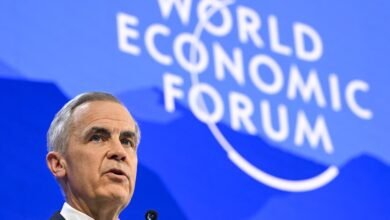
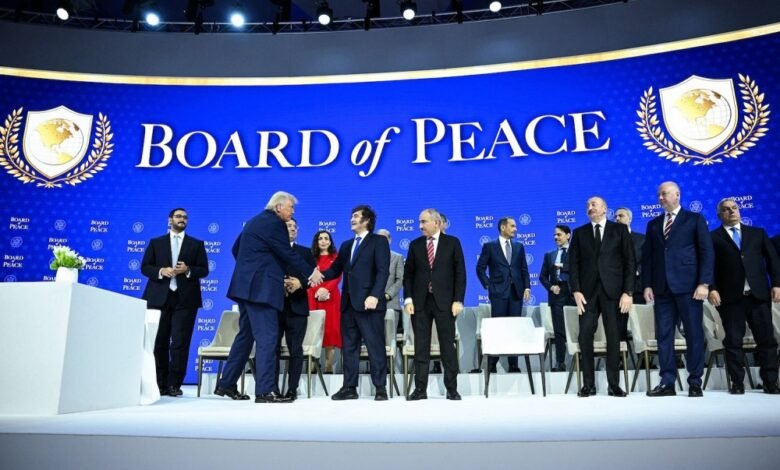
On Thursday, US President Donald Trump hosted the signing ceremony of the founding charter of his “Peace Council,” on the sidelines of the World Economic Forum in Davos, Switzerland. More than 20 world leaders joined Trump on stage, and according to a list released by the White House on Thursday, about 25 countries have accepted the invitation so far, including Argentina, Belarus, Egypt, Hungary, Pakistan, Saudi Arabia, Turkey and the United Arab Emirates.
Welcome back to the Global Brief, where we watch the signing ceremony of the Peace Council’s Charter DavosFatal Israeli Air raids in GazaAnd plans to hold elections in Guinea Bissau.
Peace Council
On Thursday, US President Donald Trump hosted the signing ceremony of the founding charter of his “Peace Council,” on the sidelines of the World Economic Forum in Davos, Switzerland. More than 20 world leaders joined Trump on stage, and according to a list released by the White House on Thursday, about 25 countries have accepted the invitation so far, including Argentina, Belarus, Egypt, Hungary, Pakistan, Saudi Arabia, Turkey and the United Arab Emirates.
The council, which was initially designed as a post-war transitional body for Gaza following a ceasefire between Israel and Hamas, received formal support from the UN Security Council in November 2025. The charter, signed on Thursday, does not explicitly mention Gaza, however, reflecting Trump’s ambition to expand the body’s mandate. The document also gives Trump the authority to name his successor, veto most decisions, and issue directives to carry out the council’s mission.
“I think we can expand on other things when we succeed in Gaza,” Trump said. “Once the board is in place, we can pretty much do whatever we want to do.”
Of the more than 50 countries invited, some are still discussing the invitation or have rejected it outright. Although no Israeli representative will attend the ceremony, Prime Minister Benjamin Netanyahu said on Wednesday that he intends to join despite previous reservations about including Türkiye. The United Kingdom is withholding its support amid concerns about the participation of Russian President Vladimir Putin; Putin said he was still studying the proposal (although Trump claimed on Wednesday that he had already accepted it).
France, Germany, Sweden and Norway have refused to participate, while Spain, Italy and Belgium are still reviewing the proposal. (The White House listed Belgium as having approved the proposal, but the country’s foreign minister said that was “incorrect.” “We hope for a joint and coordinated European response,” Maxime Prévot said. “As is the case with many European countries, we have reservations about the proposal.”
Notably, as of January 21, the US State Department temporarily suspended all immigrant visa issuances to applicants from 13 countries that have signed on to the council.
Critics warn that the initiative could further erode the UN’s authority. Trump said earlier this week that the council “may” replace the United Nations, but on Thursday he said the council would work “in cooperation with the United Nations.” The Trump administration announced earlier this month that it would withdraw the United States from 31 United Nations organizations and, as of today, has effectively ended its membership in the World Health Organization.
“The very existence of the Council confirms that the United States, the principal founder of the UN system eight decades ago, is no longer committed to it,” Richard Gowan and Daniel Forte wrote in their book. Foreign policy. “The Peace Council may have many of the formal features and protocols of a multilateral institution, but it may ultimately be a symptom of – and an accelerating factor in – the deterioration of the multilateral security system.”
Most read today
What we follow
“Better position.” Negotiations on a possible agreement on Greenland continue on Thursday, according to Trump. While few details have been revealed, Trump said in an interview with Fox Business that the deal includes giving the United States “full access” to the island, “with no time limit.”
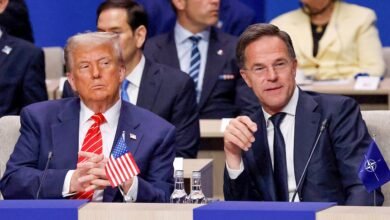
Trump announced Wednesday that he and NATO Secretary General Mark Rutte “have formed a framework for a future agreement with respect to Greenland and, in fact, the entire Arctic region,” and backed away from threats to impose tariffs against Denmark and seven other NATO countries. The announcement came shortly after Trump’s speech in Davos, in which he demanded immediate negotiations over Danish territory. Trump also said in his speech that he views US acquisition of Greenland – and the establishment of the “Golden Dome” defense system there – as essential to national security, but that he will not attempt to seize the region by force.
Danish Defense Minister Troels Lund Poulsen said in a social media post on Thursday that while Rutte could not negotiate an agreement on behalf of Denmark or Greenland, he trusted the Secretary-General to work for NATO’s unity and security, adding that the situation was clearly in a “better position” today. Paulsen also drew a red line: “We will not give up sovereignty over parts of the kingdom,” he wrote.
Danish Prime Minister Mette Frederiksen reiterated that position on Thursday, saying that Denmark and Greenland are open to discussing security in the Arctic as long as negotiations respect Denmark’s territorial integrity. Rutte said the question of whether Greenland would remain part of the Kingdom of Denmark did not come up during his conversation with Trump, but he had “no doubt” that a deal would be reached quickly. “I certainly hope it will be in 2026, and I hope even early 2026,” he said.
Deadly strikes in Gaza. Israeli forces launched raids on Wednesday that killed at least 11 Palestinians in Gaza, including three journalists, two children and a woman, according to Gaza health officials. The Palestinian Journalists Syndicate, a labor union, said in a statement that the three journalists were on a “humanitarian journalistic mission to document and photograph the suffering of civilians in displacement camps” when they were killed. The Israeli military claimed that the two journalists were operating a Hamas drone believed to pose a threat, the IDF said. New York Times.
The union said in its statement: Targeting journalists while carrying out their professional duties is part of a policy pursued by the Israeli occupation to silence the Palestinian voice, prevent the transmission of the truth, and hide the crimes it commits against civilians in the Gaza Strip.
The killings come as satellite images suggest that Israeli forces have pushed some of the yellow concrete blocks demarcating the ceasefire line with Hamas deeper into Gaza, according to reports from Reuters and the BBC. Israeli Defense Minister Israel Katz had previously said that anyone who crosses the yellow line “will be met with fire.” The IDF said it rejects “all allegations that the Yellow Line was moved or crossed by IDF forces.”—Christina Lo
election plans. Guinea Bissau will hold presidential and legislative elections on December 6, according to a presidential decree signed on Wednesday by junta leader General Horta Inta A. The announcement comes in the wake of last November’s coup, in which military officers claimed to have uncovered a plot to tamper with the results of the presidential election, suspended the vote and seized power from then-President Umaru Sissoko Embalo.
The coup appears to fit a broader regional pattern in West Africa, where Mali, Niger, Guinea and Burkina Faso have witnessed military coups since 2020, along with the failed coup in Benin last December. However, African leaders and opposition figures within the country argued that the coup was a hoax orchestrated by Embalo himself to avoid electoral defeat.
Inta, who was appointed head of the military government for a one-year transitional period, said the necessary conditions were now in place to hold free and fair elections later this year. But it remains unclear whether the planned vote will meet the demands of the Economic Community of West African States, which has called for a “rapid return to normal constitutional life” in the country.
Odds and Ends
In a new study, scientists have identified handprints on a cave wall on the Indonesian island of Sulawesi as the oldest known cave art. By dating calcium carbonate crusts that formed over the prints, the researchers determined that the images were at least 67,800 years old, suggesting that the island was home to early modern humans with “sophisticated cognition,” according to archaeologist Adhi Agus Octaviana, who discovered the handprints in 2015.
The handprints appear to have been slightly modified to resemble pointed claws, which researchers believe may indicate an indigenous practice to ward off bad luck. “This is the strongest evidence that our species… playfully and imaginatively transformed a human hand sign into something else,” said archaeologist Adam Broome, co-author of the study.
Don’t miss more hot News like this! Click here to discover the latest in Politics news!
2026-01-22 21:51:00