Trump’s Board of Peace Will Weaken International Cooperation
When countries decide to establish international organizations, they usually take some time to work out the details. The United States and its allies spent four years gradually laying the foundation for the United Nations during World War II. But President Donald Trump is not a fan of such lengthy processes.
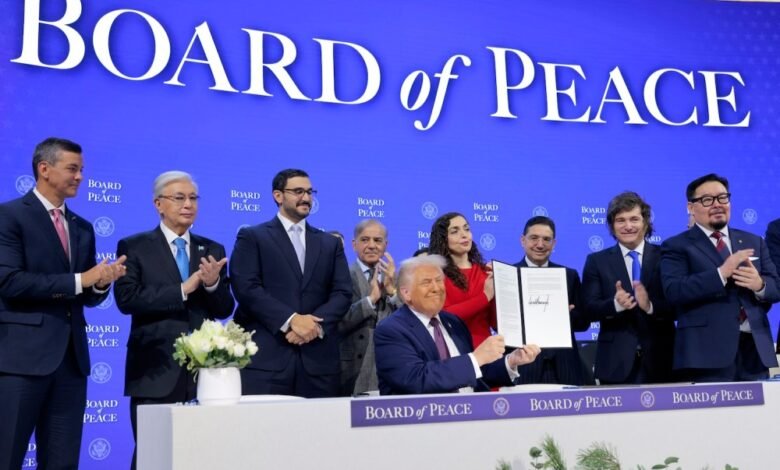
Last week, two months after the UN Security Council authorized the creation of a “peace council” to oversee a US-brokered ceasefire in Gaza, the White House sent invitations to about sixty governments to join a new “smart and effective international peacebuilding body.” Washington also participated in a draft charter for the council that would expand its scope from Gaza to address conflicts everywhere. Recipients had at most a week to decide whether they wanted to sign in or not. By January 22, when Trump held a signing ceremony to launch the council at the World Economic Forum in Davos, Switzerland, more than 20 countries ranging from Albania to Vietnam had volunteered to participate.
When countries decide to establish international organizations, they usually take some time to work out the details. The United States and its allies spent four years gradually laying the foundation for the United Nations during World War II. But President Donald Trump is not a fan of such lengthy processes.
Last week, two months after the UN Security Council authorized the creation of a “peace council” to oversee a US-brokered ceasefire in Gaza, the White House sent invitations to about sixty governments to join a new “smart and effective international peacebuilding body.” Washington also participated in a draft charter for the council that would expand its scope from Gaza to address conflicts everywhere. Recipients had at most a week to decide whether they wanted to sign in or not. By January 22, when Trump held a signing ceremony to launch the council at the World Economic Forum in Davos, Switzerland, more than 20 countries ranging from Albania to Vietnam had volunteered to participate.
The speed with which the new organization emerged is not its only distinguishing feature. It is also one of the most lopsided international political structures imaginable. The charter, which does not refer to the Security Council resolution that gave the council its powers in Gaza, let alone the founding documents of the United Nations, contains many features common to such international agreements, such as details of their legal status and voting procedures. She even announces that the painting will have its own seal.
But it also states that Trump, who was appointed as the first chairman of the board in his personal capacity, will have near-total authority to veto the board’s decisions. It then gives countries the opportunity to pay at least $1 billion to secure permanent membership on the organisation’s decision-making Executive Council, instead of the standard three-year term.
While some analysts have written this off as a frivolous project or a Barackish money-making scheme, others see it as a malicious effort to reshape the international order by creating an alternative decision-making forum in the Security Council.
Trump did This has weakened the United Nations over the past year, by freezing funds and boycotting many of its agencies. He said he wanted to see the world body do more to maintain international peace and security, but told reporters earlier this week that the council “might” replace the United Nations, which “has not been very helpful.” Several European countries, including France, Norway and Slovenia, have rejected invitations to join the council in part because of the potential to further weaken the UN.
Whatever challenges the Security Council faces, the Trump Peace Council will not be able to replace it. But this does not mean that the new organization can be written off or ignored. Rather, its effect will be to deepen the fragmentation of the international system and cause more harm to the interests of the United States.
Ironically, the Peace Council is a byproduct of strong American diplomacy at the United Nations. In November 2025, Washington pushed the Security Council to endorse Trump’s proposals for a ceasefire between Israel and Hamas, which included establishing a council to oversee security and governance in Gaza. The United States provided little clarity on the composition or structure of the council, and did not suggest that it would have a role outside Gaza. American diplomats in New York told their counterparts that they could not provide further details. While other Security Council members expressed concerns about endorsing such a shadowy entity, they approved it to end nearly two years of angry diplomacy over Gaza.
Just earlier this month, US officials began releasing details about how the council — and a series of additional committees — will oversee Gaza. The new body faces severe tests to achieve stability in the Gaza Strip, which is currently divided between areas under Hamas control and areas under Israeli occupation. The council is supposed to supervise an international security force in Gaza, but the United States is finding it difficult to obtain the necessary commitments to send forces to make this a reality.
There are a large number of Arab and Islamic countries among the signatories to the Peace Council Charter, and they are supposed to have a seat at the table for discussions about the future of Palestine. Israel also agreed to participate. If the Council struggles to make progress on Gaza’s reconstruction, the entire project will lose credibility.
However, the new charter makes clear that the institution will have a broader mandate to “secure lasting peace in areas affected or threatened by conflict.” There is no basis for this in the UN resolution defining the body’s role in Gaza, and details of its potential global functions are vague.
The charter refers to “developing and disseminating best practices” on peacemaking, making it sound like a glorified research institution. There is no indication that the new body, outside Gaza, will have the legal authority or organizational capacity to oversee military stabilization operations.
Nor does it seem likely to build the kind of institutional machinery to support mediation and peacekeeping efforts that the United Nations has built over decades, as the preamble to the Council’s charter criticizes bodies that “institutionalize crises” indefinitely. It will also be difficult to convince countries that have not received invitations to the Governing Council that this is a legitimate peacemaking body. It appears that no government in sub-Saharan Africa was ever invited.
These gaps are unlikely to worry Trump, who has emphasized his lack of interest in international law. While the president has thrown himself into an unusual number of peace initiatives, claiming to resolve wars from the Democratic Republic of the Congo to Southeast Asia, he has tended to push for quick deals and not worry about implementing them. Soon, a number of wars that he claimed to have ended flared up again. The Peace Council appears to be a framework for his free diplomacy, rather than the painstaking work of making peace agreements last over time.
It is possible that the Council – which is supposed to meet at the leadership level at least annually – will serve as a useful space for its members to search for solutions to some of the conflicts that the United Nations has been unable to deal with, especially in regions that are well represented in the Council. Among the countries that joined the new institution in Davos are some – such as Egypt and the United Arab Emirates – that supported different sides in Sudan’s horrific civil war. If Trump uses the peace council as a framework — or a diplomatic fig leaf — for these powers to calm the Sudanese war or other proxy conflicts, it would amount to a diplomatic and humanitarian coup.
But the board will be handicapped when it comes to dealing with other major conflicts, especially those involving major US rivals. Washington invited both Russia and China to join, and Moscow said it was studying the proposal. Trump claimed on January 21 that Russian President Vladimir Putin had accepted, but this remains unconfirmed; Putin has floated, perhaps maliciously, the idea of paying $1 billion for membership from frozen Russian assets.
However, even if Beijing and Moscow sign up, neither is likely to want to resolve disputes affecting their core interests through a body where Trump has unique veto powers, unlike the United Nations, where all three sit as equals in the Security Council. This means that the new institution is unlikely to form a sustainable basis for ending all-out Russian aggression against Ukraine or the civil war in Myanmar on China’s border.
If the board If it may be room for brokering a few individual deals, it will nevertheless feed into the broader fragmentation of international security cooperation already well underway. While the United Nations and other formal multilateral institutions struggled in cases like Sudan, countries large and small increasingly worked through “miniature” alternatives, such as the G7 and the Chinese-backed Shanghai Cooperation Organization. As international relations scholars John Karlsrud and Malte Brossig have argued, the world is going through a process of “deinstitutionalization” in which different powers and blocs work around existing institutions to deal with security threats.
Even if the Peace Council is not a credible institutional alternative to the United Nations, Trump’s mere creation of it is likely to accelerate this trend. The very existence of the Council confirms that the United States, the main founder of the UN system eight decades ago, is no longer committed to it. This is bad news for American diplomats in New York City, who may find it more difficult to convince other powers that there is much point in compromising on problems such as stabilizing Haiti – where the administration wants UN help – if Washington’s attention is elsewhere. Some may also feel that the United States deceived them when forming the board last year. Beyond New York, more powers may see incentives to create a small counterweight to the Council that would exclude the United States.
Given the Trump administration’s general skepticism toward international institutions, Washington may actually welcome some of this disruption. As Stephen Miller, Trump’s senior adviser, told CNN after the US raid on Venezuela at the beginning of January, the administration sees a world governed by force and authority, not laws and institutions.
The Peace Council may have many of the formal features and protocols of a multilateral institution, but it may ultimately be a symptom of—and an accelerating factor in—the deterioration of the multilateral security system.
Don’t miss more hot News like this! Click here to discover the latest in Politics news!
2026-01-22 21:11:00