Why Minnesota Can’t Do More to Stop ICE
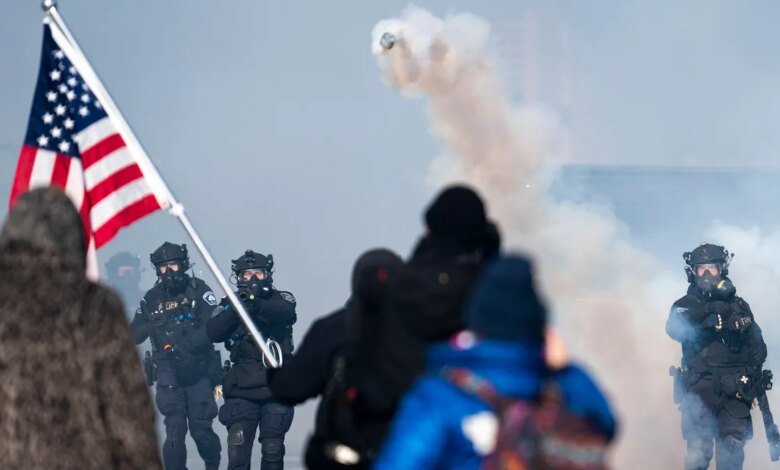
With the Marshals under attack, Kennedy first deployed the Mississippi National Guard, and then thousands of federal troops as well. (That military operation, code-named Highway, was in fact the first and only time during the Cold War that the military activated and used plans it had developed to quell civil unrest in the wake of a nuclear attack.)
Then, in 1963, Kennedy again relied on the National Guard to help integrate the University of Alabama, and his successor, Lyndon Johnson, used guardsmen and the National Guard to protect civil rights demonstrators in Selma after Alabama state troopers attacked them on the Edmund Pettus Bridge in an incident that became known as “Bloody Sunday.”
Presidents began using military forces, including the National Guard, more routinely in American cities in the 1960s. During the summer riots following police brutality in Detroit in 1967, President Johnson ordered elements of the 82nd and 101st Airborne Divisions into the city, and Michigan Governor George Romney called in the Michigan National Guard; More than 40 people were killed, more than half of them by Detroit police. National Guard troops killed 11 people, including a 4-year-old girl, Tanya Blanding, who died when a Michigan Guardsman opened fire with a tank-mounted machine gun at her apartment after mistakenly believing a sniper was inside.
While troops were used again amid the 1968 riots that followed the assassination of Martin Luther King, Jr., the downside and risks of such deployments were clearly demonstrated two years later at Kent State University when National Guard troops opened fire on students protesting the Vietnam War, killing four and wounding nine.
Over the years since then, the domestic use of federal forces has been incredibly limited — the 1992 Los Angeles riots being one exception — and presidents and attorneys general until the Trump administration typically did their best to coordinate federal law enforcement operations in cities or states.
Even during the height of the deployment of marshals and troops in the South amid the civil rights movement, presidents took action only after state officials refused to either suppress violence targeting Americans exercising their constitutional rights or, in the case of Alabama state troopers, He was The cause of violence against peaceful citizens themselves. Often, the president acted only after a challenge based on a lawful injunction occurred, ensuring that there was a second branch of government that would act as a check, balance, and catalyst for such federal action.
While Trump has said that immigration enforcement efforts in Minneapolis — as with previous efforts in Los Angeles, Washington, D.C., Chicago, Charlotte, Portland, and most recently in Maine — are intended to enforce “law and order,” there is no clear rhyme, reason, or necessity to the deployments beyond political terrorism.
Today, Trump is trying to do something unprecedented that goes against all historical traditions in the United States: the brutal use of federal forces against a state and a region for no apparent reason other than to be led by members of the political opposition.
By deploying immigration officers and border security agents from the Department of Homeland Security, rather than deputy US marshals from the Department of Justice — as presidents have done in the past — Trump is also changing the nature and content of his federal power. Marshals, whose work and training include constitutional rights and protections, have always been used to protect civil rights and valid court orders, and have strong federal police powers and authorities. Customs and Border Protection (CBP) and ICE agents disagree. They are not trained in normal federal law enforcement standards for dealing with the public, and are intended to work with very limited authority to enforce immigration matters, not general federal laws. CBP agents in particular are less a regular law enforcement agency, grounded in due process, and more of a paramilitary force intended to operate in border areas. It was never their intention to have regular contact with American citizens and civilians.
Trump has also tried to use troops in similar crackdowns over the past year, but has been stymied by federal courts, which, among other cases, initially blocked his decision to federalize the California National Guard.
Don’t miss more hot News like this! Click here to discover the latest in Technology news!
2026-01-25 18:15:00