Nvidia and Amazon Face AI Demand Challenges
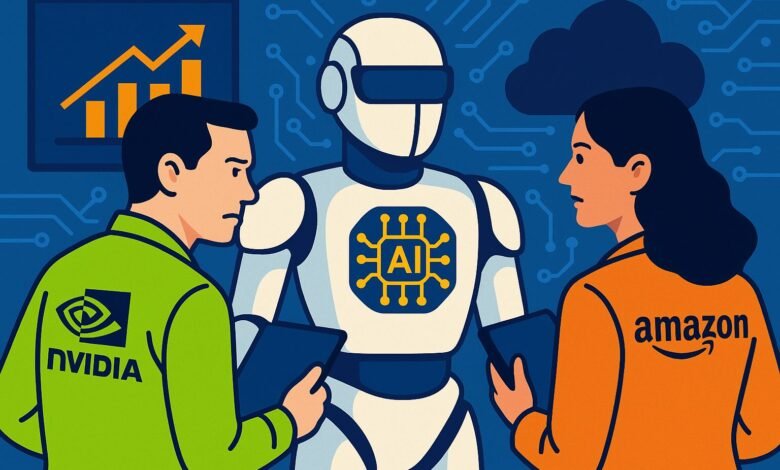
Nvidia and Amazon face AI demand challenges
Nvidia and Amazon face AI demand challengesa headline that attracts attention in the global technology market. Artificial intelligence has come into the spotlight over the past few years, and companies like Nvidia and Amazon have been riding the wave of exponential growth. From GPUs to cloud infrastructure, both giants have become an essential piece of the AI puzzle. Their solutions have powered machine learning models, enhanced cloud computing, and enabled innovation across industries. But now, there are signs that the massive demand fueling the growth of artificial intelligence may be slowing. For investors, analysts and the technology community, these warning signs raise a critical question: Is the golden age of unbridled demand for AI turning into a new phase?
Read also: 2025 predictions for technology trends in enterprises
Investor anxiety is growing amid shifting AI trends
For several quarters, stocks like Nvidia have delivered high returns fueled by massive demand for graphics processing units, which is critical for training large-scale AI models. Meanwhile, Amazon Web Services (AWS) has seen rapid adoption, as organizations rely on AI-based computing infrastructure. But according to recent reports, the two companies may now be seeing an inflection point. Analysts point to concerns about whether demand for enterprise-level AI in data centers is showing signs of slowing. This sentiment is beginning to appear in stock movements and investor behavior more broadly.
One of the more troubling signs includes the significant decline in stock prices associated with caution from Wall Street. Market watchers pointed to doubts surrounding the extent to which current demand will continue to rise. Artificial intelligence has dominated the headlines, but now companies must prove that its adoption is sustainable in the long term. Without new enterprise use cases or acceleration in monetization, even technology leaders can face stalled momentum.
Read also: Amazon’s $4 billion investment in human artificial intelligence
Nvidia’s strategy faces new scrutiny
Nvidia’s massive rise has been closely linked to its dominance in GPU production. Its chips have become the brain power behind everything from ChatGPT to self-driving vehicles. With the launch of powerful modules like the H100 Tensor Core GPUs, Nvidia has remained at the forefront of AI innovation. Its products have sold out in advance throughout the quarters, with huge demand from both tech and non-tech industries.
However, industry experts are beginning to wonder whether the pace can be maintained. Reports show that cloud providers are starting to evaluate the cost-performance ratio of chips and may change their procurement strategies to prioritize efficiency and scalability. As the costs of full AI infrastructure rise, enterprise buyers may delay or reduce upgrades. This could slow Nvidia’s revenue growth even if its technology leadership remains intact.
In response to these changes, Nvidia is also promoting its enterprise software and platforms such as CUDA and DGX Cloud. These efforts are designed to provide value beyond hardware and integrate long-term business dependencies into its ecosystem. Although this pivot is promising, it will take time to scale and compete with in-house AI offerings like those developed by Meta or Google.
Amazon Web Services is facing signs of cloud saturation
Amazon’s AWS business has played a pivotal role in making AI services available to startups and large enterprises alike. As the largest global cloud provider, Amazon has provided flexible computing infrastructure, machine learning platforms, and storage systems optimized for AI applications. Services like Sagemaker have allowed organizations to build, train, and deploy machine learning models with relative ease.
The surge in the use of AI has increased workloads across AWS data centers in the past two years. But now, some analysts suggest that the pace of new contracts and service expansions may be slowing. This shift feeds into broader concerns about cloud saturation, especially in North America where many companies have already moved their workloads.
Businesses have also become more cost conscious amid economic uncertainty, leading to tighter IT budgets. Although AI is a top priority, CFOs and IT managers are asking tougher questions about ROI. Amazon is meeting this challenge by investing in dedicated chips such as Trainium and Inferentia, with the aim of reducing AI costs and providing competitive solutions. However, Amazon must now work harder to retain its leadership position as competitors increase investments in their cloud AI capabilities.
Also Read: Top AI Robotics Stocks Ready for Growth
AI infrastructure spending may be rebalanced
The intense race toward generative AI has led to a rush of capital into data centers, graphics processing units, and digital infrastructure over the past 24 months. Nvidia and Amazon were the main beneficiaries of this race due to their underlying technologies. But as markets stabilize, some analysts believe the next phase will involve a more stable, strategic expansion of infrastructure.
This does not indicate that artificial intelligence is on the way out. It highlights that the growth of artificial intelligence is evolving. Initial investments in AI were broad and largely experimental. Now, organizations are becoming more selective. Data center operators are optimizing workloads and evaluating hybrid models that combine accelerated computing with traditional infrastructure. Efficiency and cost controls are now priorities for the company.
This shift means that Nvidia and Amazon need adaptable solutions. Its long-term growth is based on meeting high performance needs and an evolving demand curve driven by practical business results. Companies still need to innovate, but they want it at predictable costs and with measurable operational impact.
stock market fluctuations reflect mixed sentiment
The Nasdaq’s recent volatility is a window into market concerns about technology stock valuations. Both Nvidia and Amazon have come under increasing scrutiny after months of bullish momentum. Even small changes in guidance from suppliers or end users can now lead to larger shifts in trader sentiment.
In the short term, these disruptions do not necessarily mean weakness in fundamentals. Many AI services remain underutilized globally, and full digital transformation in sectors such as healthcare and manufacturing is still far from complete. However, Wall Street is now demanding more transparency and clear paths to monetizing AI-related investments.
Both companies are trying to respond with smart capital allocation and improved communication with shareholders. Nvidia frequently highlights the versatility of GPUs across industries. Amazon continues to expand its AI offerings with announcements around reinforcement learning and generative APIs. These strategic plays are intended to reassure investors of long-term viability even if 2024 brings uneven growth.
Read also: Amazon accelerates the development of artificial intelligence chips
Emerging competition creates new pressures
Big tech companies don’t operate in a vacuum. The AI landscape is becoming crowded. From Microsoft’s rollout with OpenAI integration to Google’s custom silicon chips and innovations in quantum machine learning, top-tier players are attacking every layer of AI.
This increased competition means that companies like Nvidia and Amazon will need not only the best technology, but also the most flexible business models. Margins can shrink as customers explore multiple cloud approaches or on-premises solutions. Proprietary AI tools, which have been highly valuable, may face less differentiation as open source alternatives mature.
This market development is also demonstrated through vertical integration. Companies like Apple and Tesla are investing deeply in building their own AI capabilities rather than relying entirely on third parties. This trend reduces reliance on commercial providers, again curbing runaway infrastructure spending by Nvidia and cloud giants like AWS.
Future prospects depend on innovation and implementation
The future of AI is far from failure, but current trends point to a pivotal turning point. The winners of this transformation will be those who best blend innovation with operational discipline. Nvidia and Amazon remain among the most important players in global AI development, although the path forward may require greater agility and customer-focused strategies.
With Nvidia doubling down on integrated solutions and Amazon optimizing cloud resources through in-house chip design, both companies are actively improving their offerings to align with more discerning enterprise buyers. These internal innovations indicate a long-term commitment despite short-term demand headwinds.
The next era of AI will likely see fewer large purchase orders and more integrated service solutions. Success will favor those who can eliminate the complexities of training data, infrastructure, and scalability while delivering value across real-world use cases. For Nvidia and Amazon, the moment calls for deeper partnerships, faster product cycles, and expanded vertical-specific roadmaps.
Read also: Nvidia launches AI training models for robots
Conclusion: realignment, not regression
While Nvidia and Amazon are temporarily recalibrating demand for AI infrastructure, the broader AI movement continues to gain momentum. These challenges may actually increase strategic focus and encourage smarter go-to-market strategies. Investors and stakeholders should view current signals as part of a healthy maturation process where hype gives way to measurable results and lasting business value.
As enterprise AI moves from concept to real-world deployment, leaders across the industry will need to recalibrate ambitions with economic practicality. Nvidia and Amazon remain in a unique position, equipped with scale, talent and vision. Whether dealing with data center optimization or expanding AI ecosystems, they will continue to play a leadership role on a slightly more consistent basis.
References
Jordan, Michael, et al. Artificial Intelligence: A Guide to Human Thinking. Penguin Books, 2019.
Russell, Stuart, and Peter Norvig. Artificial Intelligence: A Modern Approach. Pearson, 2020.
Copeland, Michael. Artificial Intelligence: What everyone needs to know. Oxford University Press, 2019.
Giron, Aurelian. Hands-on machine learning with Scikit-Learn, Keras, and TensorFlow. O’Reilly Media, 2022.
Don’t miss more hot News like this! Click here to discover the latest in AI news!
2025-06-02 13:33:00