Information War Against Russia Needs Smart Ethics
Russian President Vladimir Putin escalates his attack on Europe. After US President Donald Trump failed to conclude a “deal” with the Kremlin, Moscow carried out repeated drone strikes in Poland and Denmark, as well as expanding the scope of its cyber attacks against other NATO members. Russian aggression has revived discussion about what Europe and the United States can do to curb it.
Ukraine’s allies have always shied away from applying maximum pressure on Russia. Now, this discussion is changing. For example, Jack Watling of the Royal United Services Institute called for blocking Russian oil exports through the Baltic Sea, while giving Ukraine the ability to strike Russian oil refineries. Andriy Zagorodnyuk, the former Ukrainian defense minister, has called for the disruption of military assets deep within Russian territory. In these combinations of kinetic and economic warfare, we need to add another dimension.
To make Putin concerned enough to consider a ceasefire more seriously, we will have to work in the information sphere – or, as it is popularly called in security circles, the “cognitive” sphere. NATO is working on a new concept of cognitive warfare, which the organization says will focus on how to “influence attitudes and behaviors by influencing, protecting and/or disrupting individual and collective cognition to gain an advantage” – which includes the ability to target media campaigns to adversary audiences.
In our current context, Russia’s information activities can have immediate tactical benefits, such as undermining conscription efforts—but these strategies are also an important part of any larger attempts to deter Russian aggression. Putin and his generation of rulers are obsessed with maintaining the perception that they can control the internal situation within Russia.
One of the reasons the Kremlin rigged the election so brazenly is not so much that officials think anyone will believe the ridiculous results, but to show everyone they have the power and ability to rig it. Their terror of letting things slip through their hands shows in their obsessive surveys of the population. It is evident in the way Russian elites and the media classes speculate that Putin is in trouble when his popularity declines, and how difficult it is for propaganda to push it back up.
At the beginning of the war, rumors of mobilization led an estimated one million people to flee Russia, creating chaos that made the Kremlin appear powerless. Since then, it has preferred to pump huge sums into paid contracts rather than risk the political shock of another uncontrolled exodus.
This generation of Russian leaders, most of whom are in their 60s and 70s, remembers the sudden fall of the Soviet Union in 1991, when a vast empire collapsed overnight. One of the few things that will prompt them to consider their aggressive foreign policy is the fear that their domestic control might slip. There is one unplayed card that undermines their control over the information domain.
There are three big questions about engaging the Russian people: Will this work? How can this be done in an environment of intense censorship? Should the West use Russia’s dirty tricks against it, or can it engage in it in a more ethical way?
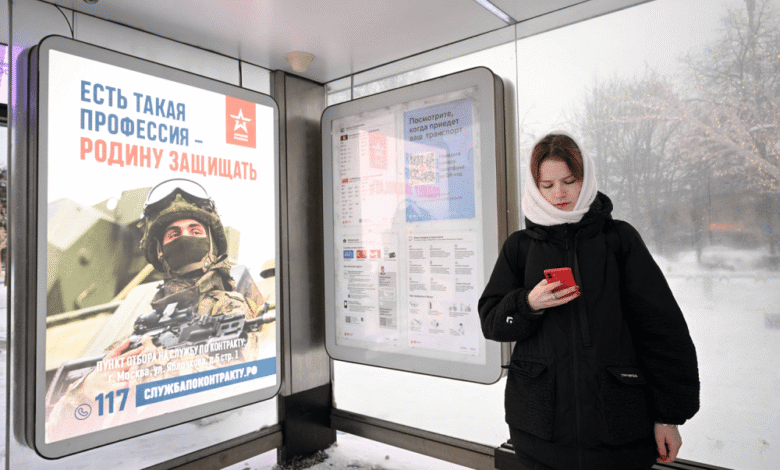
It is obvious that we should begin by undermining Russia’s recruitment into the armed forces and the military-industrial complex. In order to continue its operations, Russia needs 30,000 new recruits every month. The country is currently recruiting up to 1,200 people a day, according to Ukraine’s Foreign Intelligence Service. On social media, the Kremlin has expanded recruitment into a massive marketing operation. OpenMinds, a Ukrainian cognitive defense company, tracked at least 363,438 posts of contractual services on VK – a Russian social media platform – between March 2022 and September 2024. After Ukrainian forces entered Russia’s Kursk region in early August 2024, the volume tripled.
Ukrainian groups trying to undermine conscription with information about the suffering of Ukrainian civilians do not cause most Russians to refuse to serve. Images of dead Russian soldiers, which one might assume would always discourage conscription, could increase support for the war, which could lead to a strong patriotic backlash and a desire to punish Russia’s enemies.
However, feedback from (now exiled) Russian journalists from the provinces supplying many of the soldiers, as well as conversations with Russian prisoners of war and sociological research suggest that other issues could be more effective. These reasons include the presence of criminals in the army, concerns about families receiving compensation in the event of soldiers’ deaths, the hit on social services due to the amount spent on war, and concerns about soldiers who were conscripted for “easy” jobs such as drivers being sent to the front.
The struggle to fill the ranks of the army is only one front where information can amplify pressure. The other is economic life. Part of the purpose of sanctions is to force the Kremlin to spend more on meeting people’s economic demands, and there is some evidence that economic misery is worsening.
For example, there has been a rise in the number of complaints filed on the government’s Gosusology portal, the digital backbone of how Russian citizens interact with the state. More than 80% of complaints were related to quality of life issues such as roads, housing and community services. Research by US data analysis firm FilterLabs shows that it is these social and economic issues that the Kremlin is struggling most to control the narrative about.
These existing vulnerabilities represent enormous potential leverage, especially if Russia’s enemies exploit moments of external shock to undermine the Kremlin’s sense of control over the country. Take, for example, the Ukrainian incursion into Kursk. The Russian regime was stunned. The military and propaganda systems were in a state of paralysis. In opinion polls, trust in Putin has fallen to a record low during the war: only 45% of Russians put him as one of the three politicians they trust most, down from a high of 54%.
This should have been the moment for increased pressure by many factors: imposing secondary sanctions on Chinese banks, blockading the Russian oil fleet and imposing sanctions on the ports to which Russian oil is delivered, and facilitating media campaigns to undermine the Kremlin’s confidence in keeping people’s attitudes and behaviors under control. The Kremlin being threatened on multiple fronts will take the risks of war more seriously — and may be deterred from future aggression.
Until now, the West has tended to let Russia recover from each shock and then respond in due course. This approach appears to be rooted in a fear of escalation, which has repeatedly emerged as a complete misunderstanding of how to rein in Russia. Let us consider here the period during which the United States prevented Ukraine from striking Russian army bases inside Russian territory with missiles, for fear that this would lead to Russia’s provocation. Now, such strikes are common, and this fear seems ridiculous.
So, if this is why this activity is necessary, the next challenge is to answer how to do it.
Today, we have many tools at our disposal – social media news channels and groups, online video ads, and satellite channels. Internet censorship is on the rise, but it is still possible: the trick is to provide content so important that audiences are willing to search for it. Since 2022, Ukrainian technology specialists from the private sector have put their energies into using the latest technologies to test subjects operating within Russia. They are experimenting with ways to get around increasingly harsh Russian censorship by testing messages, measuring behavioral shifts, and pioneering ways to reach audiences by going into the kind of online spaces they use and using issues that matter to them, such as how to defect.
However, our media activities in Russia should not imitate the Kremlin’s tools of lies. Facts and repressed truth are powerful in themselves. One challenge is whether content should be attributed, such as official NATO or government accounts, or whether its source should be hidden. Publishing the previous messages is too risky for the Russians. The latter are in danger of being discovered the moment they begin to make any real impact. This question can be specific to the context of what you are trying to achieve, but it can also be a false dichotomy.
In World War II, the British Political Warfare Executive set up subversive radio stations to broadcast in Germany. Initially, the agency camouflaged them as dissident German stations, but when this was revealed, the British adapted, explaining that they were behind the broadcasts while keeping it safe to listen to by not officially labeling them.
The content—minute details of soldiers’ lives, gossip about officials, even pornography—proved all the more powerful because it showed a deep understanding of conditions on the front. British surveys of prisoners of war indicate that more than half of German soldiers listened to these stations, and even knew the source.
Likewise, during the Cold War, when American “Freedom Radios” broadcasting to the Soviet Union were found to be funded by the CIA, their popularity increased. People in the Soviet bloc wanted to know what Americans knew about their regime. By the end of the Cold War, half of the viewers in the captured countries were listening to it.
Today, we must try to match this ambition. Unfortunately, Washington is in the process of destroying the old international media it built in the Cold War, and independent Russian media generally only participate, at most, with the 14% or so of Russian audiences that follow liberal media sources. We will need a fleet of new communications initiatives to accomplish this mission.
Of course, the Ukrainian Armed Forces, and perhaps other militaries, use psychological operations targeting adversaries. But to help turn the tide of war, we need a mass media that engages outside the liberal bubble, from which foreign influences are bound to be quickly detected. Putin has already succeeded in convincing most Russians that the so-called Western information war is besieging the country. Russians already assume that the West is trying to influence them. The West’s task is not to hide the origin of its content, but to convince it of how detailed its understanding of what is actually happening inside the Russian system is while minimizing the risks to the public.
This is also an opportunity to show how allies and different sectors can work together. Some countries with a high appetite for risk, most notably Ukraine, will specialize in providing content. Others are developing technology to penetrate censorship and gain access to Russia. This also means working across sectors: the private sector can drive innovation, while civil society can be more flexible than the slow government and military in creating new media and campaigns.
Collaboration across countries and sectors is itself an integral part of what we might call “cognitive deterrence”; It shows Putin that we are united and ready to take the game to its greatest weakness.
Don’t miss more hot News like this! Click here to discover the latest in Politics news!
2025-10-23 11:00:00