Ethiopia’s Fight Against America’s Anti-Abortion Propaganda
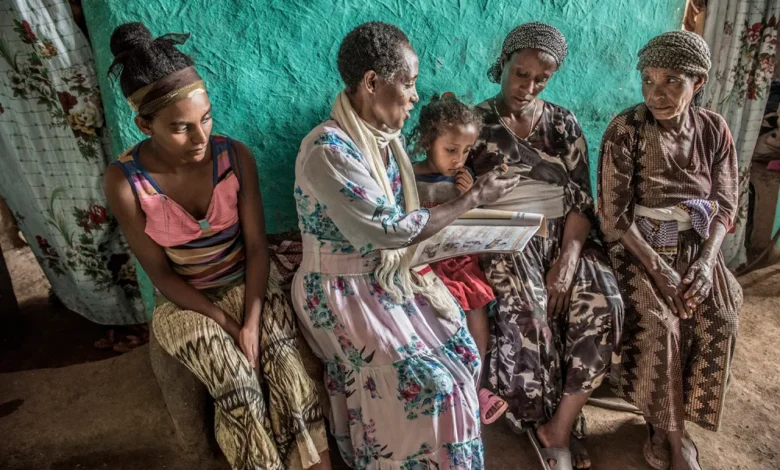
ADDIS ABABA, Ethiopia – It is the faces of women and girls receiving treatment for botched abortions that continue to haunt Nurse Hannah, 47 years into her nursing career.
“It was a look in their eyes,” she said in Amharic during an interview last month. “It was a plea to rescue them from their misery.”
It was Ethiopia in the 1980s, and Hannah – whose name has been changed to protect her identity – had just started working in a hospital. She remembers having to remove grass, pieces of wood, and dangerous chemical mixtures from the wombs of her patients. She also remembers feeling helpless.
“We did everything we could at the time, with antibiotics and all kinds of medicine,” she said. “But we couldn’t save most of them. It will be too late by the time they arrive. They will go into septic shock.”
Abortion was illegal at that time. It was allowed only with one exception: saving the life of a pregnant woman. The result of this strict legislation has been the avoidable deaths of tens of thousands of women and girls. Between 1980 and 1999, one-third of maternal deaths in Ethiopia could be attributed to unsafe abortions. After decades of campaigning by health care workers, women’s rights groups, and lawyers, politicians – forced to act by the death toll and disabilities caused by unsafe abortions – reformed the law in 2005. Today, abortion is permitted in several other cases, including if the pregnancy is the result of rape or incest.
Ethiopia, though still dealing with a high maternal mortality rate, has become a success story: Facilities across this vast East African country began offering abortion care, and by 2020, maternal deaths had fallen by 70 percent.
But the story does not end there.
Today, anti-abortion misinformation – spread across social media and television – is influencing public opinion and politics in Ethiopia, putting at risk the hard-won gains of the past two decades. Lawyers and medical professionals are beginning to speak out again, this time in defense of the law.
Opposition to abortion has intensified. Anti-abortion activists say liberalizing the law was a “mistake,” says Abebe Shibru, a doctor and country director of MSI Reproductive Choices (MSI), an international NGO that provides abortion and contraception services in Ethiopia.
Last year, he told two journalists I was working with that local activists who did not believe in women’s right to choose were adapting their tactics, increasingly inspired and influenced by the Christian right in the United States. “Before, anti-choice groups targeted the public, and they were more visible, screaming and demonstrating and telling people that abortion is a sin,” Shibrow said. “They are now targeting politicians, policymakers and safe abortion practitioners – they are trying to paralyze the system.”
In response, an umbrella organization called the Coalition for Comprehensive Abortion Care was created in 2019. It is composed of abortion providers and aims to monitor misinformation and promote public support for access to safe abortions.
“We used to have a very quiet approach to providing abortion services,” Shibru said of the alliance to which MSI Ethiopia belongs. “That is no longer an option.” “There is an organized movement to repeal this law, and the trends of disinformation campaigns have forced us to take an explicit approach.”
Twenty years after Ethiopia became a “model” for abortion law reform, Shibru said MSI had anecdotal evidence of an increase in post-abortion complications, suggesting that women were once again turning to unsafe methods of terminating pregnancies. The doctor indicated that this was related to misinformation.
Opponents have traditionally framed the safe abortion campaign as part of a so-called Western agenda that threatens to undermine Ethiopia’s religious and cultural values. But since then Roe v. Wade Overturned in the United States, the messaging has changed. Shibru said anti-abortion figures are now strongly calling for Ethiopia to follow in the footsteps of the United States.
In recent months, the coalition has tracked links between Ethiopian anti-abortion influencers and US-based anti-abortion rights groups, such as Family Watch International (FWI) and Heartbeat International. FWI has been labeled a “hate group” by the Southern Poverty Law Center, a nonprofit focused on advocacy in the American South, and Heartbeat International describes itself as working to make abortion “unthinkable.”
Both organizations are linked to United for Life Ethiopia, an organization run by a well-known surgeon and perhaps the most influential figure leading the anti-abortion movement in Ethiopia, Dr. Seyoum Antonios. Antonius, whose biography indicates his intention to “influence political discussions on family and life issues,” is also head of FWI’s Africa division. United for Life Ethiopia is listed on Heartbeat International’s Affiliate Map.
“Every day 3,000 children are slaughtered. Does a woman have the right to slaughter them?” Antonius asks in one of his many YouTube videos. He usually wears a suit or surgeon’s gown, and speaks calmly and confidently. In some videos, he uses a fetus-shaped doll to get his point across, and on other occasions, he uses crude humor about promiscuity, perhaps to endear him to younger audiences.
Antony has been the face of the anti-abortion campaign since the liberalization of the abortion law. As monitored by the Comprehensive Abortion Care Alliance, it reaches young people through social media influencers, organized discussions in schools, and community events. He is also a prolific media commentator, having written op-eds, appeared on television, and started petitions against comprehensive sex education, which he described in 2024 as “sex programs that turn them off.” [students] of their family, cultural and religious values.”
As with many anti-abortion groups in the United States and around the world, United for Life Ethiopia also opposes the rights of the LGBTQ+ community.
Anthony did not respond to multiple requests for comment.
Recognizing that part of the success achieved in 2005 came from building political will, members of the Comprehensive Abortion Care Coalition began holding workshops for parliamentarians and senior officials in Ethiopia’s Ministry of Health. Importantly, it also provides training for journalists to improve how abortion news is reported in local media. They are also trying to reach young people by working with TikTok accounts, e.g Yeni Tina (“My Health”), to dispel common misconceptions, such as the idea that “contraceptives are only for married women” or that “abortion makes women infertile.”
“The main idea is to show the gains that have been made in abortion care services after 20 years,” said Dereje Wundemo, policy and community mobilization advisor at Epas Ethiopia, a member organization of the coalition. “Demonstrating these gains is an effective way to convince people, as well as government officials.”
But combating misinformation is not without risks. In a deeply religious country, where same-sex relations are illegal and punishable by up to three years in prison, advocates say speaking out could lead to abortion supporters being labeled “homosexuals” and threatening to tear up family values, or even as Satan.
“You will end up being stigmatized immediately if you want to go and teach about abortion,” said Winchet Tebebo, executive director of the Ethiopian Women Lawyers Association, one of the main forces behind the 2005 legal reform. “It is linked to the number 666,” she added. The number is a biblical reference that has come to denote the Antichrist. According to Tebebo, women’s rights advocates are increasingly described as evil, anti-family, promoting single motherhood, and supporting the killing of children.
Tebebu admitted that the risk of public attack made her organization reluctant to publicly advocate for abortion access. “If you go out and start talking about abortion, you may not be able to do your job the next day,” she said.
MSI’s Shibru understands the desire to be cautious. He said his family is worried about him: “My wife tells me she is nervous for my safety. There are many service providers who have left the sector because of this opposition.”
Recently, Ethiopians who spoke out for women’s rights on a range of issues reportedly faced “brutal online attacks,” AFP reports, and were even forced to leave the country.
Despite the current crisis, or perhaps because of it, the Comprehensive Abortion Care Coalition wants to decriminalize abortion completely. The group has powerful allies within parliament, and we were told that Ethiopian Health Minister Maqdas Daba was the head of the coalition several years before she assumed her ministerial role. Daba was president of one of the coalition’s member organizations, the Ethiopian Society of Obstetricians and Gynecologists.
For now, neither Nurse Hanna nor the other advocates interviewed have said they will compromise their positions. But broader public support is essential if further liberalization of abortion access is to become a reality. Much will depend on the message that will be conveyed: is abortion a sin or a way to save a woman’s life.
This report was supported by MSI Reproductive Choices.
Don’t miss more hot News like this! Click here to discover the latest in Politics news!
2025-11-13 20:44:00