What William Fulbright Could Teach Today’s Republican Party
Shocking The Washington Post The story appears to have finally jolted Republicans in Congress from their deep partisan slumber. War Secretary Pete Hegseth issued instructions to “kill everyone” on a boat allegedly transporting drugs, Alex Horton and Ellen Nakashima recently reported. The attack was part of an ongoing military operation targeting ships arriving from Venezuela on the grounds that drug traffickers pose a threat to US national security.
According to the article, the special operations commander supervising the September 2 attack authorized a second strike after it became clear that there were survivors of the first strike. Hegseth insisted he was not in the room when the decision was made, and government officials also suggested that the second strike was justified because the two survivors may have been trying to contact a gang for help. But under military law, a second strike could constitute a war crime.
after mail As the article appeared, bipartisan criticism of the administration emerged, along with demands for more information. Military officials then provided a classified briefing to the House and Senate Armed Services and Intelligence committees, during which they played a video of the incident. The hearing appeared to reassure Arkansas Republican Sen. Tom Cotton, who said he “did not see anything disturbing” in the footage and insisted that all the strikes were “completely legitimate and necessary, and exactly what we expected our military commanders to do.” Speaking about his committee’s investigation, Republican Chairman of the House Armed Services Committee, Mike Rogers of Alabama, told reporters: “It’s over.”
Other elected officials, however, were far less conciliatory. “I think it will be difficult to watch this series of videos without being disturbed,” concluded Delaware Senator Chris Coons. Coons said he left the conference with “more political questions than ever before.”
The outrage over the September 2 incident is just a drop in the bucket compared to broader concerns about the Trump administration’s decision to carry out any of these deadly attacks in the first place. Even if the boats were carrying drugs — a claim the administration has yet to prove — standard procedure is to rely on the U.S. Coast Guard, which seizes ships only after issuing multiple warnings and then arrests those on board, sending them either to the United States or to their homeland for prosecution.
In the minds of the administration’s critics, President Donald Trump’s decision to authorize strikes intended to kill amounts to an unprovoked act of military aggression, and some say the killing was committed in the name of the United States.
No matter how many Democrats raise red flags and condemn Trump and his administration, nothing will change on Capitol Hill until a few Senate Republicans are finally willing to take a real stand — not just offer a few words of mild rebuke. This group of Republican senators will need to launch a comprehensive investigation into what the president of their party is doing. Courageous politicians willing to put country above party will have to launch a serious and legitimate public investigation into the Trump administration’s military operations in the Caribbean and the eastern Pacific.
Republicans have remained fiercely loyal to Trump since his inauguration in January 2025. But they should now look back almost 60 years ago to the impact that Democratic Senator William Fulbright had when, in February 1966, he opened a major investigation into Democratic President Lyndon Johnson’s expanding war in Vietnam. Fulbright became one of the first critics of the war within the political establishment, giving legitimacy to activists who grew in numbers on college campuses and in the streets.
Fulbright was not extremist. As Chairman of the Senate Foreign Relations Committee, he was known as a leading liberal internationalist who was strongly aligned with Johnson’s forceful approach to combating the threat of communism. Fulbright was a key voice in the steady expansion of the national security state since the late 1940s and one of Johnson’s most loyal allies.
Indeed, when Johnson asked Congress to pass the Gulf of Tonkin Resolution, which gave him sweeping authority to use military force in Southeast Asia based on questionable evidence of an attack against a US Navy ship, Fulbright personally shepherded the resolution through the Senate. He overcame serious concerns about giving the president such broad power by assuring his colleagues that Johnson would return to Congress before any major escalation, and by arguing that they needed to support the resolution to protect the president from being labeled “weak on defense” in the 1964 election.
By early 1966, Fulbright realized that he had made a grave mistake and had been misled. Statements made by Secretary of State Dean Rusk during a closed session in January 1996 convinced Fulbright that the Johnson administration was making terrible decisions based on false assumptions about how to fight communism.
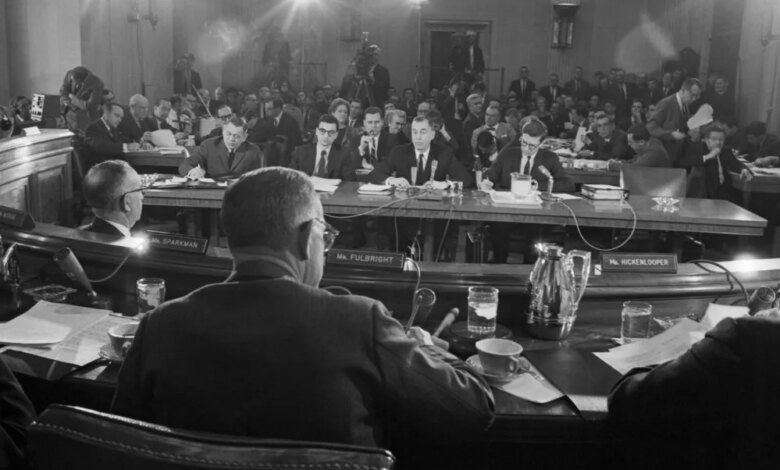
In mid-February 1996, Fulbright launched major open hearings on Vietnam in the Senate conference room, a landmark moment in the development of the anti-war movement. Although there were a few small protests at colleges, beginning with teaching at the University of Michigan in 1965, public support for military action in Vietnam remained strong and opposition within Congress was still marginal. Even most civil rights leaders who were skeptical of the war had little interest in associating their movement with a politically unpopular issue.
Rusk, foreign policy analyst George Kennan, and General Maxwell Taylor appeared before the committee during open hearings. Fulbright rejected Rusk’s insistence that war was necessary to maintain world peace, warning instead that intervention could easily “ignite” a world war. In response to Taylor’s stubborn defense of the conflict, Fulbright said: “We have burned a lot of innocent people in this war. I don’t blame you or anyone else for that. It’s the nature of war. That’s why I’d like to find some way to stop it.”
Kennan, unlike Rusk and Taylor, expressed harsh criticism of the war. He said the United States needed to withdraw “as quickly as we can do so without significant damage to our prestige or stability in the region.”
Speaking to a reporter while the hearings were ongoing, Fulbright expressed open remorse for his role in the Gulf of Tonkin decision. “You see, we have never seen such a creeping war,” he said. “Until very recently, we didn’t think it was a war at all: we thought it was an aid programme.”
Key to the hearings was the decision by the three major television networks, ABC, NBC, and CBS, to cover portions of the hearings despite frustration among high-level executives who did not want to cancel profitable sitcoms, soap operas, and game shows. “Senator Fulbright’s formal ‘teaching’ on Vietnam was quite a show.” New York Times Columnist James Reston noted, “The big lights of the TV cameras in the foreground in the Senate caucus room, the big shots and their decorated wives in the back, and the roar of protest over the ‘little band of willful men’ from the White House.” At CBS, news division head Fred Friendly went against his bosses’ commercial concerns to secure as much airtime as possible given the importance of what was being discussed. When the network’s vice president finally shut down coverage, Friendly resigned on February 15, 1966.
Johnson, who kept three televisions on in the Oval Office so he could monitor all the network news, hated what he saw. In private, he attacked his colleague, taunting him and calling him “Senator Halfbright” (an insult coined by Wisconsin Senator Joseph McCarthy). Johnson’s adviser, Joseph Califano, recalls how the president quipped: “For a Rhodes scholar to say he doesn’t know what’s in the world… [the Tonkin] The decision is more than this hillbilly would ever believe.
The hearings damaged the president’s political standing. Although public approval of Johnson remained steady, Fulbright emerged as the first senator to express opposition to the war. This southern internationalist, who is greatly admired in Washington, cannot be easily excluded. Just as importantly, the media was watching. The questions opened by the hearings have not disappeared. Reporters continued to dig, eventually uncovering many deceptions, lies, and falsehoods that were shielding American citizens from the harsh realities of what was unfolding in Southeast Asia.
“The February hearings opened a psychological door to the great American middle class…If the administration intended to wage the war in Vietnam from the political center of America, the 1966 hearings were in fact a blow to that effort,” Randall Woods wrote in his landmark biography of the senator.
In the spring of 1966, Fulbright gave a series of lectures at Johns Hopkins University, later published in book form, in which he condemned the “arrogance of power” animating American national security decision-makers. Fulbright explained that he doubted “the ability of the United States, or France, or any other Western country, to enter into a small, strange, backward Asian country and create stability where there is chaos, the will to fight where there is defeatism, democracy… where there is no tradition of it, and honest government where corruption is almost a way of life.”
After a private discussion with the President in June, Robert Dallek recounts his conversation The flawed giantas Johnson tried to win back Fulbright due to his influence in the Senate, the Arkansas senator returned to Capitol Hill very disturbed. He told his colleagues that Johnson was no longer acting rationally. He was afraid that the president might be able to do something very dangerous abroad.
Over time, more Democrats from the left and center joined the chorus of lawmakers condemning the war, investigating the administration, and even demanding spending cuts. Fulbright continued to hold hearings and make speeches, each more critical than the last. Although these representatives and senators were only one part of a much larger coalition that fought the war and ultimately ended American involvement in Vietnam in 1973, the presence of the Democratic establishment within the movement was essential. They gave the protests greater legitimacy and gave the opposition real political power.
In 2025, The chances of any Republican repeating Fulbright’s record remain slim. In a hyperpolarized political party, Republicans in Congress have repeatedly shown how willing they are to tolerate the president as long as he boosts their reelection prospects. Once the party crossed the Rubicon by accepting that participation in the January 6, 2021 insurrection did not prevent Trump from running for president, it became nearly impossible to imagine anything that would sever the umbilical cord connecting Republicans on Capitol Hill to the Oval Office.
But American policy can take unexpected turns. This is especially true as more lawmakers on Capitol Hill begin to view the president as a lame duck, with whom association carries greater political risk than reward.
The intensity of the administration’s deadly military operations against these boats has so far caused some Republicans to recoil, and a few others to quietly retreat from their moral compass. However, thoughts and prayers do not produce change. Representatives and senators can. Reining in what many agree is an imperial presidency will require a courageous Republican.
Don’t miss more hot News like this! Click here to discover the latest in Politics news!
2025-12-15 05:01:00