Korea Tests Ultra-Rugged Robot to Explore the Moon’s Mysterious Caves
If humans eventually colonize the Moon, lunar caves formed by primordial volcanic activity could provide shelter from cosmic radiation and extreme temperatures. But how can one safely explore these unknown caves before venturing inside?
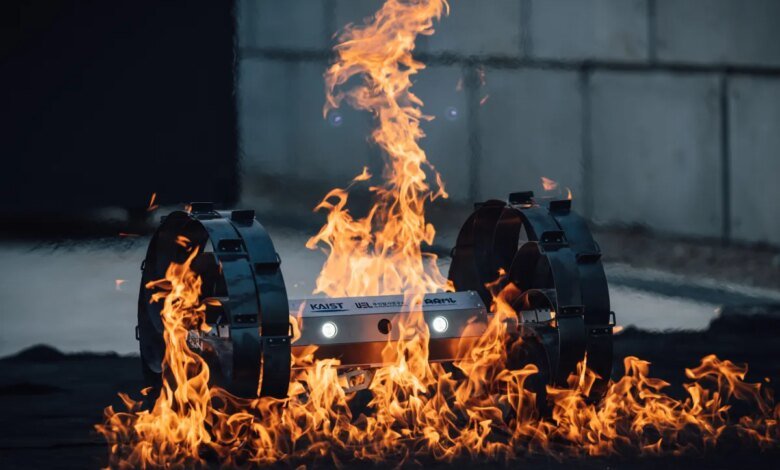
Join a team of scientists from South Korea who have built a simple prototype of a rover that can traverse rough terrain. What really sets this robot apart is its sturdy wheels, made of flexible metal strips woven together in a helix-like pattern giving it the ability to expand and contract like a piece of kinetic art.
“Experimental results show a successful traverse of 200 mm [7.8 inches] obstacles, stable navigation on simulated rocky and lunar soil surfaces, and the ability to withstand the impacts of a 100-meter drop. [328 feet] “Descent under lunar gravity,” the scientists wrote in a new paper published in the journal Scientific robotics.
Because its diameter can grow from 9 to 19.6 inches, a rover equipped with these wheels is able to distribute weight more evenly along its body. The result is a robot robust enough to navigate difficult cave landscapes, along with the ability to fit into tight spaces in its smallest configuration. Other robots used hinges or “origami-inspired folds” that could be vulnerable to the hazards of the lunar surface, according to the newspaper.
Scientists demonstrated the wheel’s power and ability to move around or over obstacles by having the rover explore a real cave here on Earth. They also used a drone to drop it into the air, bombarding it with fire and hail. The metal in the wheel itself is made from lightweight carbon steel strips, making it strong yet flexible.
“Therefore, the wheel can absorb shocks and navigate uneven terrain while maintaining its strength under harsh lunar conditions,” the paper states.
For a future mission to the Moon, the team envisions a large rover carrying several smaller rovers with these special wheels and deploying them when opening a lunar crater.
“Although the Explorers remain compact when stored, the large diameter of the deployable wheels is expected to increase the ground contact area, thus improving traction on dense dust and uneven slopes,” the paper states. “This capability will allow explorers to safely navigate the challenging crater entrance terrain.”
The large spacecraft will then drop these small vehicles directly into the lunar crater leading into the cave, where the wheels’ “resilience and impact capacity” will absorb the shocks.
“The results highlighted the ability of the deployable wheel to combine adaptability, robustness and operational efficiency, making it a promising solution for diverse and challenging mission scenarios,” the paper states.
More about the moon: Scientists say there may be life on the moon
Don’t miss more hot News like this! AI/" target="_blank" rel="noopener">Click here to discover the latest in AI news!
2025-12-22 21:05:00