Nvidia to poach top staff from AI chip start-up Groq in licensing deal
Open Editor’s Digest for free
Rula Khalaf, editor of the Financial Times, picks her favorite stories in this weekly newsletter.
Nvidia is luring the founder and other top talent from Groq, one of the most prominent startups aiming to challenge the chipmaker’s dominance in artificial intelligence processors.
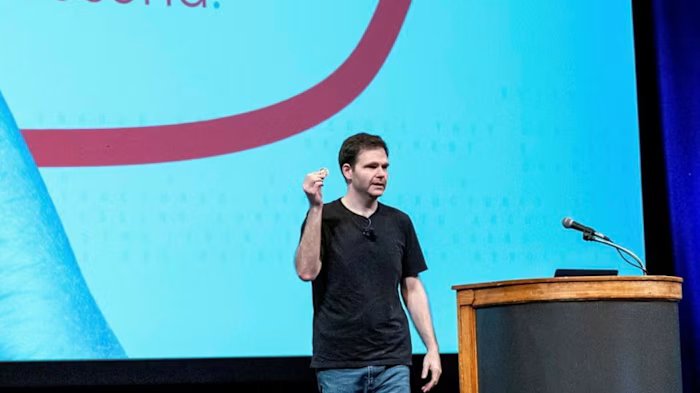
Jonathan Ross, the former Google chip engineer who founded Groq in 2016, and the startup’s president Sunny Madra, are among those who will join Nvidia as part of a technology licensing deal, the two companies announced on Christmas Eve.
Nvidia CEO Jensen Huang said in an email to employees that the Groq deal would “expand the capabilities” of the data centers built around its chips, which he calls “AI factories.”
“We plan to integrate low-latency Groq processors into the Nvidia AI Factory architecture, expanding the platform to serve a broader range of AI inference and real-time workloads,” he wrote in the email seen by the Financial Times.
Despite losing a significant portion of its leadership team, Grok said it “will continue to operate as an independent company.”
Grok has focused on developing chips that can speed up AI “inference,” the process of returning responses to user queries via chatbots like OpenAI’s ChatGPT or Google’s Gemini.
The startup was valued at $6.9 billion as of last September, when it raised $750 million in funding. Groq claims that its language processing units are up to 10 times more power efficient than the types of GPUs made by Nvidia and its main competitor, AMD.
Ross helped launch Google’s AI Tensor Processing Unit chip software before leaving to found Groq. TPUs are widely seen as an important asset in Google’s AI arsenal, helping its Gemini chatbot catch up with OpenAI’s ChatGPT, which has largely relied on Nvidia chips.
Several major technology companies – including Microsoft, Meta and Google – have struck licensing agreements with startups that brought in top talent and assets without making an outright acquisition, after antitrust scrutiny over dealmaking in the sector mounted in recent years.
“Antitrust appears to be the main risk here, although structuring the deal as a non-exclusive license may keep the fantasy of competition alive,” Bernstein Research analyst Stacy Rasgon said in a note to clients regarding Nvidia’s deal with Groq.
Groq said its agreement with Nvidia “reflects a shared focus on expanding access to high-performance, low-cost inference.”
The tie-up comes as many of Nvidia’s largest customers are developing their own AI processors or exploring alternatives to its GPUs, including adopting Google’s TPUs.
The Financial Times reported last week that Amazon is in talks to invest more than $10 billion in OpenAI as part of a deal in which the ChatGPT developer will use more of the e-commerce giant’s Trainium series of AI chips.
Nvidia has closed a series of high-value investment deals this year, including agreeing to invest up to $100 billion in OpenAI.
The company achieved a record $5 trillion valuation in late October, but has seen its shares decline as concern grows about the sustainability of the artificial intelligence boom. Nvidia shares have risen 36 percent year to date, while shares of Alphabet, Google’s parent company, have risen 66 percent over the same period, driven by growing investor enthusiasm for the latest Gemini models.
Additional reporting by Hannah Murphy and Michael Acton
2025-12-24 23:36:00