AI in Healthcare: Applications, Benefits, Challenges, and Real-World Examples
Introduction to artificial intelligence in healthcare
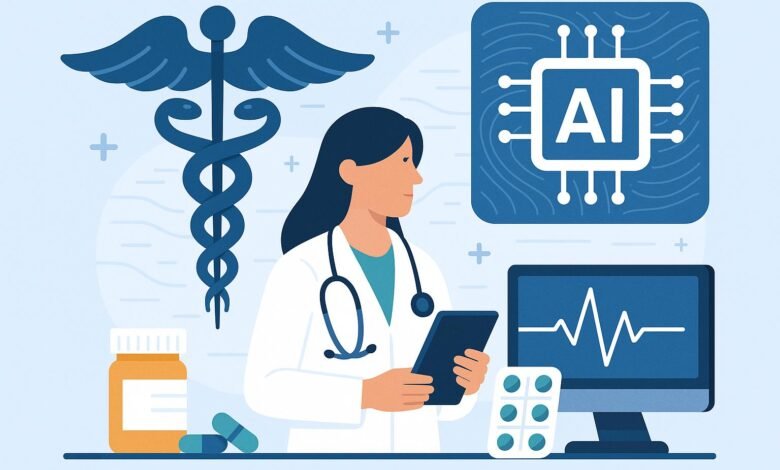
AI in healthcare is revolutionizing how medicine is delivered by improving diagnosis, automating processes, and enhancing patient care. As of 2025, more than 88 percent of healthcare providers globally report using at least one form of AI. Imagine a hospital that detects the risk of sepsis before symptoms appear or a model that identifies cancer cells faster than a trained specialist. These breakthroughs are not predictions. It’s real, it’s in use, and it’s reshaping care today. If you are a doctor, policymaker, investor, or patient, understanding AI in healthcare is critical to understanding what comes next.
Key takeaways
- AI enhances diagnosis, triage, and workflow efficiency.
- Real-world deployments show fewer errors and better patient outcomes.
- Moral risks and regulatory uncertainty must be addressed.
- Future innovations will focus on personalization, robotics, and global accessibility.
Read also: Predictive diagnosis for early detection of diseases
What is artificial intelligence in healthcare?
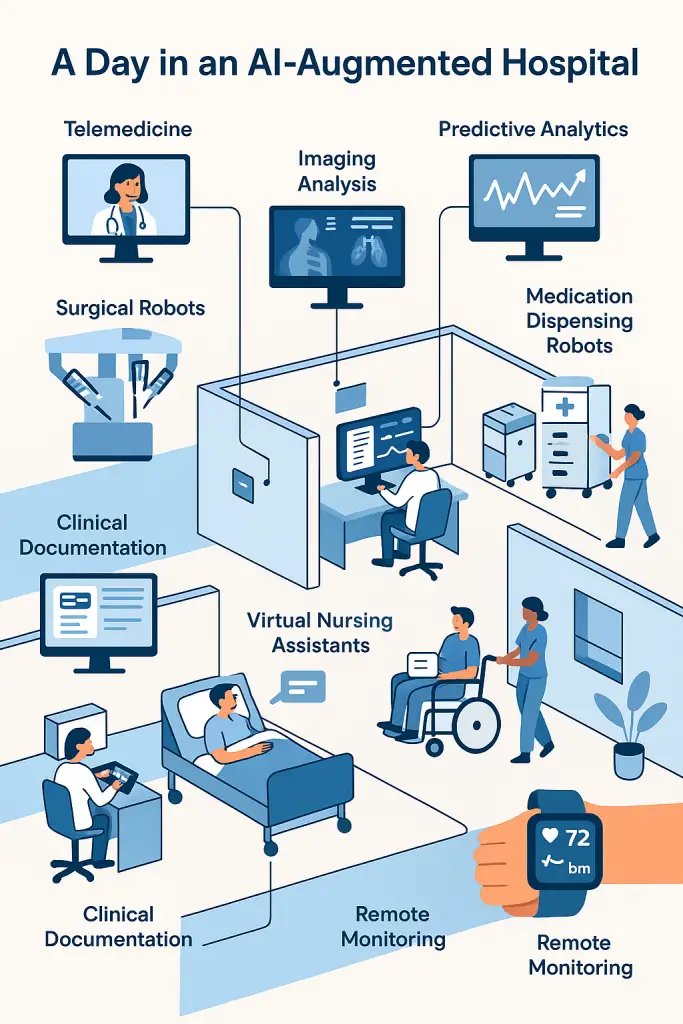
AI in healthcare refers to computer systems that mimic human cognition to improve clinical decision making, automate tasks, and interpret complex medical data. Applications of AI include diagnostic imaging, personalized treatment planning, virtual assistants, robotic surgery, and administrative automation.
The global AI market in healthcare was worth $16.3 billion in 2022, and is expected to grow to $173.5 billion by 2029, according to Fortune Business Insights. This rapid adoption reflects the demand for scalable, cost-effective and data-driven health services.
Read also: The increasing uses of artificial intelligence (AI) in diagnosis
Basic applications of artificial intelligence in healthcare
1. Medical imaging and diagnosis
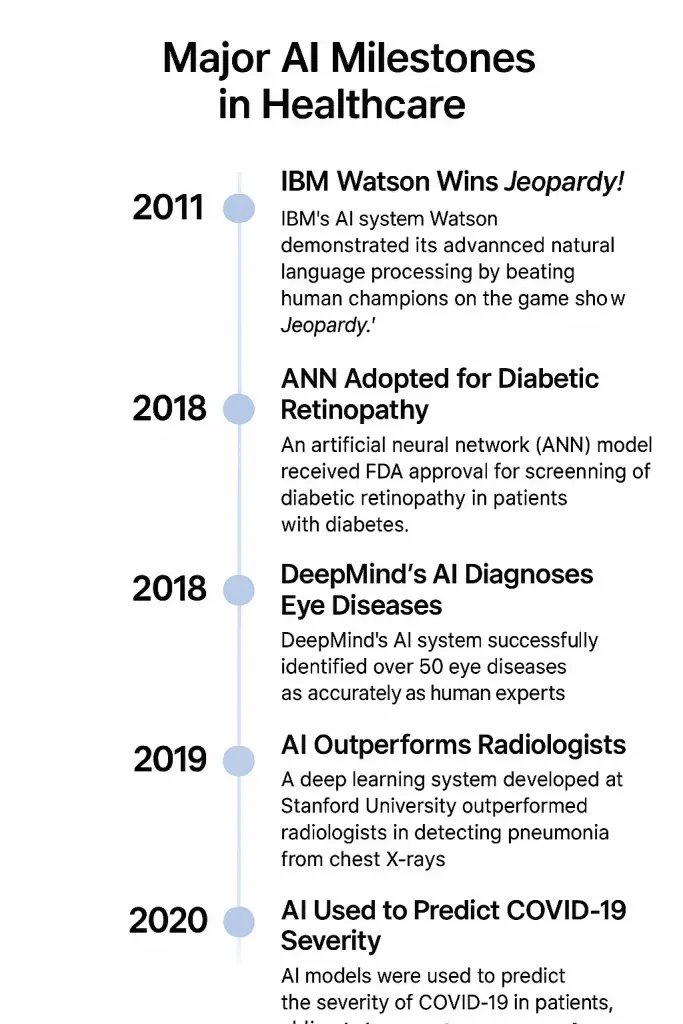
AI models, such as CheXNet, detect pneumonia from chest X-rays with up to 92% accuracy, rivaling radiologists (Rajpurkar et al.). These tools can identify early signs of tumors, strokes, and fractures. In dermatology, a convolutional neural network at Stanford University classifies skin cancer with 91 percent accuracy, consistent with expert-level performance (Esteva et al.).
2. Predictive analytics
AI systems analyze electronic health records to predict adverse events before they occur. Mount Sinai deep learning model predicts heart failure risk 48 hours in advance. According to the Journal of the American Medical Informatics Association, AI-based alerts have led to a 35 percent reduction in ICU transfers.
Predictive models also determine readmission risk, manage chronic diseases, and support emergency response planning.
3. Virtual assistants and chatbots
More than 100 million people use AI chatbots like Babylon Health, Ada Health, and Buoy to manage symptoms and receive care recommendations. In the UK, Babylon’s triage system reduced GP workload by 15 percent.
Voice systems help elderly patients manage medications, track vital signs, and communicate with caregivers remotely.
4. Drug discovery and genomics
AI reduces early-stage drug discovery time by 40 to 60 percent, according to Deloitte. Atomwise’s neural networks screened 10 million compounds over 72 hours to identify antiviral candidates. The Insilico Medicine platform generates drug targets and molecular structures using deep reinforcement learning.
In genomics, artificial intelligence identifies relationships between genes and diseases and designs treatment protocols according to individual DNA profiles.
5. Robotic surgery and wearable devices
The da Vinci Surgical System has completed more than 10 million surgeries globally. Artificial intelligence improves accuracy, reduces recovery time and reduces surgical complications. In orthopedic surgery, robots help align joints and reduce revision rates.
Wearable devices like Fitbit and Apple Watch use artificial intelligence to detect irregular heartbeats, monitor oxygen levels, and alert users to abnormal patterns. These tools support continuous remote monitoring and early intervention.
6. Electronic health record and administrative automation
Doctors spend up to 40 percent of their time on documentation. AI-powered tools, like Nuance DAX, turn clinical conversations into notes, saving an average of seven hours per week per clinician. Other tools automate billing, coding, scheduling, and patient reminders.
Read also: Healthcare innovations based on artificial intelligence
Benefits of artificial intelligence in healthcare
| benefit | impact |
|---|---|
| Early diagnosis | Reduces mortality rate and improves treatment success. |
| Improving workflow efficiency | Saves time and reduces physician fatigue. |
| Cost reduction | Avoids unnecessary procedures and readmissions. |
| Access to care | Enables diagnosis in underserved or rural areas. |
| Customization | Treatment of tailors based on genetic and behavioral data. |
Ethical and regulatory challenges
Data privacy and cybersecurity
AI systems require access to sensitive patient data. Between 2020 and 2023, healthcare data breaches increased by 95 percent (IBM Security). Solutions include data encryption, secure cloud storage, and role-based access controls.
Algorithmic bias
Stanford researchers found that some AI models underdiagnosed heart failure in black patients by 36 percent. Bias in training data can lead to unequal care. Fairness-aware algorithms, diverse data sets, and routine audits are needed.
Explainability
Many AI systems are black boxes, offering little insight into how decisions are made. This hinders trust. Explainable AI techniques, such as SHAP and LIME, help clinicians understand feature contributions, improving model transparency.
Regulatory uncertainty
Only 343 AI-based medical tools have been licensed by the FDA as of 2024. Guidelines for lifelong learning models remain inconsistent. Developers should work with regulators early and design models with auditability and compliance in mind.
Read also: ChatGPT outperforms doctors in diagnosing diseases
Real-world case studies
Cleveland Clinic – Stroke Risk
Cleveland Clinic uses artificial intelligence to analyze speech and movement for early signs of stroke. Among high-risk patients, stroke-related deaths decreased by 13 percent after implementation.
DeepMind and Moorfields Eye Hospital
DeepMind has developed an AI model that diagnoses more than 50 network conditions with expert-level accuracy. This tool allows doctors in the UK to prioritize patients who need urgent care.
Mayo Clinic – Heart Failure Screening
Mayo Clinic’s AI model detects asymptomatic heart failure through an electrocardiogram. This system has been used at 15 sites, increasing detection rates by 22 percent while maintaining a low false positive rate.
Babel Health – Virtual Consultations
The Babylon app has conducted more than 5 million consultations globally. In Rwanda, this system has enabled triage at the population level where access to doctors is limited.

Future trends in healthcare with artificial intelligence
Generative artificial intelligence for feedback: Tools like Microsoft Copilot automatically generate medical records from voice conversations.
Multimedia models: Artificial intelligence systems that analyze collected text, image, and laboratory data to make more accurate decisions.
Artificial intelligence for global health: AI supports infectious disease tracking and maternal care in low-income countries.
Artificial intelligence surgical navigation: Real-time augmented reality systems for operating room guidance.
Personal digital twins: AI simulations of individual patients used to virtually test treatments.
Responsible AI Adoption Framework
| platform | an act |
|---|---|
| Definition of the problem | Identify a clinical or operational gap. |
| Seller Rating | Choose tools with published performance metrics and regulatory approval. |
| Pilot test | Launch small-scale tests and collect feedback. |
| Training and qualification | Educate employees about the capabilities and limitations of artificial intelligence. |
| Monitoring and feedback | Continuously evaluate the performance of artificial intelligence and its impact on the patient. |
| Judgment | Set accountability and regularly update forms and audit results. |
Final thoughts
AI in healthcare is moving from hype to impact. Hospitals and health systems are already seeing gains in diagnostics, efficiency and patient outcomes. However, the real challenges remain moral hazard, trust gaps, and regulation. This requires thoughtful leadership, comprehensive design, and clear accountability. When implemented correctly, AI not only enhances medicine. Makes care more humane.
References
Parker, Professor Philip M., Ph.D. Global Outlook 2025-2030 for Artificial Intelligence in Healthcare. INSEAD, March 3, 2024.
Khang, Alex, editor. Artificial intelligence-based innovations in digital healthcare: emerging trends, challenges, and applications. IGI Global, February 9, 2024.
Singla, Babita, et al., editors. Revolutionizing the healthcare sector using artificial intelligence. IGI Global, July 26, 2024.
Topol, Eric J. Deep Medicine: How Artificial Intelligence Can Make Healthcare Human Again. Basic Books, 2019.
Nelson, John W., editor, et al. Using predictive analytics to improve healthcare outcomes. First edition, April, 2021.
Subhuram, Vinithasree. Predictive Analytics in Healthcare, Volume I: Transforming the Future of Medicine. First edition, Physics Publishing Institute, 2021.
Kumar, Abhishek, et al., editors. The Evolution of Predictive Analytics in Healthcare: New AI Technologies for Real-Time Interventions. Institute of Engineering and Technology, 2022.
Tate, Hassan A. Smarter Healthcare with AI: Harnessing Military Medicine to Revolutionize Healthcare for Everyone, Everywhere. Forbes Books, November 12, 2024.
Lowry, Tom. Artificial Intelligence in Health: A Leader’s Guide to Winning in the New Era of Intelligent Health Systems. First edition, HIMSS, February 13, 2020.
Holly, Kerry and Manish Mathur. LLMs and generative artificial intelligence for healthcare: the next frontier. First edition, O’Reilly Media, September 24, 2024.
Holley, Kerry, and Ciobo Baker MD AI-First Healthcare: Applications of artificial intelligence in business and clinical management of health. First edition, O’Reilly Media, May 25, 2021.
Don’t miss more hot News like this! Click here to discover the latest in AI news!
2025-05-14 17:29:00