AI Leaders vs. Laggards: Key Differences Revealed
AI leaders versus laggards: revealing the key differences
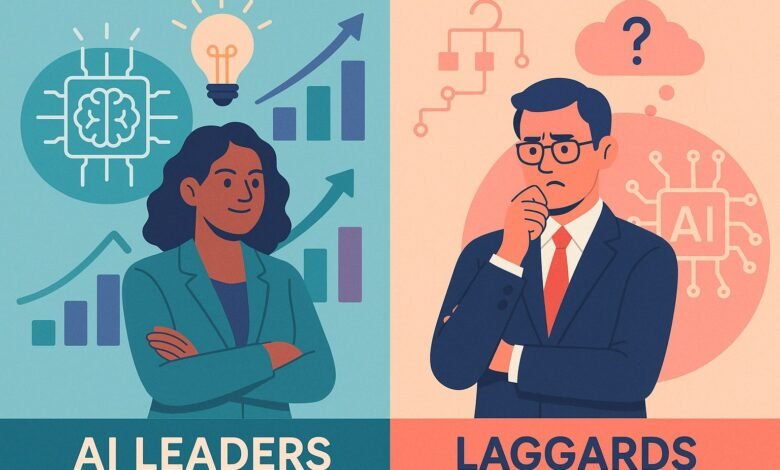
AI leaders versus laggards: revealing the key differences It is a topic of great interest as artificial intelligence continues to redefine business performance. Are you trying to figure out what separates high-performing organizations from those that struggle to implement AI effectively? Would you like to know how leading companies are increasing value and outperforming the competition using artificial intelligence technologies? This blog post will highlight the clear differences between front-runners in AI and those who are lagging behind. Follow until the end and discover how your business can transform from laggard to leader.
Read also: ChatGPT’s Shocking Water Consumption Revealed
What defines an AI leader?
AI leaders are organizations that use AI not just as a tool, but as a transformative force across all business processes. These companies recognize the potential of AI to enhance efficiency, personalize experiences, launch new products, and increase revenues. True AI leaders invest deeply in data infrastructure, integrate machine learning into decision-making, and cultivate a culture where experimentation is encouraged and guided by insights.
One of the key features of leading AI companies is top-down support. C-suite executives engage in AI strategy, with clear goals aligned with business outcomes. Employees are encouraged to learn, adapt and innovate, supported by strong technical resources and open access to data across departments.
These companies aren’t adopting AI just because it’s trendy. They use it strategically to link it to measurable KPIs, customer experience improvements, and ongoing operational improvements. For them, artificial intelligence is an integral part, not an assistant.
Read also: AI agents in 2025: A guide for leaders
Challenges facing laggards in the field of artificial intelligence
In contrast, AI laggards treat AI as isolated experiments or short-term fixes. Their projects often lack strategic alignment and cannot scale. Although they may run a few pilot programs, they rarely evolve into fully deployed AI solutions that support the overall business strategy.
There are many obstacles that separate those who are left behind. They often lack skilled staff, underfund AI initiatives, and rely on outdated data systems. Decision-making remains rooted in traditional processes. Data is siloed, highly fragmented, or unreliable, which limits the effectiveness of algorithms. Leadership tends to view AI as a cost center rather than a value driver. As a result, these companies miss innovation opportunities and often struggle to catch up with more agile competitors.
Share leadership and vision
AI leadership starts at the top. Companies that excel in AI have executive leaders deeply involved in setting the direction of AI and investing in talent. These leaders don’t just approve budgets; They support AI education, drive long-term expectations, and ensure AI is integrated into all levels of business functions.
Having a unified, well-understood vision helps align teams, reduces fear of change, and increases collaboration. In AI laggards, executive support is often limited or negative. This disconnect leads to fragmented projects with less impact on the business. Without visionary leadership, AI cannot be scaled or deeply integrated.
Read also: OpenAI’s clear definition of artificial general intelligence (AGI) revealed.
Data and infrastructure strategy
AI leaders have data infrastructures that are reliable, centralized, and scalable. Accessible data pipelines are critical to train models effectively and extract insights with high accuracy. These companies prioritize data management, security, compliance, and quality assurance. They ensure that employees can use data tools with minimal friction.
In comparison, laggards are held back by outdated or manually maintained data systems. Inconsistent or incomplete data prevents AI algorithms from performing efficiently. Without a sound foundation for data readiness, AI initiatives will either falter or fail altogether. Data remains in departmental silos, preventing the organization from finding cross-functional insights or innovative breakthroughs.
Artificial intelligence strategy to improve skills and skills
Leading AI companies view talent as a long-term investment. Their employees are either well versed in machine learning techniques or participate in continuous learning programs. These leaders often hire data scientists, AI engineers, and analysts while providing reskilling and upskilling opportunities for the existing workforce.
Cross-functional teams with technical and business acumen ensure that AI deployments actually solve real business problems. Upskilling isn’t just for developers; It includes professionals in marketing, human resources, finance and operations. This widespread adoption allows for efficient and scalable applications.
In underdeveloped organizations, talent gaps hinder progress. There is often reliance on external vendors without sufficient internal learning, which leads to short-term results. Lack of training leads to an ill-informed workforce unable to support or scale AI solutions.
Read also: Developing a culture of innovation using artificial intelligence
AI use cases with measurable ROI
The best-performing companies move quickly from piloting to operating. AI leaders excel by deploying models in production across multiple departments such as supply chain optimization, customer personalization, fraud prevention, and employee automation. These use cases are directly linked to ROI metrics, allowing executives to justify further investments and build momentum.
Machine learning becomes part of everyday decision-making. AI leaders regularly monitor model performance, retrain algorithms, update datasets, and extract insights. This consistent cycle of evaluation and improvement ensures not only survival, but leadership in their industries.
In contrast, laggards often fail to scale pilot projects to include full-scale business applications. Projects remain stuck in the review stages. They lack the feedback mechanisms and performance monitoring needed to demonstrate impact. Decision makers are reluctant to expand due to unclear financial results or past failures.
A culture of innovation and agility
Beyond technology, culture is the most powerful differentiator. Leading companies foster environments that support experimentation, allow for minimal failure, and encourage collaboration between teams. Their employees feel empowered to test ideas and explore how AI fits into their workflow. Agile methodologies ensure that AI projects are quickly iterated and closely aligned with business needs.
The mentality of continuous improvement is deeply ingrained in their culture. Companies that support this culture are more resilient and able to adapt during disruption. They treat every project as a learning opportunity, feeding those ideas into the next innovation cycle.
In contrast, laggards often operate in rigid work cultures where change is resisted, experimentation is viewed negatively, and innovation is stifled. Internal friction and siled teams slow AI adoption. Employees lack a clear sense of ownership or importance regarding the role of AI in their jobs, leading to poor performance and missed opportunities.
Read also: Leadership and AI visions for 2025
Conclusion: Move from laggard to leader
Bridging the gap between AI leaders and laggards requires a strategic shift. Organizations that want leadership must start with executive commitment and alignment at the company level. Building scalable data frameworks and fostering a skilled and flexible workforce is key to long-term success.
A culture that encourages innovation and supports continuous experimentation is no longer optional, but rather essential. Those willing to invest in infrastructure, talent development, and cross-functional collaboration are poised to leverage AI not only for automation, but also for growth and industry leadership.
Key takeaways:
- AI leaders use data as a strategic asset, not just a reporting mechanism.
- Executive leadership plays an active role in developing clear AI strategies.
- Training and upskilling is ongoing and integral to success.
- Scalable AI applications provide measurable business value.
- Organizational culture makes or break the success of AI transformation efforts.
References
Anderson, C. A., and Dale, K. E The social impact of video games. MIT Press, 2021.
Rose, D.H., and Dalton, P. Universal design for learning: theory and practice. Cast Professional Publishing, 2022.
Selwyn, N. Education and technology: key issues and debates. Bloomsbury Academy, 2023.
Lukin, R. Machine learning and human intelligence: the future of education for the 21st century. Routledge, 2023.
Siemens, J., and Long, P. Emerging technologies in distance education. Athabasca University Press, 2021.
Parker, Professor Philip M., Ph.D. Global Outlook 2025-2030 for Artificial Intelligence in Healthcare. INSEAD, March 3, 2024.
Khang, Alex, editor. Artificial intelligence-based innovations in digital healthcare: emerging trends, challenges, and applications. IGI Global, February 9, 2024.
Singla, Babita, et al., editors. Revolutionizing the healthcare sector using artificial intelligence. IGI Global, July 26, 2024.
Topol, Eric J. Deep Medicine: How Artificial Intelligence Can Make Healthcare Human Again. Basic Books, 2019.
Nelson, John W., editor, et al. Using predictive analytics to improve healthcare outcomes. First edition, April, 2021.
Subhuram, Vinithasree. Predictive Analytics in Healthcare, Volume I: Transforming the Future of Medicine. First edition, Physics Publishing Institute, 2021.
Kumar, Abhishek, et al., editors. The Evolution of Predictive Analytics in Healthcare: New AI Technologies for Real-Time Interventions. Institute of Engineering and Technology, 2022.
Tate, Hassan A. Smarter Healthcare with AI: Harnessing Military Medicine to Revolutionize Healthcare for Everyone, Everywhere. Forbes Books, November 12, 2024.
Lowry, Tom. Artificial Intelligence in Health: A Leader’s Guide to Winning in the New Era of Intelligent Health Systems. First edition, HIMSS, February 13, 2020.
Holly, Kerry and Manish Mathur. LLMs and generative artificial intelligence for healthcare: the next frontier. First edition, O’Reilly Media, September 24, 2024.
Holley, Kerry, and Ciobo Baker MD AI-First Healthcare: Applications of artificial intelligence in business and clinical management of health. First edition, O’Reilly Media, May 25, 2021.
Don’t miss more hot News like this! Click here to discover the latest in AI news!
2025-04-29 15:44:00