Bondi becomes focus of fury over Australia’s tide of antisemitism
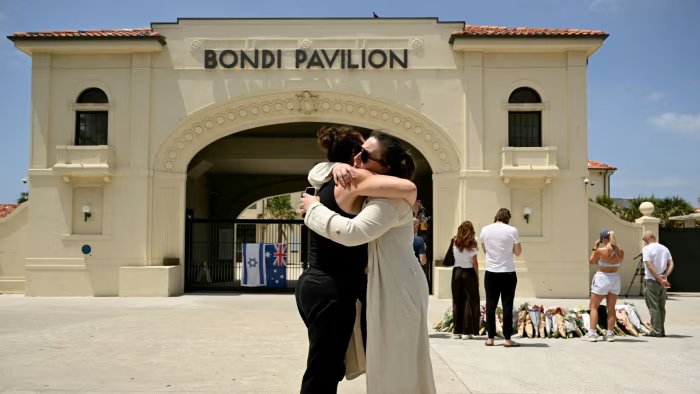
Coble Harkovich’s mother wanted him to become a rabbi when the family emigrated from Europe to Australia in the 1920s, but instead he became a lifeguard at Bondi Beach.
His grandson Tim Harcourt, an economist and academic, told the Financial Times on Monday that his grandfather enjoyed his role as Australia’s “true blue savior” on the most famous strip of sand in what he considered “the safest and most democratic country in the world.”
But Bondi Beach, long a scene of peaceful mingling between Australia’s diverse communities, this week became a sore spot for the country’s Jews — and a focus of bitter criticism of its government’s handling of rising anti-Semitism.
Two gunmen opened fire on a public celebration of Hanukkah, the Jewish holiday of light, where families were sharing traditional snacks and children were enjoying face painting and a petting zoo. The attack killed 15 people, including a Holocaust survivor, making it the deadliest incident of violence in Australia in nearly three decades.
Harcourt, whose grandfather died peacefully at the age of 96, said the shooting “was an attack on all of us. Bondi is Australia, and Australia is Bondi Beach.” Some of his family still live in the Bondi house where he grew up.
Australian intelligence chiefs have warned of a growing risk of anti-Semitic violence in recent years, as Israel’s war in Gaza inflames deep tensions between communities in the country.
Jewish leaders had feared that a series of recent incidents – particularly the firebombing of a synagogue in Melbourne in 2024 and arson attacks on Jewish businesses in Sydney – could turn deadly.
“For the past two years, I have been convincing myself that while anti-Semitism is on the rise, it will stop at verbal abuse and arson – and that Australians are too good to resort to extreme violence,” Jake Klein, CEO of gold miner Evolution Mining, posted on LinkedIn after visiting Bondi in the wake of the attack.
“But last night that illusion was shattered,” he wrote.
A report by the Community Security Group, which protects synagogues and Jewish events in Australia, said anti-Semitic attacks rose 26 per cent in 2024 to 1,045 incidents, the highest level ever recorded in a single year. They ranged from abusive behaviour, property damage, assaults and six acts of severe violence.
In August, Australia expelled the Iranian ambassador after it accused the Iranian Revolutionary Guard of being behind some of the attacks.
Josh Frydenberg, former treasurer and now head of Goldman Sachs Australia, told Sky News that the attack on Bondi Beach was “not an isolated, spontaneous event” but was “the culmination of hatred”.
Friedenberg listed a series of incidents targeting the Jewish community since the attack launched by the Palestinian Hamas movement on Israel on October 7, 2023, which led to Israel’s attack on Gaza.
These included damage to the offices of Jewish politicians, the publication of personal information about Jewish artists and businessmen, and weekly protests with chants including “Globalize the Intifada,” which many Jews interpret as a threat of violence rather than a call to liberate Palestine.
Anti-Semitic incidents have also increased in countries such as the United Kingdom, where two people were killed in an attack on a synagogue in October on Yom Kippur, the Jewish Day of Atonement.
Israeli politicians say Australia has done little to suppress anti-Semitism. Benjamin Netanyahu criticized Israeli Prime Minister Anthony Albanese, accusing his Australian counterpart of ignoring warnings of an attack, and blaming Canberra’s decision to recognize Palestine as a state last September, for adding “fuel to the fire of anti-Semitism.”
Netanyahu said: “Your government did nothing to stop the spread of anti-Semitism in Australia. You did nothing to curb the cancer cells that were growing inside your country. You did not take any action. You did nothing to stop the spread of anti-Semitism in Australia.” “You have allowed the disease to spread and the result is the horrific attacks on Jews that we saw today.”
Albanese on Monday denied a link between recognizing Palestine and defended his record of anti-Semitism. He also pointed to his government’s efforts to beef up security at synagogues and events, move to ban the collection of personal information, and fund museums related to the Holocaust and Jewish life.
Last year, Albanese also appointed Gillian Segal, a lawyer who sat on the boards of the Stock Exchange and the National Australia Bank, to make recommendations on combating anti-Semitism.
Its report, published in July, included proposals ranging from new laws on anti-Semitic behavior to greater regulation of online content, and withdrawing public funding for events that promote hateful content.
“This did not come without warning,” Segal said on Sunday, referring to previous incidents in Sydney where protesters chanted “Where are the Jews” and marched carrying pictures of the Iranian leader and the flag of the jihadist group ISIS. She added: “These are Australian icons. Their targeting is deliberate… It is an attack on Australia.”
Albany has been criticized by community groups and political opponents for not acting more decisively to respond to the potential threat of violence and for not adopting many of the recommendations of the Seagal Reports.
“There is no place in Australia for anti-Semitism. There is no place for hatred,” the Prime Minister said on Monday when asked about concrete steps to make the Jewish community feel safe again.
A Jewish business executive who lives in Bondi said her neighbors embraced her in tears on Monday in disbelief that something like this could happen in Australia.
“I’m not in disbelief. We’re sad, but we’re angry,” said the executive, who declined to be identified, arguing that intimidating behavior at weekly protests against Israel’s war in Gaza had not led to any action by police. “It takes bloodshed for people to get the message,” she said.
Vigils will be held across the country over the course of Hanukkah, which lasts eight days, during which the bodies of the victims are returned to their families for burial as soon as possible, according to Jewish customs.
Yanky Berger, a Sydney rabbi with the Chabad group that organized Bondi’s Hanukkah celebration, placed the massacre in the context of Jewish history in a letter to his congregation that he shared with the Financial Times.
“This is what our ancestors lived through. What Jews have endured through the generations,” wrote Berger, whose colleague Rabbi Eli Schlanger was killed in the attack. “Sadly, this is what we still experience today, not in distant history, not somewhere else, but here, now in Sydney. It’s real. It’s close.”
Additional reporting by James Shooter in Jerusalem
2025-12-15 13:22:00