David Sacks warns America can ‘lose the AI race’ because of ‘pessimism’
The race for AI supremacy has pitted Silicon Valley bigwigs against decision-makers in Washington and Chinese rivals. President Donald Trump has taken a non-regulatory approach to AI development, at times facing criticism calling for improved safety infrastructure, an argument the administration’s leading technology adviser viewed as a willful abandonment of the race for AI dominance.
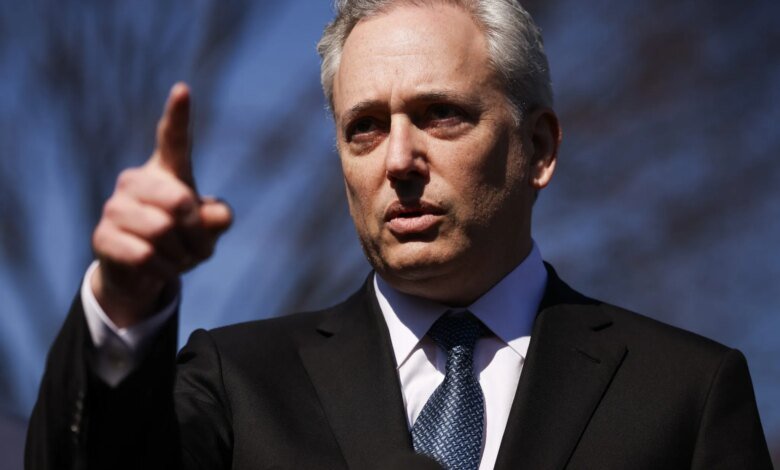
The so-called “destructive” AI mindset — the view that unchecked AI will ultimately lead to a net negative outcome for humanity, perhaps even causing societal collapse — amounts to “self-injury” on behalf of the United States, according to David Sachs, a long-time technology investor whom Trump has appointed as his AI and cryptocurrency czar.
“We see in general that optimism about AI in Western countries is much lower,” Sachs said Wednesday during a conversation with Salesforce CEO Marc Benioff at the World Economic Forum in Davos, Switzerland. In Sachs’s view, Edelman’s long-running confidence measure showed a surprising result that Americans were more pessimistic about AI than most of the world in 2025.
Sachs said he fears a “bout of pessimism” caused by the overzealous regulatory approach to AI development, including senator Bernie Sanders’ call last month to halt construction of data centers.
“If we have 1,200 different AI laws in the United States, you know, to stifle innovation, then I worry that we might lose the AI race,” Sachs told Benioff.
In the year since he took office, Trump has taken a clear pro-free-market stance on the development of artificial intelligence. In an AI action plan released last summer, the administration dismantled many regulations related to AI research, a reversal from Biden-era standards that consolidated a whole-of-government approach with federal involvement in AI governance. Trump took it a step further in December, issuing an executive order that weakened barriers to AI development nationwide. The order said that global dominance of artificial intelligence will require American companies to be “free to innovate without burdensome regulations.”
Sachs reiterated the administration’s rejection of state-level interventions elsewhere in Davos as well. In an interview Wednesday with CNBCSachs criticized California’s proposed billionaire wealth tax, a one-time 5% tax on total wealth for residents worth more than $1 billion, which will be put on the ballot next November.
“It’s not a one-off, it’s the first time,” said Sachs, who moved from California to Texas last month. “And if they get away with it, there will be a second and a third time. This will be the beginning of something new and different in this country.”
Sachs is one of several wealthy Californians who have criticized the proposal and decided to leave the state, including Google founders Larry Page and Sergey Brin. talking to CNBCHe referred to the plan as a potential “frightening trend” of state overreach.
Despite the departure of Silicon Valley leaders, and the fact that some AI companies have welcomed regulatory relief passed by the Trump administration, the no-holds-barred approach to AI development has also come under fire as research approaches the sun. Concerns about the employment impacts of automation, the collapse of financial markets, and the spread of potentially unsafe AI models have dampened some AI enthusiasm in the stock market.
Even some AI leaders feel uncomfortable. In November, Anthropic CEO Dario Amodei said so 60 minutes He is “deeply uncomfortable” with how AI companies are now being entrusted with self-governance, saying he favors “responsible and thoughtful regulation of the technology.”
Proponents tend to justify deregulation as necessary to keep pace with China’s AI competitors. AI research in China is rapidly closing the gap with the United States, where some models, most notably those developed by Hangzhou startup DeepSeek, match or even outperform Western models on specific inference tasks.
In his conversation with Benioff, Sachs cited recent research on varying rates of optimism in AI around the world, published last year by Stanford University’s Human-Centered AI Institute. Optimism prevailed in China, where 83% of respondents saw artificial intelligence as more beneficial than harmful. In the United States, by contrast, only 39% felt optimistic.
But while figures like Trump and Sachs call for a no-holds-barred AI approach, pessimism is not a purely partisan issue in the United States. In December, Florida Governor Ron DeSantis, a former Republican presidential candidate, called for more restrictions on the construction of data centers. Last week, a bipartisan House committee heard testimony about the impact of artificial intelligence in K-12 education. While some Republican committee members warned against stifling innovation through more regulation, broad consensus was found about the potential dangers of exposing children to artificial intelligence.
Don’t miss more hot News like this! Click here to discover the latest in Business news!
2026-01-22 17:46:00