DJI’s Neo 2 selfie drone adds obstacle avoidance and gesture controls
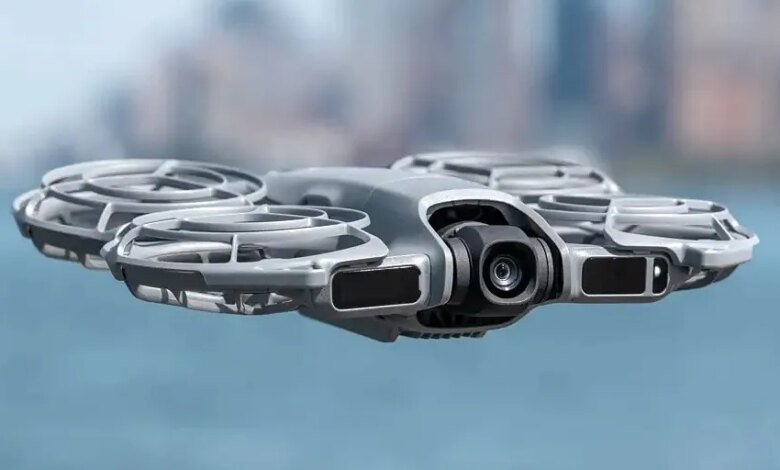
DJI has announced a follow-up to the Neo selfie drone it launched last September for $199. Although the price of the original was suitable for widespread adoption, it lacked many of the useful features that the new DJI Neo 2 adds, including gesture control and the ability to actively avoid obstacles instead of relying solely on a design that can survive impacts and collisions.
The DJI Neo 2 is slightly larger than its predecessor, and at 151g, it’s 16g heavier, but that extra weight is a small trade-off given the extra functionality and larger battery. The Neo 2’s new obstacle avoidance system uses forward-facing LIDAR and down-looking infrared sensors to detect and avoid hazards while the drone follows you in forward and sideways flight modes. It still features built-in guards that fully protect its four propellers, but you won’t have to be as careful about where you choose to fly it.
The drone’s maximum follow speed has been increased to 12 meters per second, or roughly 27 mph, which is much faster than the highest follow speed of the original drone, even after a firmware update last November raised it to about 18 mph. The Neo 2 is also better at flying in less than ideal conditions. In our tests, the original Neo could be difficult to control in the breeze and had a tendency to drift, but DJI says the Neo 2 can maintain stable flight in winds of up to 24 mph.
The Neo 2 is primarily designed to capture drone footage autonomously, but in addition to offering support for DJI’s RC-N3, motion controllers, and the Goggles N3 headset, the company is adding gesture controls. You can adjust the drone’s position and distance by moving your hands while it’s in flight and flying close to it, and DJI has added a small display to indicate what mode it’s in. In the original Neo, this was presented using a series of illustrations and LED lights above the drone.
A larger 1,606 mAh rechargeable battery increases the Neo 2’s flight times to up to 19 minutes, and it comes with 49GB of on-board storage – up from 22GB. The drone’s camera now uses a dual-axis gimbal for improved stability, and although it has the same half-inch sensor as the original, it now offers a wider field of view and can capture 4K footage at up to 60fps, or up to 100fps while piloting the Neo 2 manually.
The upgrades make the Neo 2 a more compelling and cheaper alternative to HoverAir’s offerings, including the entry-level X1, but as with DJI’s recently announced Osmo Mobile 8 smartphone, the company’s latest drone is being launched exclusively in China. Pricing starts at CNY 1,499, or about $211 USD, an increase of about $28 USD. DJI also offers the Neo 2 in a bundle that adds extra batteries and a multi-charger for CNY 1,499 ($282) and bundles the drone with a motion joystick and Goggles N3 for CNY 3,699 ($521).
Don’t miss more hot News like this! AI/" target="_blank" rel="noopener">Click here to discover the latest in AI news!
2025-10-30 16:35:00