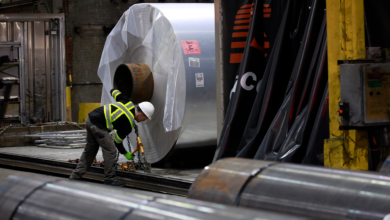
The U.S. Mint ended production of the penny citing cost savings and the coin’s fading relevance as its buying power—once enough for a snack or candy—has all but disappeared

The U.S. Mint on Wednesday ended production of the penny, a change made to save money and because the one-cent coin with which you could buy a snack or a piece of candy has become increasingly irrelevant.
The last pennies were minted at the Philadelphia Mint, where the nation’s smallest coins have been produced since 1793, a year after congress passed the Mint Act. The last few pennies will be auctioned off, officials said.
“God bless America, we will save taxpayers $56 million,” said Brandon Beach, US Treasury Secretary, before pressing the button to squeeze in the last penny.
Pennies remain legal tender, but new coins will no longer be made.
The last coin to be discontinued was the half cent in 1857, Beach said.
President Donald Trump ordered the demise of the penny as costs rose to nearly 4 cents per penny and the 1-cent valuation became somewhat obsolete. Billions of pennies are still in circulation, but they are rarely necessary for financial transactions in the 21st century economy.
“For too long the United States has minted pennies that have literally cost us more than our two cents,” Trump wrote in an online post in February. “This is extremely extravagant!”
However, many people are nostalgic for them, seeing them as lucky or fun to collect. Some retailers have expressed concerns in recent weeks as supplies decline and the end of production approaches. They said the phase-out was sudden and did not come with any government guidance on how transactions should be handled.
Some have rounded prices down to avoid shortchanging shoppers. Others implored customers to make the exact change. The most creative among them handed out prizes, such as a free drink, in exchange for a pile of pennies.
“We’ve been calling for the abolition of the penny for 30 years,” Jeff Lennard, of the National Association of Convenience Stores, said last month. “But that’s not the way we wanted things to go.”
At the same time, some banks have begun rationing supplies, a somewhat paradoxical result of efforts to address what many see as a glut of coins. Over the past century, nearly half of the coins made at the Philadelphia and Denver mints have been pennies.
But they still have a better production cost-to-value ratio than nickel, which costs about 14 cents to manufacture. By comparison, the production cost of a dime is less than 6 cents, and a quarter is about 15 cents.
In 1793, a penny could get you a biscuit, a candle, or a piece of candy. These days, much of it sits in drawers or glass jars and is tossed aside or collected.
Regardless of its face value, collectors and historians consider it an important historical record that can be traced back more than 200 years. Frank Holt, a professor emeritus at the University of Houston who has studied the history of coinage, laments the loss.
He added: “We put logos and self-identifiers on them, and we decide – in the case of the United States – which dead people are most important to us and whose memory should be commemorated.” “They reflect our politics, our religion, our art, our sense of ourselves, our ideals, our aspirations.”
2025-11-12 20:08:00