Elon Musk says his tech empire is built on idea that humans are universe’s only intelligent life
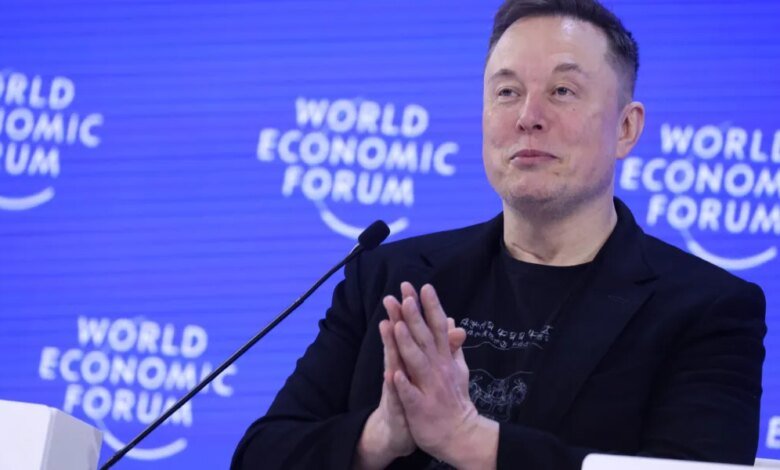
Despite Elon Musk’s multiple claims that he is an alien – something he reiterated on the World Economic Forum stage on Thursday – SpaceX’s billionaire CEO believes it is unlikely that intelligent life exists beyond Earth.
In a conversation in Davos, Switzerland, with BlackRock CEO and interim President of the World Economic Forum Larry Fink, Musk said this belief is the framework for his technology projects and his $600 billion fortune. Since there is little possibility of extraterrestrial life, Musk said the project to preserve humanity has become more urgent.
I am often asked: Are there aliens among us? I will say that I am one. “They don’t believe me,” Musk said, unclear whether he was joking or what specific point he was trying to make by emphasizing his foreignness.
“Or you’re from the future,” Fink replied, referring to earlier times when Musk called himself a time-traveling vampire 3,000 years ago.
“The bottom line is that we need to assume that life and consciousness are extremely rare, and it might just be us,” Musk added. “If that is the case, we must do everything possible to ensure that the light of awareness does not go out.”
Musk’s vision for protecting humanity unfolded more than a decade ago, when he founded OpenAI alongside Sam Altman in 2015 in hopes of addressing the existential risks and safety concerns associated with the emerging technology. Tesla and SpaceX, worth $1.4 trillion and $800 billion respectively, were an extension of that belief, aiming to create not just sustainable technology, but “sustainable abundance,” Fink told Fink.
Musk’s vision for the future of humanity
Musk reiterated his vision of an abundance of humanoid robots that would make work optional, claiming that the technology would ease the burden on humans in getting jobs or even getting money.
“With robotics and artificial intelligence, this is truly the path to abundance for everyone,” Musk said. “People often talk about solving global poverty, or basically, how do we get everyone to have a very high standard of living? I think the only way to do that is with artificial intelligence and robotics.”
The billionaire describes a world in which billions of robots – which would outnumber humans – would complete tasks including looking after children and elderly parents. He expects functional humanoid robotics technology to emerge by the end of the year, and said he expects these robots to be available at retail in the next two years.
Tesla’s Optimus robots have certainly faced hurdles, consistently falling behind production schedule, with Musk as recently as Tuesday saying that manufacturing the robots, as well as Tesla’s Cybercab, will be “painfully slow” before production eventually ramps up.
Musk previously said that humans will be able to support themselves without work through universal basic income, but he did not provide details about the political steps necessary to provide this income for humans.
These missions to sustain humanity extend far beyond Earth. Musk described his goals as a “Mars-shot,” a reference to his hopes of putting human life on Mars, efforts he even touched on in Tesla’s financial filings. The CEO previously said he envisions Mars as an insurance policy for humanity’s future, and wants to use it as a springboard to expand resources to explore human consciousness.
“I’ve been asked many times like, ‘Do I want to die on Mars?'” Musk said Thursday. And I say: “Yes, but not only for effect.”
The Fermi Paradox, says Musk
Musk’s philosophy regarding extraterrestrial life has previously dealt with the Fermi Paradox, a theory that posits a significant change in intelligent life beyond Earth, and the scant evidence to prove it.
In 1950, Italian-American physicist Enrico Fermi, the architect of the atomic bomb, posed a question in a conversation with colleagues at Los Alamos National Laboratory in New Mexico: “Where is everyone?”
This three-word search launched a 1963 paper written by American astronomer Carl Sagan, which spread throughout the scientific community, and soon the famous Fermi Paradox emerged.
Humans “are the only small candle of consciousness in the abyss of darkness,” Musk said in an X post in 2023.
“The scariest answer to the Fermi Paradox is that there are no aliens at all,” he said.
In 2022, Musk commissioned a sculpture depicting “The Great Fermi Filter,” a potential solution to the Fermi Paradox that posits that intelligent life must face and overcome a series of challenges, including a Great Filter that only a few evolved species can overcome. The sculpture shows a giant fork with two paths diverging, indicating the choices a civilization must make in order to survive: a fork in the road, a motive that Musk has often relied on.
Criticisms of Musk’s philosophy
The high-risk nature associated with Musk’s philosophy has raised concern, with some saying this effort to preserve humanity actually threatens it. Rebecca Charbonneau, a historian at the American Institute of Physics, had a different interpretation of Musk’s business philosophy. In an article published in Scientific American in February 2025, Charbonneau said that Musk’s beliefs about preserving humanity reflect a larger ideology in the world of technology.
Charbonneau argues that technology leaders, whose roots go back to the remnants of Cold War fears (the same time period as the Fermi Paradox), often saw a false dichotomy of either unlimited prosperity or complete societal collapse. As a result, many in the field, including Musk, are willing to go to extreme measures in the name of avoiding what they see as the demise of humanity.
“Proponents of this survival mentality argue that it justifies certain programs of technological escalation at all costs, framing the future as a desperate race against disaster rather than a space of multiple thriving possibilities,” Charbonneau wrote.
She noted that Musk’s “Fork in the Road” strategy, the strategy he used to execute employees at Company X and in the federal government as the de facto leader of DOGE, reflected that. Musk described DOGE as a “bureaucracy chainsaw” and promised to cut $2 trillion in federal spending. Instead, this advice eliminated about $150 billion in spending through employee cuts and contract cancellations. Federal workers said the cuts made their jobs more difficult, eliminating valuable resources and causing their jobs to take longer, with the quality of government work suffering.
Charbonneau said Musk’s philosophy eliminates opportunities for nuance, leaving organizations — and humanity — vulnerable to often extreme responses to sensitive situations.
“By framing human challenges as simple engineering problems rather than complex systemic problems, technologists position themselves as critical architects of our future, crafting grandiose visions that avoid the necessary, messy work of social, political, and collaborative change,” she said.
2026-01-22 23:11:00