Europe hates Trump’s play for Greenland so much that even far-right nationalist groups are repulsed
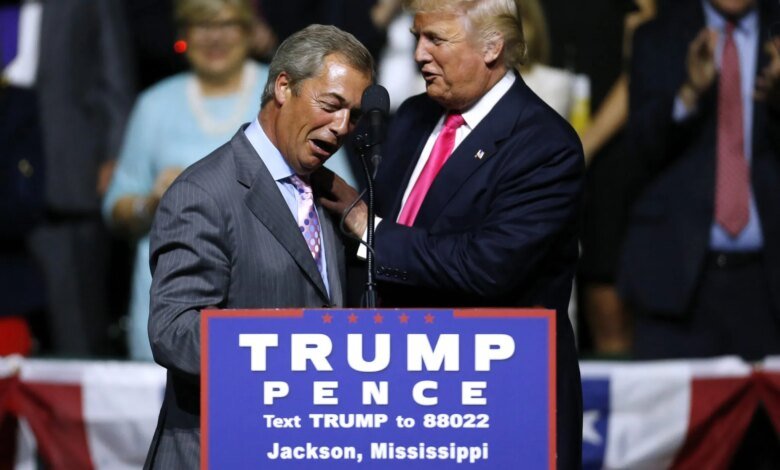
This rift seems to indicate that ideological consensus alone may not be enough to allay concerns among European nationalists about Trump’s interference abroad.
Far-right leaders in Germany, Italy and France strongly criticized Trump’s plans for Greenland. Even Nigel Farage, a longtime Trump ally and head of the UK’s National Reform Party, described Trump’s moves in Greenland as a “very hostile act.”
During Tuesday’s debate in the European parliament, far-right lawmakers usually aligned with Trump overwhelmingly supported halting the EU-US trade agreement because of their discomfort with his threats, calling them “coercion” and “threats to sovereignty.”
MAGA Partners Transatlantic
Such a difference between Trump and his European followers was somewhat surprising.
Far-right parties will come to power in 2024 across the European Union, shaking traditional powers throughout the bloc’s 27 countries from Spain to Sweden. Their political groupings now hold 26% of the seats in the European Parliament, according to the German Institute for International and Security Affairs.
Less than a year ago, Europe’s far-right parties gathered in Madrid to hail Trump’s election under the slogan “Make Europe Great Again,” while Elon Musk, before his fall from Trump’s favor, worked to bolster the influence and personalities of European far-right figures on X, including Germany’s far-right Alternative for Germany party.
US Vice President J.D. Vance sparked scorn within Germany and across Europe after he met AfD leader Alice Weidel during elections in February. The party, which the mainstream parties refuse to work with, has upset German politics by doubling its presence in the Bundestag to become the country’s second-largest party.
However, deep divisions within MAGA itself over Trump’s approach to foreign affairs have reverberated in Europe, where his actions over Greenland, Venezuela and Iran have forced his political allies to put their own ideological convictions over their respect for the US president.
Sovereignty trumps shared values
France’s far-right National Rally party has at times boasted of its ideological closeness to Trump, especially on immigration.
A year ago, the party sent one of its senior figures, Louis Elliott, to attend Trump’s inauguration. On the other hand, Trump strongly defended party leader Marine Le Pen, describing her conviction for embezzling European Union funds as a “witch hunt.”
Jordan Bardella, the head of the National Rally party and a 30-year-old member of the European Parliament, has praised Trump’s nationalist views, telling the BBC last month that “the winds of freedom and national pride” were blowing through Western democracies.
But in recent days, Bardella seemed to distance himself from the US administration. In his New Year’s speech, he criticized the American military intervention in Venezuela with the aim of arresting then-President Nicolas Maduro, describing it as “foreign intervention” aimed at serving “the economic interests of American oil companies.”
Moreover, Bardella on Tuesday condemned Trump’s “commercial blackmail” over Greenland.
“To subjugate us would be a historic mistake,” Bardella said.
Another Trump ally, Italian Prime Minister Giorgia Meloni, echoed this sentiment. In an interview with Rai TV on Wednesday, she said she told Trump during a phone call that his threat of tariffs on Greenland was a “mistake.”
Reluctance to criticize the eastern side of the European Union
However, reactions among European right-wing leaders were not consistent. Hungarian Prime Minister Viktor Orban, widely seen as a forerunner of Trump’s illiberal populism, has been careful to avoid even the slightest criticism of the US president.
Facing what is likely to be the toughest election of his 16 years in power in April, Orban has built his political identity around his affinity with Trump, promising voters that his close relationship with the president will yield huge gains.
Orban insisted that Trump is Europe’s only hope for peace amid the war in Ukraine and the guarantor of national sovereignty.
Orbán has sought to portray Trump’s threats over Greenland and Maduro’s arrest as either beneficial to Hungary, or none of its business.
“It’s an internal issue…it’s a NATO issue,” Orban said of Trump’s plans for Greenland during a news conference earlier this month, adding that any proposed change to Greenland’s sovereignty could be discussed within NATO.
Despite his staunch defense of national sovereignty, Orban also praised US action in Venezuela, calling the country a “narco-state” and suggesting that Maduro’s ouster could benefit Hungary through cheaper oil prices on global markets in the future.
Hungary’s reluctance to respond to Trump’s actions reflects similar attitudes among far-right leaders on the European Union’s eastern flank.
Polish President Karol Nawrocki, seen as an ally of both Orban and Trump, said in Davos this week that tensions over Greenland should be resolved “diplomatically” between Washington and Copenhagen — not a broader European alliance. He called on Western European leaders to tone down their objections to Trump’s behavior.
In the neighboring Czech Republic, Prime Minister and Trump ally Andrej Babis refused to speak out against US threats to Greenland, and warned that the European Union would allow the issue to cause conflict with Trump. In Slovakia, Prime Minister Robert Fico remained silent about Trump’s plans in Greenland, even when he met the president at the Mar-a-Lago resort last week.
However, Trump’s removal of Maduro prompted Fico to “unequivocally condemn this act,” calling it a “hijacking” and “the latest American oil adventure.”
Future turmoil or division
The ideology that binds MAGA and its European allies may survive recent controversies by doubling down on old shared grievances, said Daniel Hegedus, Central Europe director for the German Marshall Fund.
He pointed to recent votes against Brussels’ leadership in the European Parliament by far-right European lawmakers over the EU’s migration pact and halting the massive trade deal with the Mercosur bloc, which includes five South American countries.
He added: “If Trump continues in this manner and poses a threat to the sovereignty of European countries, this will of course lead to the division of the European far right.”
“We don’t know whether this division will stay with us or whether they can join forces again on issues on which they can cooperate. These issues could be harmful enough for the European Union.”
___
Spike contributed from Budapest and Courbet from Paris.
Don’t miss more hot News like this! Click here to discover the latest in Business news!
2026-01-25 16:32:00