Experts: Troops risk court-martial over ‘illegal orders’ advice

newYou can now listen to Fox News articles!
President Donald Trump said a widely circulated video of Democratic senators urging service members to “reject unlawful orders” should be “punishable by death,” intensifying outrage across the political spectrum — and confusion over what such advice could actually mean under federal law.
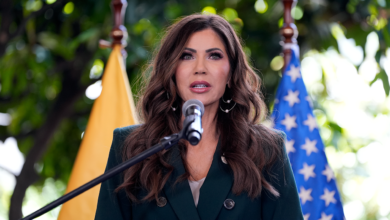
While the lawmakers behind the video — led by Sen. Elissa Slotkin, D-Mich., and joined by Sen. Mark Kelly, D-Ariz., and several House Democratic veterans and intelligence officers — framed the appeal as a defense of the Constitution, military legal codes make clear that refusing orders, even ones a service member personally believes are illegal, can result in devastating penalties.
“You can’t expect a sailor to overrule a Washington lawyer,” Rachel Van Landingham, a retired Air Force officer and professor at Southwestern University School of Law, told Fox News Digital. “That is why it is unfair to put the burden on the army instead of on decision-makers.”
Under the Uniform Code of Military Justice (UCMJ), the body of laws that governs all members of the U.S. armed forces, obeying orders is not optional – except in the narrowest cases where illegality is “clear” or unambiguously obvious. In practice, this distinction means that most soldiers risk punishment if they refuse an order before a court or higher authority rules that it is illegal.
Dangerous War Games: Asking service members to resist Trump invites chaos
UCMJ Section 90 states that any service member who “willfully disobeys a lawful order” of a superior officer can face imprisonment for up to five years, loss of all pay and allowances, and dishonorable discharge. If the crime occurred during wartime, the penalty could be death or any lesser penalty decided by the military court.
While the lawmakers behind the video portrayed the appeal as a defense of the Constitution, military legal codes make clear that refusing orders still carries devastating penalties. (Reuters)
Article 92 – “Failure to obey orders or regulations” – adds that disobeying any legal order or regulation may also result in court-martial, with penalties including forfeiture of pay, reduction in rank, and imprisonment for up to two years. Military lawyers say these provisions are the backbone of discipline and the chain of command, the same system that the senators’ video appears to challenge.
The law leaves little room for mere good intentions.
“There is no duty to obey an illegal order, but a subordinate who disobeys based on that belief runs the risk of being convicted by a court-martial unless he can prove that the order is truly illegal,” said Jeffrey Korn, a law professor at Texas Tech University and director of the university’s Center for Military Law and Policy.
The opposite error can be equally devastating. Under Section 77, service members who carry out an illegal order can be punished as “commanders,” meaning they bear the same criminal liability as the commander who issued the order.
This principle – which was established after World War II – rejects the idea that “merely following orders” constitutes a means of defense.
Graham calls on Democrats to explain their ‘reject illegal orders’ message to troops
If an order violates the Constitution, the law of armed conflict, or the rights of American citizens, obedience offers no protection. A service member who follows such a directive could face prosecution for war crimes or dereliction of duty under Article 134, the UCMJ’s broad “general rule” that covers conduct that brings into disrepute the armed forces.
Military law sets a very narrow standard for rejecting an order: it must be clearly illegal—so clearly illegal that “a person of ordinary sense and understanding” would recognize it as a crime on its face. Examples include orders to kill civilians, torture detainees, or overthrow the government.
By contrast, orders to deploy troops, impose federal authority, or implement presidential directives are presumed lawful unless specifically prohibited by law or court ruling.
“There is an assumption that military orders are legal,” said Victor Hansen, a former Army officer and professor at New England School of Law in Boston. “There is no defense unless the order is clearly illegal – something clearly criminal, such as ordering the killing of a prisoner of war. This is where the duty to disobey applies.”
Hansen said service members are not in a position to explain the legality of the president’s decisions on deployments or strikes. “If a soldier came to me after watching this video, I would tell him: ‘Don’t do anything different than what you’re already doing,'” he said. “It’s not your job to guess the politics behind the decision to use force.”
The one-minute “Don’t Give Up Ship” video tells military and intelligence personnel: “You can reject illegal orders. You must reject illegal orders.” It never specifies which orders qualify — even as the same lawmakers push legislation that would limit Trump’s ability to deploy National Guard units or launch strikes to combat drug-related terrorism abroad.
Conservatives quickly accused the group of encouraging insurrection.
“TDS Phase 4,” Defense Secretary Pete Hegseth responded on Channel X, referring to what the president’s supporters call “Trump Derangement Syndrome.”
Inside the Pentagon, officials have long warned that calls for troops to interpret legality themselves could undermine civilian control of the military — a cornerstone of the American constitutional order. Current regulations require service members to seek immediate legal guidance through their chain of command or the Judge Advocate General’s office before denying direction, except in cases of clear criminality.
Retired Air Force Maj. Gen. Stephen Lieber, former deputy general of the Armed Forces, said Democrats’ letter “simply rewrites existing law” but risks confusion about where accountability really lies.

Sen. Mark Kelly, a former Navy captain, urged troops to reject “illegal orders” in the video that went viral. (Eric Lee/Bloomberg)
“There is a strong presumption that military orders are legal,” Lieber said. “This is as it must be, because if the assumption goes the other way, our army will be hopelessly weakened.”
In 1968, US forces massacred hundreds of unarmed civilians in the Vietnamese village of My Lai, a crime its leaders initially tried to cover up. When the murders came to light, 1st Lt. William Calley was convicted of murder despite his claim that he was following orders—a case that taught generations of soldiers that some orders were so clearly criminal that they should be rejected.
Decades later, the Abu Ghraib prison abuse scandal in Iraq revealed another breakdown of command responsibility. Reservists at a US detention facility humiliated and assaulted detainees under what they believed were permissible interrogation practices.
Eleven military personnel have been prosecuted, while senior officials have escaped prosecution — a stark reminder, military lawyers say, that vague orders and weak oversight can lead troops to commit criminal acts.
VanLandingham called the video “negligent and dangerous,” saying it misrepresents how limited the legal duty to refuse orders actually is.
“Service members are not legally obligated to follow illegal orders,” she said. “But the world of orders that are clearly or clearly illegal to the point that a soldier of ordinary understanding would recognize them as such is very small—and that is by design. The Army depends on obedience.”
She said this principle, born out of the post-Holocaust Nuremberg trials, remains the foundation of modern military law — a reminder that obedience can never justify crimes “that are so clearly unlawful that any person of ordinary understanding would recognize them as such.”

The standard becomes more ambiguous in modern conflicts, VanLandingham said, citing US strikes on suspected drug smuggling boats in the Caribbean and off Venezuela. She added that these missions may be illegal in terms of international law, but they would not appear clearly illegal to the forces that were ordered to carry them out. “ (Minister of War via X)
The standard becomes more ambiguous in modern conflicts, VanLandingham said, citing US strikes on suspected drug smuggling boats in the Caribbean and off Venezuela. She added that these missions may be illegal in terms of international law, but they would not appear clearly illegal to the forces that were ordered to carry them out. “
“They disobey at their peril,” VanLandingham added. “If they refuse an order believing it is illegal, they risk their careers, their family’s income, and even court-martial. But if they obey, they may later be charged with a crime. It is a conundrum, and it is unfair to expect military service members to bear this burden.”
“Don’t go after the troops,” VanLandingham said. “Go after policymakers who issue illegal orders. congress should rein in executive power, not tell soldiers and lieutenants to decide what’s legal.”
Click here to download the FOX NEWS app
For individual forces, the risks are high. Refusing a legal order — or obeying an illegal order — can end a career, result in years of incarceration, and erase veterans’ benefits.
While the senators say they are defending constitutional duty, the UCMJ leaves little room for personal interpretation — and no safe haven for those who guess wrong.
Don’t miss more hot News like this! Click here to discover the latest in Politics news!
2025-11-21 18:19:00