Tulsi Gabbard’s Politics Are Blinding U.S. Intelligence
Since 1997, the U.S. Intelligence Community has published an unclassified “Global Trends” report every four years to assess different scenarios for our global future and their potential impact on the United States. Having all served in senior national security positions in the US government, we can confidently say that these reports provide a rare impetus for policymakers to shift their focus from everyday inboxes to looming strategic threats.
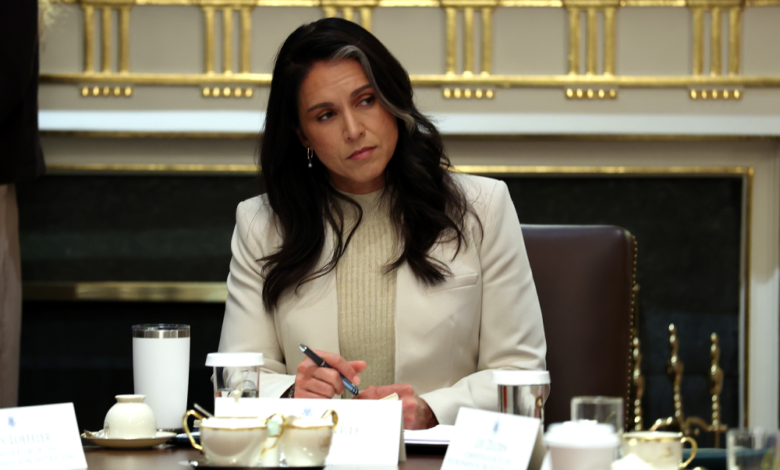
They also provide a platform for US officials to compare assumptions with their foreign counterparts, strengthen international cooperation and deepen shared understanding of our uncertain future. However, US Director of National Intelligence Tulsi Gabbard decided to halt the upcoming Global Trends Report and dismantle the unit that wrote it, accusing its authors of pushing “a political agenda that conflicts with all of the current President’s national security priorities.”
Since 1997, the U.S. Intelligence Community has published an unclassified “Global Trends” report every four years to assess different scenarios for our global future and their potential impact on the United States. Having all served in senior national security positions in the US government, we can confidently say that these reports provide a rare impetus for policymakers to shift their focus from everyday inboxes to looming strategic threats.
They also provide a platform for US officials to compare assumptions with their foreign counterparts, strengthen international cooperation and deepen shared understanding of our uncertain future. However, US Director of National Intelligence Tulsi Gabbard decided to halt the upcoming Global Trends Report and dismantle the unit that wrote it, accusing its authors of pushing “a political agenda that conflicts with all of the current President’s national security priorities.”
The truth, of course, is that the decision to cancel the report and liquidate the group that wrote it was itself politically motivated. The intelligence community’s job is never to endorse the president’s priorities, but rather to provide unbiased analysis and warning. Eliminating the Global Trends Report, along with other steps taken by the Trump administration to dismantle U.S. capabilities to ascertain future threats, would leave the United States less prepared, less resilient, and less safe.
What drives this administration to make this decision? We only have to look at President Donald Trump’s comments before the United Nations in September, when he criticized climate change as a “hoax.” Climate change has been covered in every global trends report since the one released in 2000, and we assume that the topic is included in this report. From Trump’s perspective, this is an act of heresy. By punishing analysts for providing an unbiased view, Gabbard undermined the very purpose for which her office was created.
This incident will certainly have a further dampening effect on the willingness of others to provide information that contradicts prevailing political assumptions, whether based on reality or not. We’ve already seen Gabbard politicize intelligence on other topics, revoke security clearances of career national security officials for their work investigating Russian election interference, and remove officials who have published analyzes that conflict with the administration’s views on Venezuela.
The loss of foresight in the intelligence community is part and parcel of a larger effort by the Trump administration to diminish the US government’s ability to monitor climate change by reducing weather monitoring; reducing Earth systems monitoring mechanisms, such as the long-term facility on Mauna Loa; eliminating US government support for climate science; And halt work on the next national climate assessment.
The Trump administration seems to hope that climate change will go away if we simply ignore it, consistent with the president’s initial response to coronavirus disease 2019 (COVID-19). We saw how this plan worked.
The Trump administration also reduced the US government’s ability to implement climate change policy. The administration has signaled its intention to withdraw from the 2015 Paris Agreement on climate change, but that action will not take effect before January 2026. Meanwhile, Secretary of State Marco Rubio has abolished the State Department’s Office of Global Change, meaning there is no one to advocate for US interests in international environmental forums, including upcoming negotiations at the UN climate conference in Brazil in November. (COP30).
Destroying the government’s ability to analyze future trends and implement policies—whether related to climate change, artificial intelligence, global public health, or other challenges—endangers American national security and cedes influence to the country’s rivals. China certainly will not halt its long-term plans for how to manage climate change and steer the energy transition to its own advantage. In late September, as Trump was dismissing climate change to hundreds of countries badly affected by it, Beijing announced a new target to cut its own greenhouse gas emissions, stealing another march from the United States in perceptions of global leadership.
Depriving the United States of the ability to monitor and evaluate future problems does not make them go away; It simply makes the country less prepared to confront threats it might otherwise have anticipated. This decision is similar to pilots turning off their on-board instruments mid-flight and flying blind into the unknown.
Last year, the United States saw devastating climate-related storms and wildfires from North Carolina to California. These incidents led to the deaths of hundreds, the displacement of thousands, and caused billions of dollars in damage. The US military has deployed nearly 50 times in the past year in response to climate risks. In California alone, more than 1,800 members of the National Guard were mobilized to support efforts to fight wildfires in January, taking them away from other national security duties.
Climate risks are also undermining US military infrastructure and readiness in the Indo-Pacific region, with extreme weather causing billions of dollars in damage to Andersen Air Force Base in Guam in 2023 and US military facilities on Kwajalein Atoll, part of the Marshall Islands, in 2024.
US rivals and adversaries exploit these disasters to sow division and undermine US security through disinformation; China launched a social media campaign blaming the US military for the Hawaiian wildfires, and Russia amplified a campaign claiming that Washington could not afford to respond to Hurricane Helen because of its support for Ukraine.
Other governments will continue to proactively assess threats, because they recognize the value of planning ahead and working to mitigate risks before they materialize, but it is inconceivable that the world’s pre-eminent national security community will not continue to develop its own assessment, rooted in its own national interests.
If the United States government is no longer determined to assume this responsibility, even as it faces the most challenging global security landscape since the end of World War II, a bold think tank, NGO, or foundation will need to take this work forward. Refusing to plan how to keep the United States secure and prosperous is simply not an option.
Don’t miss more hot News like this! Click here to discover the latest in Politics news!
2025-10-20 11:00:00