How Russian Support Fuels Iran’s Repression of Protests
Over the past year, Russia has watched pillars of its external authoritarian ecosystem erode. Syrian leader Bashar al-Assad’s collapse stripped Moscow of its most important Arab client and a central node of its regional power projection. The dramatic U.S. capture of Venezuela’s Nicolás Maduro at the start of January further exposed the fragility of Russia’s network of partners. Now, as nationwide protests convulse Iran, threatening the Islamic Republic’s survival, how will the Kremlin respond?
Moscow will not rescue Iran through direct military intervention, something that would cross a decades-long Russian red line. Instead, Moscow is doing what it has done repeatedly over the past two decades when authoritarian partners face internal threats: reinforcing the tools of repression, sharing lessons from its own experience managing dissent, and insulating the regime from external pressure. Publicly, the Kremlin has defaulted to familiar language by condemning “foreign interference,” warning against destabilization, and affirming respect for Iranian sovereignty. Privately, however, its role is far more consequential. Moscow continues to provide the key military equipment and sophisticated internet suppression technology that the Iranian regime is using today.
For Moscow, Iranian regime stability is not merely a question of influence abroad. It is tightly bound to Russia’s own fears of authoritarian vulnerability at home. Russian elites view mass protest through a specific and deeply ingrained lens: contagion, elite defection, and rapid regime collapse. These fears are rooted in formative shocks—the color revolutions of the 2000s, Russia’s 2011-12 protests, and Iran’s 2009 Green Movement—that reshaped how both states conceptualize internal unrest.
This convergence laid the groundwork for sustained cooperation on repression. Over the past decade, Iran has benefited from Russian surveillance technologies, internal security know-how, and institutional lessons drawn from Moscow’s efforts to manage dissent. These include communications interception systems, advanced monitoring tools, interrogation technologies, and software designed to track, deter, and disrupt organized protest networks. Much of this cooperation has been formalized through bilateral agreements framed in the language of public order, counterterrorism, and sovereignty—providing political cover for what is, in practice, regime-security collaboration.
Among these agreements, the text of the two countries’ 2025 Comprehensive Strategic Partnership Treaty is revealing. Its provisions are tailor-made for regimes confronting internal unrest, particularly in the digital and information domains. It calls for cooperation on “international information security,” coordination against the use of information technologies for “criminal purposes,” support for state sovereignty in the information space, and the exchange of experience managing national segments of the internet. In effect, it provides the legal and political framework for precisely the forms of assistance Iran now needs most.
Notably absent from Moscow’s response are pledges of direct military intervention. This omission is deliberate. Neither Russia nor Iran has ever expected the other to deploy troops during domestic crises. Their partnership has always operated along different lines.
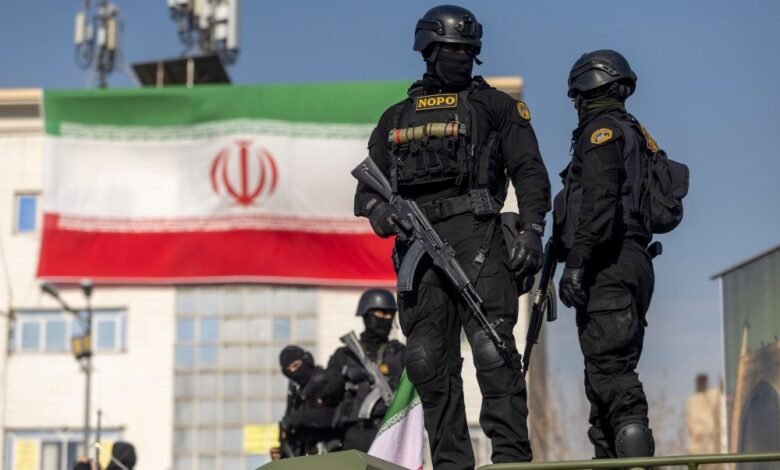
At the most basic level, Russia is embedded in Iran’s internal security architecture through decades of weapons transfers that span the escalation ladder from crowd control to military-grade suppression. Iranian police, Basij, and Islamic Revolutionary Guard Corps (IRGC) units are armed with Kalashnikov-pattern rifles based on Russian designs. This foundation deepened after Russia transferred AK-103 rifles to the IRGC in 2016, followed by Iran’s domestic production of closely related variants. These small arms ensure baseline lethality when protest policing escalates beyond crowd control.
Iran has repeatedly deployed Soviet-designed arms during major crackdowns. The SVD Dragunov designated marksman rifle has been documented in use against protesters, enabling selective, targeted killings at distance. During the November 2019 protests—among the deadliest in the Islamic Republic’s history—security forces employed vehicle-mounted PKM machine guns. Subsequent reporting revealed the deployment of T-72 main battle tanks, which are equipped to employ PKM-derived coaxial machine guns.. Iran maintains substantial inventories of Soviet-era armored platforms adapted for internal security roles, including BTR-60 and BTR-50 armored personnel carriers and BMP-series infantry fighting vehicles.
Over time, these platforms have been modified explicitly for domestic repression. BTR-60s have been fitted with heavier weapons, BTR-50s converted into the Makran infantry fighting vehicle with enhanced armor and remote-controlled 30 mm cannons, and BMP-1s reverse-engineered into the domestically produced Boragh armored personnel carrier. These adaptations reflect a long-standing Iranian effort to repurpose conventional military hardware for internal coercion.
Russia has also provided Iran with rotary-wing assets that enhance rapid deployment and psychological dominance during crackdowns. Under arms deals dating back to the 1990s, Iran acquired at least 25 Mi-17 transport helicopters, which have been used to ferry security forces across the country and conduct low-altitude flights over restive areas. During the November 2019 protests, local reporting described helicopters coordinating security operations as forces encircled demonstrators—used for intimidation and command and control even when not firing directly. More recently, Iran confirmed the acquisition of Mi-28 “Havoc” attack helicopters, designed for counterinsurgency and urban combat. While there is no confirmed evidence of their use against protesters, their procurement signals contingency planning for scenarios in which unrest escalates beyond unarmed protest.
More revealing, however, is how Russia has helped Iran address gaps exposed by recent protest cycles. In March 2023—six months after protests erupted over the death of Mahsa Amini in police custody—a 17-person Iranian delegation spent eight days touring subsidiaries of a major Russian defense conglomerate. The focus was not conventional warfare but internal security: stun guns, flash grenades, breaching charges, and other so-called nonlethal systems designed to incapacitate protesters while managing the political costs of mass fatalities. This was not routine procurement. It was a postcrisis assessment that treated Russia as a repository of expertise in maintaining authoritarian control under sustained pressure.
That assessment has since translated into concrete transfers. In late 2025, Moscow quietly supplied Iran with approximately 40 Spartak MRAPs—mine-resistant armored vehicles designed specifically for Russia’s National Guard and optimized for prolonged urban operations against internal threats. Unlike legacy Soviet-era platforms, the Spartak is a modern, purpose-built system combining heavy ballistic protection, blast resistance, and the ability to mount heavy weapons. Its role is not symbolic crowd control but escalation insurance for regimes anticipating sustained unrest, potential armed resistance, or fractures within their own security forces.
The timing underscores Moscow’s intent. Between December 2025 and January 2026, as protests in Iran intensified, Russian and Belarusian Il-76 transport aircraft conducted repeated flights to Tehran along routes designed to avoid NATO airspace.
If lethal force defines the outer boundary of Iran’s repression strategy, Russia’s most consequential contribution lies in how the regime controls the information environment once unrest reaches national scale. The ongoing internet shutdown, which began on Jan. 8, is unprecedented not because Iran cut connectivity but because it demonstrated a shift from blunt censorship to managed connectivity. Mobile networks and international access were severed, while government platforms, banking services, and approved domestic infrastructure remained online. Society was digitally immobilized, while the state retained command and control. This asymmetric outcome reflects a model Russia has spent years refining at home: repression that disrupts mobilization without weakening the regime’s own capacity to govern.
At the core of this capability is Russian-assisted network control architecture built around deep packet inspection (DPI) and lawful intercept integration. DPI allows Iranian authorities to move beyond blocking websites toward shaping traffic in real time—identifying specific applications, detecting virtual private networks, degrading encrypted messaging services, and selectively throttling platforms used for protest coordination. This mirrors Russia’s approach to internet governance, which treats telecommunication infrastructure as an extension of state security authority. The strategic value is not censorship per se but operational flexibility: the ability to fragment communications geographically, temporally, and socially while preserving economic and administrative continuity. That flexibility is what makes repression sustainable over weeks rather than days.
Russian involvement has also extended into the operational layer that links network control to security services. Russian telecom vendors, including Protei, have supported Iran’s mobile operators in deploying interception, monitoring, and traffic management systems that integrate DPI with Iran’s legal intercept framework. This linkage enables more than passive surveillance. It allows security agencies to identify coordination hubs, track communication patterns, and respond dynamically as protests evolve. In practice, this shifts repression away from reactive mass arrests toward anticipatory disruption—raising uncertainty, slowing mobilization, and eroding trust among organizers. These are precisely the techniques Russian authorities have relied on to suppress dissent without resorting to continuous, large-scale violence.
Electronic warfare fits into this architecture, but its role should not be overstated. Systems such as the Krasukha-4 and Murmansk-BN, originally designed to disrupt military communications and satellite links, can be repurposed to degrade GPS-dependent systems and satellite communications at the margins. Their role in domestic unrest is best understood as complementary, not decisive: increasing friction, reducing reliability, and complicating alternatives rather than “shutting down” connectivity outright. This distinction matters when assessing satellite internet. Starlink has never been a mass solution inside Iran. Terminal availability is limited, possession is criminalized, and usage is geographically uneven. Even without perfect jamming, the state can neutralize much of Starlink’s protest utility through confiscation, intimidation, and selective interference. Starlink is subject to geographic access controls, meaning its service can be disrupted or manipulated through GPS-based electronic warfare—something Russia has extensively employed in Ukraine. The lesson of the current protests is not that Russia enabled Iran to defeat Starlink but that Russia helped Iran build a layered system in which satellite workarounds can never become central to nationwide mobilization in the first place.
Russia’s approach to Iran’s crisis reflects a clear and constrained strategic logic. Moscow will not send troops to patrol Iranian streets or mount a direct military intervention to save the regime. Such a move would be costly, escalate international scrutiny, and risk trapping Russia in an open-ended commitment reminiscent of Syria, an outcome the Kremlin is determined to avoid. Just as importantly, overt intervention would likely weaken Tehran rather than stabilize it, casting the regime as dependent on foreign force and potentially inflaming nationalist sentiment at precisely the moment the state is seeking to project control. Instead, Russia will continue to do what it has proved capable of doing: enabling the regime to save itself. This means discreet but sustained support designed to reinforce the Islamic Republic’s coercive capacity while preserving plausible deniability.
Russia will also work to shield Iran diplomatically. As a permanent member of the U.N. Security Council, Moscow can block or dilute sanctions initiatives, frame the crisis as an internal matter of sovereignty, and amplify narratives of foreign interference to blunt Western criticism. This diplomatic insulation costs Russia little but matters significantly to Tehran by preventing international consensus around punitive measures that could further weaken the regime during a moment of internal strain.
Russia’s room for maneuver, however, would narrow sharply if the crisis were to escalate beyond repression into open confrontation with the United States. U.S. military strikes would fundamentally alter Moscow’s calculus. On the one hand, direct U.S. action would constrain Russia by raising the risks of entanglement and limiting the utility of deniable support channels. On the other, it could also increase Moscow’s incentive to step up assistance short of direct intervention.
In such a scenario, Russia would likely still avoid overt military deployment, but it could intensify support along existing lines. This could include accelerating arms deliveries, expanding intelligence sharing, deepening cyber- and electronic warfare cooperation, and providing more explicit political backing. These steps would reflect not confidence but fear. Paradoxically, the closer Iran moves to regime failure, the more Russia may feel compelled to act, even as its options become riskier and more constrained.
At the same time, Moscow’s capacity to shape outcomes would remain limited. Russia cannot reverse the effects of U.S. military action, repair Iran’s economy, or restore domestic legitimacy through external support alone. Even an intensified Russian effort would be aimed at buying time rather than determining Iran’s political future. What is unfolding is therefore a test of not simply Iranian regime survival but whether authoritarian cooperation can meaningfully slow collapse once internal legitimacy and external pressure converge.
Russia is betting that layered, deniable support can keep Iran’s regime afloat long enough to avoid a catastrophic outcome. It is a calculated wager, shaped as much by Russia’s fear of losing another partner as by its confidence in repression. Whether that bet succeeds remains uncertain. What is clear is that Moscow sees the costs of inaction as rising sharply if the crisis escalates, even as the risks of deeper involvement grow in parallel.
Don’t miss more hot News like this! Click here to discover the latest in Politics news!
2026-01-14 22:15:00