India EU FTA: ‘New Delhi, Brussels have chosen not to retreat amid trade wars,’ says Brahma Chellaney
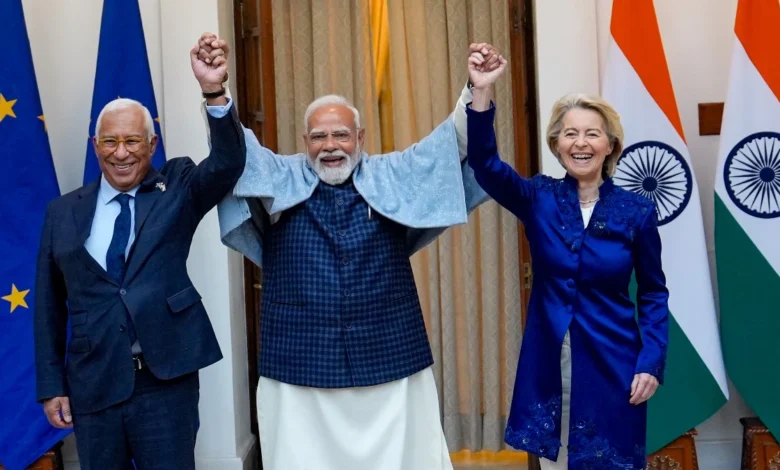
Amid trade wars and coercion by powers, New Delhi and Brussels decided not to back down as they signed the “mother of all deals”, the India-EU Free Trade Agreement (FTA), said geostrategist Brahma Chellaney.
“The bottom line: In an era of trade wars and great power coercion, New Delhi and Brussels have chosen not to back down but to take sides,” Chellaney said. “This agreement elevates the relationship between India and the European Union from a transactional arrangement to a strategic anchor for the global order in the 21st century, centered around a common project of economic resilience, strategic independence and geopolitical balance.”
He added that this is not just a trade deal, but a strategic insurance that positions the EU and India as a democratic counterweight to China’s state-centric trade model while also weakening Trump’s tariffs as a weapon.
Chellaney explained that India is seeking to reduce over-reliance on both the US and China due to “chronic tariff uncertainty.” “For the EU, it secures a permanent foothold in the world’s fastest-growing major economy and strengthens Brussels’ drive to de-risk critical supply chains,” he said, adding that the deal also signals a shift towards deeper maritime cooperation.
Free Trade Agreement between India and the European Union
Tariffs on more than 90 per cent of EU goods exports to India are set to be eliminated or reduced under the broad free trade agreement between India and the EU. The European Union expected to save up to €4 billion in tariffs annually on European products once the changes are implemented.
The key sectors set to benefit from the India-EU FTA include machinery, chemicals and pharmaceuticals, with most of the customs duties amounting to 44% on machinery, 22% on chemicals and 11% on medicines being eliminated. The chemicals sector, in particular, stood out, as tariffs on its chemicals will be eliminated for almost all products.
Other key industries that will see significant tariff reductions are medical equipment and aerospace. Customs duties imposed by European Union countries on optical, medical and surgical equipment will be removed for 90 percent of products, which may affect the prices of imported devices and their availability in hospitals and clinics. Tariffs on aircraft and spacecraft will be eliminated for almost all products.
The agreement also covered the automotive and food sectors. The automobile tariff will gradually come down to 10 per cent, with a quota of 2,50,000 vehicles annually. For consumer goods, tariff reductions will include olive oil, ghee and vegetable oils. Customs duties on beer in the European Union will be reduced to 50 percent, and customs duties will be reduced by about 20 to 30 percent on wine in the European Union.
Regarding services and climate, the EU will get privileged access to India for service providers in the financial and maritime sectors. In addition, the European Union is set to provide support worth €500 million over the next two years to help India reduce greenhouse gas emissions. The European Union expects the deal to double its exports to India by 2032.
Don’t miss more hot News like this! Click here to discover the latest in Business news!
2026-01-27 08:05:00