Is Cambodia’s Scam Industry Too Big to Fail?
Having your personal advisor indicted by the US Department of Justice for orchestrating the largest fraud in history would be job poison for most prime ministers. But this is not the case for Cambodian Hun Manet. Under the protection of his government – and that of his father, Hun Sen, before him – a network of more than 250 fraud factories has taken root across the country.
These industrial-scale frauds, largely staffed by what the United Nations estimates are more than 100,000 trafficked and forced laborers, generate billions of dollars annually. Much of this money is raised through Cambodia’s entrenched patronage politics, supporting a dynastic regime that came to power in 1997 and has not backed down from repressive strongman tactics to maintain what Human Rights Watch has described as a “one-party state.”
One fraud lord exemplifies this relationship more than any other: Chen Zhi.
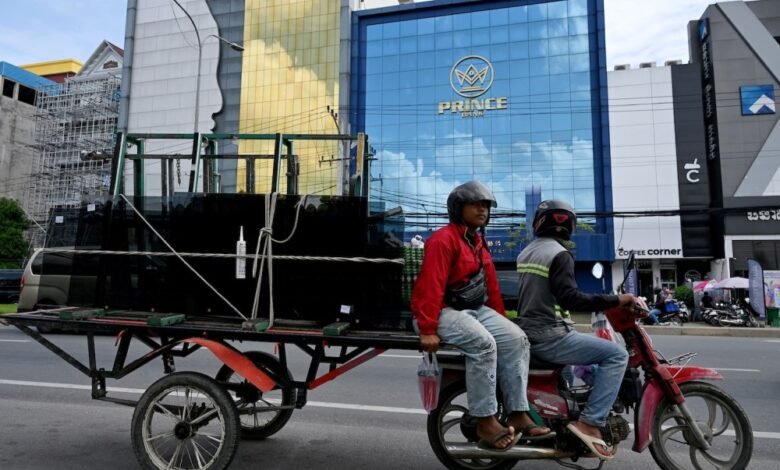
But on October 14, Chen lost his aura. In a coordinated effort, the British and American governments unveiled a sanctions package against Chen’s Prince Group. For the past decade, Chen has been presenting his multi-billion-dollar company as a legitimate, socially conscious venture group, and has been donating millions of dollars each year to the Cambodian government. Prince’s group issued a statement on November 11, denying any involvement in any wrongdoing on its part or on Chen’s part.
Born in China nearly 37 years ago, Chen has risen to heights beyond imagination in the eyes of most Cambodians. He set up a company, according to the indictment, that ran fraudulent complexes with the Minister of the Interior and bought the land for another complex from the daughter of a senior army general. On the political scene, Chen’s role as advisor to current and former prime ministers gave him a rank within the government equivalent to that of a cabinet minister – and he even traveled with former Prime Minister Hun Sen on an official visit to Cuba.
The US Treasury alleged that Prince’s group was merely a front for a “laundry list of transnational crimes”, including operating “cyber fraud operations on an industrial scale” that were “reliant on human trafficking and modern slavery” for employment.
These allegations are consistent not only with my own reporting on the Prince Group in recent years, but also with the contours of the so-called “epidemic” of fraud and forced labor across the region.
Most often practiced A particularly cruel form of romance fraud is eerily known as “pig slaughter,” and organized crime groups have taken root in the region from conflict-plagued Myanmar to the Philippines. They allegedly work in complexes that at first glance appear to be malls, until closer inspection reveals barred windows and security guards preventing trafficked workers from escaping.
At the same moment the US Treasury Department announced its sanctions, federal prosecutors in New York unveiled a 26-page indictment accusing Chen of being the ringleader — overseeing everything from money laundering and bribery of government officials to forced prostitution and torture. A separate court filing revealed that $15 billion in cryptocurrencies were seized from Chen as proceeds of crime.
He may have fallen, but it is not certain that Chen was unconscious. As you read this, analysts are watching billions of dollars in cryptocurrency being shuffled among online wallets linked to the leader of the Prince Group, beyond the reach of Western law enforcement. US sanctions carry power beyond their legal force, which on paper extends only to transactions with Americans or passing through US banks.
However, there are plenty of places that will still handle the money of those targeted by the sanctions — from the money launderers alleged to be Prince’s conglomerate to Hong Kong, which has long insisted that unilateral US sanctions have no legal standing there. Chen certainly has the means to continue the work, albeit on a smaller scale. The real question is to what extent his supporters in the Cambodian government will continue to view him as an asset rather than a liability.
Accused of being the world’s richest criminal—the $15 billion seized by the US Department of Justice alone exceeds the $12.6 billion the United States requested from Mexican drug kingpin El Chapo—Chen’s fate reveals a broader dilemma facing Phnom Penh’s leaders.
Cambodia’s legitimacy as a country is already threadbare, since it dissolved its only significant opposition party and imprisoned its leadership in 2017. The consolidation of power has continued with the premiership passing from father to son six years later. This legitimacy will soon erode if it continues to be known as a haven for modern slavery and cybercriminals. But just as important is the question of whether the ruling Cambodian People’s Party can maintain its grip on power without the illicit revenue streams provided by alleged crime bosses like Chen.
This would not be the first time a politically connected Cambodian has been summoned and accused of being a scam agent. Earlier this year, with renewed border conflict with Thailand, police in Bangkok raided the mansion of Kok An, a Cambodian People’s Party senator, as part of an investigation into his ties to fraud complexes in the western Cambodian city of Poipet. (Although Kok An has not responded publicly to these accusations, the Cambodian government has denied any connection to the fraud.) The South Korean government was complaining louder than ever about smuggling its citizens into, and sometimes killing, Cambodian scam factories. In September 2024, the United States imposed sanctions on another senator, Lee Yong Fat, over his alleged involvement in the industry. (Lee Young Fat denies these allegations.)
However, the indictment against Chen goes further. US authorities say he kept a notebook of bribes given to government officials, which the FBI now claims is in his possession. While prosecutors were clearly careful not to embarrass Cambodian decision-makers by naming names, they made it quite clear that they could do so later.
It doesn’t take much investigating to deduce the identity of the “senior government official” who Chen allegedly bribed in 2020 with a multi-million-dollar watch in exchange for a diplomatic passport. (The curious may find interesting this 2020 article about then-Prime Minister Hun Sen’s new Patek Philippe watch.) The message from US government officials is clear: Do not test their magnanimity.
Cambodia is now being forced to decide between two options, neither of which is without risks. The first is to continue business as usual, let the kickbacks continue to flow, and slowly embrace North Korea-style pariah status. This thinking might be better to be a despised and wealthy dictator in a mafia state than his poor and deposed cousin.
The other option is to dismantle fraud factories. There is hardly a country worth its name today that doesn’t lose billions of dollars a year to scams from gangs like the ones Phnom Penh protects, so this is a major diplomatic win. But it also means shutting down an industry whose revenues — conservatively estimated at $12.5 billion a year — rival sectors such as the apparel industry ($9 billion) that form the backbone of the legitimate economy, which has been struggling more than most other sectors to recover post-Covid-19. There is a real question to be asked about whether Cambodia’s patronage system can continue to deal with fraud.
Throughout his family’s four-decade rule, Hun Sen positioned himself as the sole guarantor of the country’s stability. He rarely shirks credit for ending Cambodia’s civil war in 1998, which he attributes to his “win-win” policy of integrating disbanded Khmer Rouge forces into the regular army and civil service.
But long before the fighters emerged from the rainforest, Hun Sen was hard at work turning Cambodia into a nationwide pyramid scheme, one in which many could enjoy a slice of the kleptocratic pie. Announcing a 2016 investigation into the royal family’s fortunes, accountability NGO Global Witness described it as “[o]“One of the cruelest ironies of Hun Sen’s model of dictatorship” is that “he has made Cambodia’s economy so tight that the people of Phnom Penh are likely to struggle to avoid lining the pockets of their oppressors several times a day.” Transparency International describes the country’s patronage system as operating “vertically and horizontally across government ministries.”
For a long time, it has been Cambodia’s natural resources that have fueled this engine of corruption. In particular, this has happened to the country’s forests, which have shrunk by a third since the start of the 21st century, thanks in large part to the government’s habit of doling them out to loyal cronies — like Try Pheap, which was sanctioned in 2019 for alleged illegal logging, only to have another of his companies sanctioned last September for alleged involvement in forced labor and fraud. (Try Pheap’s logging company has denied allegations that it illegally cut trees.)
Likewise, all kinds of infrastructure were distributed to the highest bidders, with one major businessman buying a concession at the port simply to pass marijuana through. Likewise, the armed forces (one of the world’s largest per capita) are operated on a pay-to-play basis, with commissions auctioned off and entire military units sponsored by business tycoons. Stability is largely ensured by giving everyone with a gun or a checkbook a stake in the corrupt status quo.
However, this dynamic has increased with the emergence of the fraud industry. Whatever the civilian price paid over the past quarter-century of peace, leaving powerful figures – often under the command of armed men – without a chair when the music stops can lead to destabilizing competition among elites.
The legitimate economy has been rocking the boat for a few years now. This year’s conflict with Thailand has led to the repatriation of nearly a million newly unemployed migrant workers. This would be a bad time for what will likely be the country’s largest industry to go out of business.
Cambodia also appears to be desperate for US approval, spending its money on a variety of lobbyists in Washington. And Beijing, the kingdom’s strongest and most powerful ally so far, is quietly beginning to run out of patience as well. Chinese nationals have long been a disproportionate number of scam victims, as well as trafficked operators and pool bosses.
Across the region, governments are tired of being held back when they ask Phnom Penh to free their citizens from scam centers.
If you do Cambodia If it looks to bolster its tattered global standing by turning away from the state’s fraudulent ways, it may find a historical lesson from the narco-state useful.
In July 2000, the Taliban, which was suffering from successive droughts, announced a ban on opium poppy cultivation by Afghan farmers. It was shockingly effective, and a later survey found that yields fell by 94 percent. But despite Washington’s approval, the Taliban committed “economic suicide,” according to historian Alfred W. McCoy. The embargo impoverished another 15% of the already poor population, and the UN found that it encouraged local elites to “rebel against the regime” when US-led coalition forces invaded the country the following year.
The Hun Dynasty is a family of survivors with a track record of doing whatever it takes to hold on to power. For now, the fraud industry – while it may be morally repugnant – seems to be its best bet.
Don’t miss more hot News like this! Click here to discover the latest in Politics news!
2025-12-01 05:01:00