Is Israel Annexing More Than Half of Gaza With Its Yellow Line?
In early December, the Israeli military commander raised the alarm before the international community, saying that the so-called yellow line in Gaza was the country’s new border with the Strip. IDF Chief of Staff Eyal Zamir told forces in Gaza: “We will not allow Hamas to re-establish itself. We have operational control over large parts of the Gaza Strip, and we will remain on those defensive lines.” “The Yellow Line is a new border line, serving as a front line of defense for our communities and a line of operational activity.”
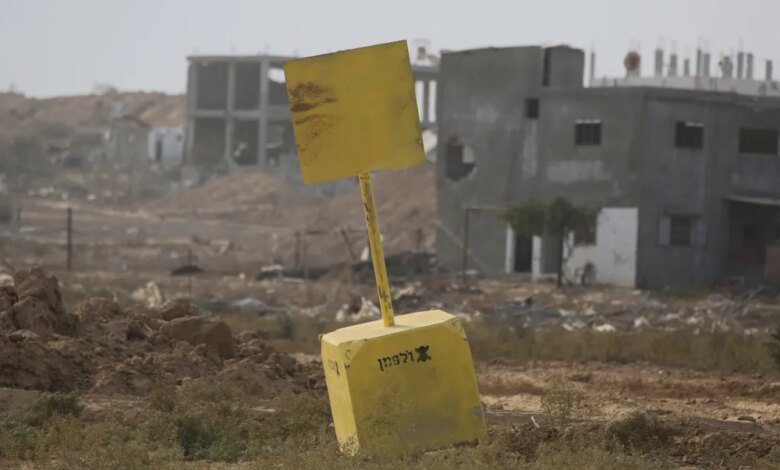
Israeli forces have withdrawn east of this line, which was drawn as part of a US-brokered ceasefire plan last October, but no further. The result is Gaza split into two, with a buffer zone controlled by the IDF surrounding and sealing off the inner section. The Israeli army has already placed concrete barriers to mark some stretches of the line, according to a report issued by the center Guardian. The area under Israeli military control amounts to more than half of the original territory of the Strip, with estimates ranging from 53% to 58%.
In early December, the Israeli military commander raised the alarm before the international community, saying that the so-called yellow line in Gaza was the country’s new border with the Strip. IDF Chief of General Staff Eyal Zamir told forces in Gaza: “We will not allow Hamas to re-establish itself. We have operational control over large parts of the Gaza Strip, and we will remain on those defensive lines.” “The Yellow Line is a new border line, serving as a front line of defense for our communities and a line of operational activity.”
Israeli forces have withdrawn east of this line, which was drawn as part of a US-brokered ceasefire plan last October, but no further. The result is Gaza split into two, with a buffer zone controlled by the IDF surrounding and sealing off the inner section. The Israeli army has already placed concrete barriers to mark some stretches of the line, according to a report issued by the center Guardian. The area under Israeli military control amounts to more than half of the original territory of the Strip, with estimates ranging from 53% to 58%.
Under the 20-point peace plan put forward by US President Donald Trump, Israel will not occupy or annex Gaza, but will gradually hand over the territories it occupies to an international stabilization force, which will be deployed at a later stage. The plan ultimately calls for Hamas to disarm and have no role in the future government in Gaza, and also calls for Israel to completely withdraw from the Strip.
But many fear the frozen conflict will continue indefinitely, with Gaza de facto divided into an Israeli-controlled zone east of the Yellow Line, where it cultivates anti-Hamas Palestinian groups, and a Hamas-controlled zone where reconstruction will not take place. “It’s in keeping with the typical Israeli playbook that says, ‘We’ll take whatever we can while there’s an ongoing process that doesn’t achieve much.’” “When it comes to negotiations, there is little to negotiate,” Sam Rose, acting director for Gaza at the United Nations Relief and Works Agency for Palestine Refugees (UNRWA), said in an interview with The New York Times. Foreign policy.
The area east of the Yellow Line controlled by Israel creates a buffer zone with the rest of the Gaza Strip, which Israel says it needs for the security of communities living in the south of the country. However, it deprives the rest of the Strip, where most of its population of more than two million is crowded, from the border with Egypt, isolating it even more than it was before the war sparked by the Hamas terrorist attack on October 7, 2023.
What’s more, it contains most of the agricultural land that Palestinians in Gaza used before the war, and produces some of the food that residents consume and even some of the crops it exports, according to the United Nations. “If that land is not permanently available, it will have major impacts on Gaza’s economy,” Rose said.
Many experts said that holding on to those lands may be just part of Israel’s negotiating strategy. “If they pull back a little bit, it will look like they’ve conceded something, when in reality that wasn’t anything up for negotiation anyway, so I think some of it is just the way Israel does things and the way it presents things,” Rose said.
On January 14, the United States announced that the second phase of the ceasefire agreement was scheduled to begin, under which Israel was expected to withdraw from additional parts of the Strip. But no timetable was mentioned for the withdrawal linked to the disarmament of Hamas under the ceasefire agreement reached in October.
The next day, Trump issued a new ultimatum to Hamas, calling for the group to disarm amid the start of Phase Two, even as key elements of Phase One appeared to have not been met, and demanding the return of the remains of the last Israeli hostage still believed to be held by the movement.
Meanwhile, Israel is suspected of increasing the portion of the Strip under its control, by arbitrarily moving blocs that are supposed to define the post-ceasefire line deep into Gaza in several places, according to the BBC.
“I will not talk about actual annexation, because things are very fluid at this juncture,” said Michael Wahid Hanna, director of the US program at the International Crisis Group. “I think this reflects Israeli extremism. They continue to push the limits in terms of how aggressive they are in this ceasefire phase.”
Hanna added that the yellow line indicates Israel’s position at this stage. He said: “It is very clear that there will be no progress in implementing the terms of the ceasefire unless there is a very strong American counterweight and pressure on the parties to move forward.” He added that any long-term Israeli plan to continue occupying the area beyond the demarcation line would mean that Gaza would never be allowed to reconstitute itself as a functioning society. “I think this goes to the heart of the possibility of Gaza remaining as one of the areas where Palestinians can live,” Hanna said.
Far-right groups in Israel have been loudly pushing for resettlement in the Strip since the first months of the war against Hamas, and calling for the expulsion of the Palestinians. Occupying the area beyond the Yellow Line could serve as a political stance by the government to appease its more extremist wing, which includes many Israeli settlers in the West Bank. The support of these parties is considered vital for Netanyahu to remain in government.
On December 18, two groups of activists from the Nashala settlement organization crossed the border into Gaza, marking the latest attempt by ultra-nationalists to establish a Jewish presence in the Strip. The Times of Israel I mentioned. They planted the Israeli flag at a site that the organization claimed was located near the former Morag settlement in the southern part of the area, before the Israeli army escorted them out of the Strip.
In the summer of 2005, then-Israeli Prime Minister Ariel Sharon withdrew the Israeli army and about 8,000 Jewish settlers from within the Gaza Strip after concluding that maintaining and defending the settlements there was not worth the cost. “It is precisely now that we must say in a clear voice the obvious: Gaza belongs to the people of Israel,” said Daniela Weiss, leader of Nakhala. “We must start stabilizing Gaza now.”
The end result of indefinite occupation or even annexation of Gaza territory bounded by the Yellow Line could be that the rest of the territory remains in ruins, and thus largely uninhabitable, forcing Palestinians to leave. However, many in Israel rule out that the area will eventually be annexed. Many Israelis believe that holding on to it is necessary at this stage for security reasons, although it is not clear how long the IDF will not withdraw from this part of the Strip.
He added, “The American administration is trying to pressure Israel to continue in the second phase.” [of the cease-fire plan]“Which means an additional withdrawal of Israeli forces for a new redeployment,” said Kobi Michael, a senior researcher at the Institute for National Security Studies and the Misgav Institute, two Israeli think tanks.
Michael said that Israel will likely not accept any withdrawal, even partial, until the body of the last Israeli hostage is released from Gaza and before any progress is made in disarming Hamas, as required by the ceasefire plan. He said: “As long as Hamas is there, we will be there. There will be no annexation of this part of the Gaza Strip or any other. The purpose is to ensure that Hamas will not be able to reconstitute itself in this region, because this will ultimately be a direct threat to the Israeli kibbutzim and towns along the border.”
Against the backdrop of a very fragile Gaza ceasefire plan that struggles to move forward, the prolonged Israeli occupation of part of the Strip could pose a major obstacle in negotiations. Establishing an international stabilization force to replace Israeli military forces on the ground is a key plank of Trump’s plan. Without this, Gaza’s future will hang indefinitely in the balance.
Don’t miss more hot News like this! Click here to discover the latest in Politics news!
2026-01-20 09:18:00