‘I’ve tried to be very human’
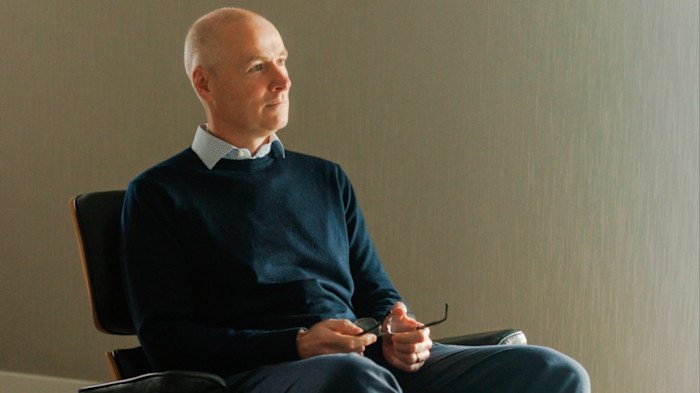
Tim Campbell remembers a somber meeting more than two decades ago that helped shape his mindset as a business leader.
The chief executive of Edinburgh-based fund manager Baillie Gifford remembers having lunch in the early 2000s with the CFO of an Argentine bank that was “basically bankrupt,” he says. One stark memory that remains etched in Campbell’s mind is “the damage done to him.”
“When he couldn’t even return his depositors’ money, it was very formative for me and made me very aware that extreme things happen,” Campbell says. “Most financial crises are born from a breakdown in models, so I think the human element in investing and what we do remains absolutely vital.”
It hints at one of the biggest challenges facing active fund management — the inexorable rise of passive investing, which follows the market rather than relying on stock pickers.
For more than 100 years, Baillie Gifford, founded in 1908 and one of Britain’s largest fund managers, has focused on investing for the long-term benefit of its clients. Its equity fund managers focus on selecting so-called growth stocks that are expected to rise more than the broader market.
But she was under pressure. Assets under management fell from a peak of £336bn in 2021 to around £210bn last year, as growth stocks fell out of favour, weighing on the value of company investments, and as more investors turned passive.
Campbell is now leading a restructuring exercise aimed at entering new areas – particularly “active” exchange-traded funds. This allows fund managers to try to beat the market but in a product that is cheaper to operate and easier for investors to trade than mutual funds. “In the US, people are moving away from mutual funds to ETFs,” he says. “We need to respond to that.”
It also refocuses Baillie Gifford on growth areas such as private markets and wealth management.
Jason Hollands, of wealth manager Evelyn Partners, says that because Baillie Gifford is “unashamedly focused on active fund management”, it is “struggling during a period when market leadership was narrowly concentrated and passives were capturing a large slice of flows”.
“Recent years have been more difficult for many Baillie Gifford funds in terms of relative performance,” he adds.
Campbell was voted into the top job in April last year by the firm’s 59 partners. He replaces Andrew Telfer, who has worked at the company for more than three decades. Like Telfer, and many of Baillie Gifford’s partners, Campbell has been with the firm for decades — he joined in 1999.
Baillie Gifford has faced challenges beyond turning to passive investing. In 2024, a lobby group urged authors to boycott literary events it sponsors because of the asset manager’s investments in companies with links to Israel and the fossil fuel industry. Campbell, who was not CEO at the time, says she withdrew funding because the protests were a “huge distraction for the administration.”
The £15bn Scottish Mortgage Fund, known for backing fast-growing technology stocks including Elon Musk’s Tesla and SpaceX, came under scrutiny over its holdings of private assets when board member Amar Bhide, who has since departed, raised the alarm over the fund’s ability to monitor such illiquid investments, among other issues.
A few of the company’s investment funds were also subjected to a campaign by activist hedge fund Saba Capital, which criticized the performance of these funds.
Baillie Gifford cut nearly 50 jobs last year to help keep costs under control and as part of a broader refocus.
“There are some things when you look at our organization now compared to five years ago…we need less of it and there are some things we need more of,” Campbell says. “It is unfortunate that we have made some layoffs, those roles are no longer needed in the world we live in and we will continue to evolve with whatever our customers need.” The company tries to put people in different roles.
Campbell acknowledges that leadership style is crucial during this type of restructuring. “I tried to be very humane,” he says, noting that “everyone has a life outside of work…[and I]Try to get to know people,” he adds. “Especially when you’re going through periods of change, it’s very important to communicate that clearly with others.”
He came up with the idea of creating a five-minute video to summarize management committee meetings for colleagues. “[People] Do you want to know why they come to work and what the organization stands for, what it believes in and what it does?
After studying history and political science at university, Campbell spent a short period as a music teacher in the Middle East, before returning to Edinburgh in search of work. Two of his friends were in asset management and recommended he join the industry.
“I chose Baillie Gifford, I joined them in 1999 a few months before the tech bubble burst, which was a huge build-up.” He is now one of three managing partners overseeing the management of the company, but with overall leadership responsibilities.
After decades of attracting pension fund clients to manage money on their behalf, from the UK and US to Australia and Hong Kong, the asset manager is seeking to attract a broader mix of clients, including more wealth managers, family offices and global financial institutions.
The accumulation of pension funds in cheaper passive funds has made it difficult to win mandates to run “active” strategies – Baillie Gifford’s bread and butter.
As part of this transformation, the fund group opened an office in Singapore in 2024 to capitalize on the country’s “large private wealth client base” and opportunities across Asia. It has 11 offices, including Hong Kong, Shanghai, Zurich, Frankfurt, Amsterdam, New York, Toronto, Dublin, Edinburgh and London.
“I look at our industry now and more than 50 percent of assets are owned by passive people,” Campbell says. “It’s strange to think [active management has] It becomes a minority endeavor. I think this provides great opportunities for us.
“But I fully realize that this means that if we want to have a thriving business in 10, 15 or 20 years, we need to be exceptional” and “continue to invest heavily” in investment research.
“A large presence in private companies is now very important,” Campbell insists, especially as some fast-growing companies choose to stay private longer. It has about $10 billion invested in private markets, including holdings in TikTok owner ByteDance and payments company Stripe.
But Campbell acknowledges the risks involved in backing private companies, whose values are more uncertain than listed shares and are often harder to sell. “It’s very important that people have a rigorous process on how they do this [they] “The value of private companies,” he says.
As Campbell prepares to oversee Baillie Gifford through its strategic transformation, he is focusing on his leadership style based on what he has learned over the years.
“There were one or two examples of how not to lead that were very formative,” he recalls. “I think it’s one of the things I tried really hard [to achieve]Perhaps in response to these [is] Consistency: Show up every day; Be friendly, accessible, honest, and transparent about what [you’re] a job.”
He admits that the financial industry is “not universally loved”, but says: “If we do our job well, it improves people’s quality of life, and is good for society, the economy and business in general; I want people to feel proud of what they do. . . .”[and]I realize how privileged it is to take care of people’s money.
A day in the life
With our younger twin daughters in college, my wife and I are adjusting to the lack of morning chaos. She’s a GP, so we both got up early for work. I try to go for a run three times a week before heading to the office in central Edinburgh.
There is no typical day. This is usually a combination of talking with customers, driving progress on strategic priorities and checking in with partners, employees and external offices to make sure everyone has what they need.
When I’m in Edinburgh, I eat lunch at the shared table in our staff canteen. I spend about a quarter of my time meeting with clients and prospects, which gives me the opportunity to network with different colleagues. I devote any free time to reading – our investment research or exploring how industries and client needs are evolving.
Dinner is followed by a walk with my wife to debrief the day. If I had any energy left, I’d sit down at the piano and revisit my first career as a music teacher, wrestling with Rachmaninoff’s “Prelude in C-sharp minor.” And for now, Rachmaninoff wins.
2026-01-26 05:00:00