Microsoft’s Bold AI Bet with OpenAI
Microsoft Bold AI Bet with OpenAI
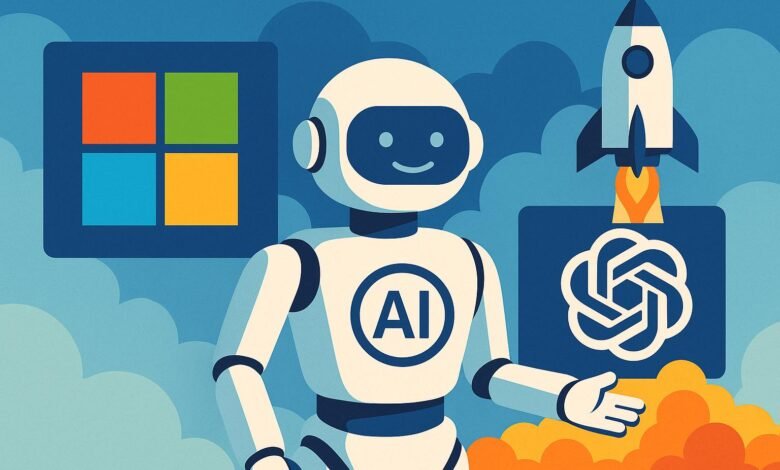
Microsoft Bold AI Bet with OpenAI is redefining the competitive landscape of enterprise technology. As companies around the world accelerate their digital transformation, Microsoft has made a calculated decision to include AI at the foundation of its future strategy. Led by CEO Satya Nadella, the company’s integration of OpenAI models into Azure, Microsoft 365, GitHub, and Power Platform reflects not just an ambition, but the widespread deployment of AI in real-world workflows. With rival tech companies like Google, Amazon, and Meta charting their own AI paths, Microsoft is positioning itself as an enterprise leader through innovation, versatile tools like Copilot, and its unique integration with cloud AI.
Key takeaways
- Microsoft is investing heavily in responsible AI through strategic integration with OpenAI and Azure cloud infrastructure.
- Copilot tools across GitHub, Microsoft 365, and Power Platform increase productivity and reshape developer and enterprise workflows.
- Satya Nadella’s vision for AI emphasizes accessibility, security, and widespread deployment across Microsoft’s technology stack.
- Microsoft differentiates itself from Google, Amazon, and Meta by getting AI faster through real use cases and reaching enterprises.
Read also: Nvidia’s bold investment in robotics and artificial intelligence
Microsoft’s AI strategy: Designed for scale and trust
Microsoft’s shift into AI is based on its deep partnership with OpenAI, which created models like GPT-4, DALL·E, and Codex. Unlike other tech giants who build their own AI models in-house, Microsoft has chosen a partnership model. This approach combines OpenAI’s leading search capabilities with Microsoft’s powerful cloud infrastructure.
Through the Azure OpenAI service, Microsoft enables enterprise customers to access large language models (LLMs) via secure and scalable APIs. According to Satya Nadella during Build 2023, the service is powering a new wave of intelligent apps, offering everything from summarization to code generation and chatbot capabilities. The service is now used by more than 11,000 customers globally, including major companies in finance, healthcare and manufacturing.
A focus on responsible AI is key. Microsoft’s Responsible AI Standard, updated in 2022, guides product development with principles such as fairness, reliability, privacy, and transparency. Nadella emphasizes that trust is the foundation for gaining long-term adoption in enterprise environments.
Read also: Unlock Microsoft Copilot: Your AI Guide
A copilot is not a single tool. It is an AI-powered assistant framework that is applied across multiple domains. Here’s how to design each variation for unique use cases:
- Github helper: Designed in collaboration with OpenAI and launched in 2021, this tool helps developers by automatically generating code using context-aware AI. It is now used by over 1.5 million developers and is integrated into Visual Studio. GitHub data shows that Copilot cuts programming time by up to 55 percent for repetitive tasks.
- Microsoft 365 Copilot: Used in Word, Excel, Outlook, and Teams, this tool improves productivity by turning natural language queries into draft documents, data visualizations, or meeting summaries. So far, Microsoft has reported usage among Fortune 500 companies in the legal, financial, and consulting industries during the early access rollout.
- Co-pilot on the power platform: Enables non-technical users to create automations, Power Apps, and dashboards using conversational prompts, reducing reliance on IT overhead and accelerating solution delivery.
These tools demonstrate Microsoft’s goal of democratizing AI, making it accessible across business roles (not just developers or data scientists).
Azure OpenAI Service: The backbone of enterprise AI adoption
Azure OpenAI plays an essential role in Microsoft’s AI offerings. This fully managed service provides organizations with access to GPT models through Microsoft’s secure Azure infrastructure. Unlike OpenAI’s public APIs, Microsoft offers important features for business adoption: built-in compliance, customer data privacy, and integration with enterprise identity platforms.
Organizations are already using Azure OpenAI across industries:
- KPMG: Leverage Copilot and Azure OpenAI to redefine client consulting and reporting deliverables.
- PricewaterhouseCoopers: Trained 65,000 employees on AI-powered audits through Copilot integrations.
- Carmax: Uses natural language forms hosted on Azure for customer reviews and support case summaries.
These applications highlight the growing confidence in Microsoft’s AI infrastructure. Organizations get predictable performance at scale, along with coordinated AI model governance.
Read also: OpenAI’s bold move towards AI chips
Comparative Breakdown: Microsoft vs Big Tech in AI
Microsoft’s speed of execution and corporate focus sets it apart from competitors. The chart below shows how Microsoft’s AI assets compare to Google, Amazon, and Meta across key categories:
| feature | Microsoft (OpenAI, Copilot, Azure) | Google (Gemini, Workspace AI) | Amazon (Bedrock, Code Whisperer) | Meta (llama, search tools) |
|---|---|---|---|---|
| Enterprise publishing | Extensive and integrated across M365, Dynamics, and Azure | Gmail, Docs, and APIs are in the early stage | Available on AWS with a focus on startup adoption | Research-focused models with limited institutional use |
| Pricing transparency | It’s scaled across Azure, and has deep discounts for businesses | Unknown to many integrations | Pay as you go on AWS Bedrock | There is no commercial pricing yet |
| Developer ecosystem | GitHub integration and Power Platform support | Limited integrations with development tools | CodeWhisperer, Amazon Q for developers | Open models, but with minimal dev UX wrapper |
| Responsible AI Framework | Published policies and tools integrated across Azure | Broad principles, but less integration within the product | Strong, compliance-focused AWS enterprise controls | Most of them are academic, under development |
Microsoft’s AI suite provides end-to-end services from prototype to deployment, all embedded in the environments businesses already use. Its partnerships, especially with OpenAI, allow faster time to value assessment for companies that need AI tools ready to adopt.
Impact on developers and the future of work
GitHub Copilot is reshaping how developers write code. According to GitHub’s Copilot product team, developers who use the tool are 55 percent more productive on repetitive code tasks and see a 27 percent reduction in cognitive load. AI Assistant significantly reduces onboarding time for new engineers and improves documentation compliance.
For business users, Microsoft 365 Copilot enables knowledge workers to automate repetitive tasks, analyze data without formulas, and prepare documents from contextually relevant assets stored in SharePoint or OneDrive.
Satya Nadella portrays this shift as “AI being the first assistant, not the autopilot.” This philosophy ensures users stay in control while AI improves speed, quality, and decision-making.
Also Read: AI predicts NFL Week 15 betting picks
Conclusion: a strategic bet built on infrastructure, not hype
Microsoft’s AI strategy reveals a distinct philosophy: partner intelligently, build responsibly, and deploy at scale. Its alliance with OpenAI complements Microsoft’s cloud, developer, and productivity offerings. Tools like Copilot, powered by Azure OpenAI, are positioned not as experimental features, but rather as core productivity tools that transform an organization’s daily workflow.
With adoption accelerating across industries and clear differentiation from competitors, Microsoft is implementing one of the most actionable AI roadmaps in the technology sector. If current indications hold, this AI bet would not only be bold, it could be fundamental.
References
Brynjolfsson, Erik, and Andrew McAfee. The Second Machine Age: Work, Progress, and Prosperity in a Time of Great Technologies. W. W. Norton & Company, 2016.
Marcus, Gary, and Ernest Davis. Rebooting AI: Building AI we can trust. Vintage, 2019.
Russell, Stuart. Human consensus: Artificial intelligence and the problem of control. Viking, 2019.
Webb, Amy. The Big Nine: How Tech Giants and Their Thinking Machines Could Distort Humanity. Public Affairs, 2019.
Crevier, Daniel. Artificial Intelligence: The Troubled History of the Search for Artificial Intelligence. Basic Books, 1993.
Don’t miss more hot News like this! Click here to discover the latest in AI news!
2025-05-16 17:53:00