Real-Time AI Agents Reshape Industries
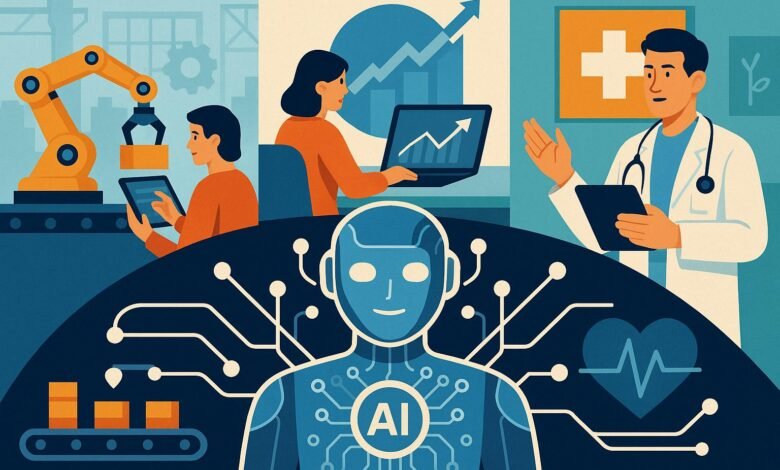
Real-time AI agents are reshaping industries
Real-time AI agents are reshaping industries by changing the way businesses operate, make decisions and serve customers across sectors such as healthcare, logistics and e-commerce. With the rapid advancement of AI capabilities, more companies are adopting these intelligent agents to automate repetitive tasks, manage complexity at scale, and enhance efficiency. This article explores real-world use cases, market growth data, and implementation paths for organizations of different sizes. It also offers a grounded perspective on both ongoing advantages and limitations.
Key takeaways
- Real-time AI agents enable faster, autonomous decision-making in industries such as logistics, healthcare, and retail.
- Startups and small businesses are leveraging AI-as-a-service platforms and tools such as GPT-4, AutoGPT, and Azure OpenAI.
- Enterprise examples, such as deployments by Shopify and Amazon, show how AI is expanding into operational environments.
- Challenges around trust, interpretability and ethics highlight the continuing need for human oversight and governance protocols.
What are real-time AI agents?
Real-time AI agents are autonomous software systems that receive inputs, process data, make decisions, and take actions with little to no human intervention, all within moments. These agents use large language models, machine learning algorithms, decision trees, and reinforcement learning. It outperforms traditional bots by adapting to real-time information and supporting responsive workflows. Real-time agents work either independently or in human partnerships.
These agents are often pivotal to AI-driven automation, supporting digital transformation across many domains. Examples include customer service chatbots, AI-driven logistics coordinators, and real-time health diagnostic tools. Leaders can gain insights from the future of AI tools to better understand agent deployment.
Industry applications and real-world case studies
health care
In healthcare, real-time AI agents help with diagnosis, patient triage, and system efficiency. For example, Curai Health is improving telemedicine by quickly analyzing symptoms and recommending care plans. According to McKinsey’s 2024 findings, AI-based diagnostics reduce time to diagnosis by up to 40% while reducing physician burnout.
Logistics
Amazon is incorporating real-time AI to route delivery and fulfillment. Its agents use live data including fleet location, weather and inventory availability. A 2023 Boston Consulting Group study estimates that AI-enhanced logistics could lead to 25 percent faster delivery along with an 18 percent reduction in distribution costs.
Retail and e-commerce
Shopify’s Sidekick Assistant shows how real-time AI agents act as real-time strategists. By monitoring consumer trends and historical sales, Sidekick recommends promotional tactics and manages inventory coordination. This example indicates that small business owners now have access to tools that were previously limited to enterprises. Those interested in emerging applications can explore how AI agents will evolve by 2025.
Customer service
AI-based support agents now handle routine interactions with customers. These systems respond to inquiries, manage tickets, and determine when an issue is escalated. Zendesk’s 2023 Customer Experience Trends Report found that companies using real-time AI achieved a 29 percent faster average response time and 21 percent higher satisfaction rates.
AI integration is becoming easier for startups and SMEs
Large companies led early adoption, but the technology quickly became more accessible. AI platforms like GPT-4 and AutoGPT are now available through services like Azure OpenAI. These options allow small organizations to implement intelligent tools without a large budget.
Several automation platforms simplify the AI agent deployment process:
- Zapier: Enable code-free communications between applications using automation triggers.
- LangChain: Offers tools to sequence AI claims for a multi-step workflow.
- Replit: Provides browser-based tools for organizing and deploying agents with live collaboration options.
These tools reduce the technical barrier and provide space for custom solutions. For entrepreneurs curious about what’s next, a guide to how AI agents have evolved may be a useful resource.
Market growth and adoption trends
Growth is strong across the AI agents market. According to Boston Consulting Group’s Future of Operations 2024 report, 62 percent of companies intend to increase investment in AI agents in the next 12 months. The global market for these systems is expected to exceed $100 billion by 2027, growing at a CAGR of more than 35% from 2022 onwards.
Key contributing factors include:
- The need for around the clock service and immediate response.
- Advances in multimodal artificial intelligence (text, audio and visual interpretation).
- Progress in model explanation and regulatory alignment.
- Reduced infrastructure and AI modeling costs.
What real-time AI can (and can’t) do today
Real-time AI works reliably in highly structured, data-rich settings. However, there are still limitations in tasks that require abstract thinking, cultural insight, or emotional nuance. Comparing capabilities can help guide responsible deployment.
| Tasks that AI agents can handle in real time | Tasks that require human supervision |
|---|---|
| Dynamic route planning in logistics | Medical diagnosis of rare cases |
| Sort your customer support ticket | Intercultural negotiation or conflict resolution |
| Email categorization and response formulation | Make strategic business decisions with unclear data |
| Inventory restocking is triggered based on demand | Hiring decisions and interview judgments |
Challenges: Ethical considerations and agent reliability
Performance does not equal perfection. Issues such as lack of interpretability, biased stereotypical behavior, and risk of failure must be acknowledged. Ethical AI governance requires constant monitoring and responsible deployment practices.
- Explainability: Many models provide limited transparency regarding how decisions are formed.
- prejudice: Training data can introduce hidden bias, creating unethical results.
- Risk of “open failure”.: Agents may continue to operate incorrectly after failure without guarantees.
- protection: Compromised clients can act maliciously while appearing legitimate.
Efforts to mitigate these risks must include human-in-the-loop systems, strong oversight, and clear design principles. Some sectors, such as decentralized finance, have begun to thoughtfully apply AI. Learn more about how AI agents are reshaping DeFi environments.
Frequently asked questions
What are real-time AI agents?
Real-time AI agents are autonomous systems that interpret and process live data inputs and initiate real-time actions without manual instructions. Their application extends to logistics, telehealth, marketing, and customer support.
How are AI agents used in customer service?
Customer service AI handles basic queries, escalates complex issues to human staff, and learns from past interactions to improve over time. These capabilities improve responsiveness while reducing human workload.
Which industries benefit most from AI automation?
Sectors with workflow redundancy and abundant live data are most suitable. Examples include retail, e-commerce, transportation, healthcare, finance, and customer service.
Can AI agents work without human supervision?
They can work independently in structured environments with predictable outcomes. For high-risk or ambiguous tasks, human input remains essential. Most deployments include backup procedures or monitoring loops.
The way forward: strategic integration without the hype
The future of AI in business is about augmentation, not complete automation. Leaders should prioritize use cases with clear returns, ensure technical integrity, and promote transparency. As evidenced by recent developments in industries such as nonprofit fundraising.
Don’t miss more hot News like this! Click here to discover the latest in AI news!
2026-01-22 14:37:00