Russia’s Military Procurement Is a Warning for Europe
Even as its invasion of Ukraine continues, Russian forces are increasingly testing European defenses with drones, manned aircraft, and warships. These are not just mistakes or simple reconnaissance operations, but rather an attempt to normalize the intrusion. Behind each probe sits a retooled and increasingly efficient military-industrial machine: shipyards producing ice-capable submarines, missile factories working triple shifts to store long-range offensive weapons, and explosives factories expanding to a strategic scale.
A closer look at Moscow’s military procurement decisions highlights why Europe is prepared for a campaign of sustained Russian pressure that extends beyond Ukraine’s borders. In Russia’s naval and missile sectors, which are most important for the European theater, there are three worrying trends: rapid growth in production facilities, clear prioritization of strategic platforms, and investments aimed at long-term operational endurance rather than short-term wartime troop surges.
Even as its invasion of Ukraine continues, Russian forces are increasingly testing European defenses with drones, manned aircraft, and warships. These are not just mistakes or simple reconnaissance operations, but rather an attempt to normalize the intrusion. Behind each probe sits a retooled and increasingly efficient military-industrial machine: shipyards producing ice-capable submarines, missile factories working triple shifts to store long-range offensive weapons, and explosives factories expanding to a strategic scale.
A closer look at Moscow’s military procurement decisions highlights why Europe is prepared for a campaign of sustained Russian pressure that extends beyond Ukraine’s borders. In Russia’s naval and missile sectors, which are most important for the European theater, there are three worrying trends: rapid growth in production facilities, clear prioritization of strategic platforms, and investments aimed at long-term operational endurance rather than short-term wartime troop surges.
Unless NATO shifts from reactive responses to a credible, forward-leaning form of deterrence—coercive redlines, offensive range, and continued support for Ukraine’s drone innovation—Moscow will continue to dictate the terms of confrontation long beyond the current phase of its war against Kiev.
The Russian Black Sea Fleet was severely damaged by Ukrainian naval drones and long-range strikes. Moreover, it cannot easily recoup those losses, thanks to the choke point in the Bosphorus Strait. NATO ally Turkey has closed the straits to warring warships since 2022 under the terms of the Montreux Convention — a situation that is certain to continue until the end of the war.
If Russia were indeed focused exclusively on Ukraine, one might expect to see it deprioritize naval shipbuilding and focus on ground systems and aircraft production instead. But instead, despite sanctions and chronic incompetence, Russian shipyards have turned decisively toward platforms that directly threaten Europe. Ice-capable fleets, nuclear service ships, and diesel-electric submarines now dominate the order books. These platforms are designed to carry cruise missiles and electronic warfare systems to NATO’s most vulnerable sea lanes. They are also, crucially, not systems designed to compete with the US Navy in the open ocean, but closer to home – primarily in the waters around northern Europe.
In 2023, the Baltic Shipyard, a key site for the Russian maritime industry in St. Petersburg, incurred an estimated loss of $264 million. However, in just one year, that turned into a profit of $41 million. The shipyard received a wave of government naval contracts. These orders include nuclear maintenance ships dedicated to operations in the Arctic, where NATO hosts exercises and some of Europe’s major submarine cables converge.
Steel consumption has jumped by 98% in the Baltic Sea basin in one year, and by 93% in the Vyborg shipyard since 2022, showing the extent to which Moscow will support the maritime recovery. In parallel, St. Petersburg authorities and the United Shipbuilding Company (operating under the majority state-owned VT Bank) have put forward a plan to merge the city’s five shipyards into a single group, allocating $2.6 billion for modernization. The goal is simple: to make the Russian maritime industry faster, more difficult to disrupt, and more capable of mobilization on a large scale.
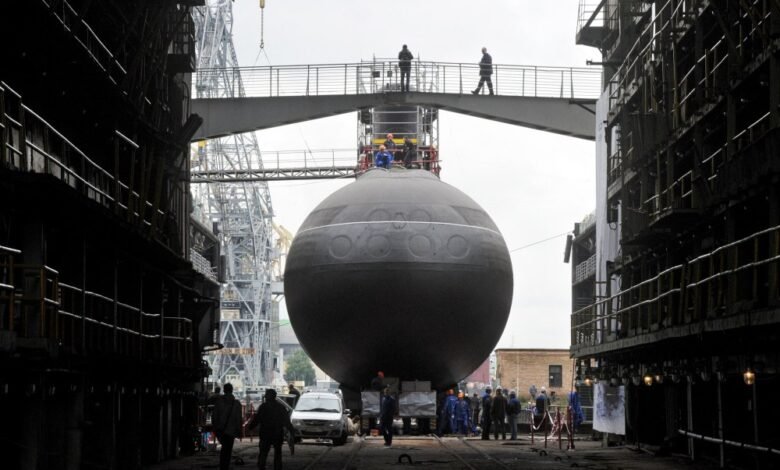
The output is already visible. Admiralty Shipyards has continued serial production of non-nuclear submarines, including Project 636.3 Yakutsk, launched for the Pacific Fleet in October 2024, and the Lada-class (Project 677) Kronstadt, which entered service in early 2024 after redesign. These relatively small, conventionally powered submarines are much less capable than their larger, nuclear-powered counterparts in the open ocean. However, they are formidable in the restricted waters of the North, Baltic or Mediterranean Sea.
Russia’s focus on equipping its small fighters – both submarines and surface ships – with long-range cruise missiles exacerbates existing air defense gaps in Europe. It gives Russian leaders the ability to threaten long-range lethal strikes into the heart of Europe from multiple angles, a tactic honed over years of multi-vector attacks on Ukrainian cities and critical civilian infrastructure.
Russian missile production has also increased since 2023. This indicates more than just an effort to replenish the invading forces and carry out terrorist operations against Ukraine. According to Ukrainian intelligence, Russia produces between 115 and 130 long-range systems per month. This is a pace that, if it continues, will build stockpiles that far exceed immediate wartime needs.
The Kalibr cruise missiles, Kh-101/102 air-launched weapons, and Iskander ballistic missiles launched from these production lines could put European capitals and NATO bases at risk. Given that Russian forces have tended to use a relatively small number of cruise and ballistic missiles in their regular strikes against Ukraine, preferring huge numbers of cheap Shahed-type drones instead, this rate strongly suggests their stockpiling for current post-war operations.
This is confirmed by the modernization of equipment and increased employment at the Fotinex Machine Building Plant, which produces Iskander missiles and other components of intercontinental ballistic missiles. Media investigations document thousands of new machines and thousands of additional workers brought in since 2022, with open hiring continuing through 2025.
Meanwhile, Russia is building a new facility at the Biysk Oleum plant to produce up to 6,000 metric tons of high explosives annually. Munitions manufacturer Sverdlova Plant has received billions in government investment to boost production of TNT, which is crucial for missile warheads. MKB Novator, part of Almaz-Antey, switched to 24/7 production of Kalibr and Iskander missiles early in the war. The Krasnoyarsk Machine-Building Plant is ramping up serial production of the RS-28 Sarmat heavy intercontinental ballistic missile, with infrastructure repairs reported in 2024.
These weapons will enable Moscow to increase pressure on NATO. The Russian Navy operates ships armed with Kalibr missiles within close range of European capitals in both the Baltic Sea and the Mediterranean. Russian long-range strategic bombers – many of which have been converted to carry the long-range cruise missiles described above – conduct periodic flights over and near the Barents and Norwegian Seas. These flights treat NATO approaches in the north as training areas, normalizing Russia’s military presence in the region in the same way as naval patrols.
Russian bombers and munitions are also increasingly deployed forward – such as at the newly renovated Severomorsk-2 airfield on the Kola Peninsula – to enable deep strikes against European targets, rather than hindering them in a preventive and reactive mode.
Expansions of Russian industrial capacity reveal a strategy designed to make pressure on Europe cheap and make continued confrontation practically possible. Moreover, it creates the ability to keep targets across the continent vulnerable from multiple angles simultaneously, exacerbating European defense strategic dilemmas.
Across the maritime and missile domains, Moscow is testing NATO unity and pushing the limits of the alliance’s response. Limited responses such as stampedes, airspace closures, and declarations without consequences encourage wider replication. Instead, NATO and the European Union should define and enforce red lines, link air defense with credible strike options, and preserve Ukraine’s creative edge.
Red lines should become operational rules, not press statements. NATO should publicly define automatic responses to intrusions: virtually intercept drones, deny naval assets access to certain areas, and impose targeted sanctions on enablers within 48 hours. Violations should result in automatic, predictable costs. The coalition has begun to indicate that its position is changing, which is a step in the right direction, but it is only a first step.
Deterrence also requires the pairing of defense and offensive range. A “drone wall” of sensors, electronic warfare systems, and point defenses is necessary but insufficient, as is better integrated air and missile defense across the continent. Effective deterrence requires the ability to respond. European capitals must publicly discuss options for long-range strikes – whether in the form of cruise missiles, armed drones, or cyber capabilities – that increase the cost of subversion and penetration. A credible attack changes Moscow’s calculations.
Finally, Europe should support drone innovation in Ukraine, which now serves as an advanced defense laboratory. Ukraine’s drone ecosystem, characterized by mass production, rapid adaptation, and battlefield testing, is developing capabilities that Europe will need. Funding this innovation is not charity; It ensures that when pressure shifts to NATO territory, Europe has the tools and tactics ready.
Russia has used its naval and missile reinforcements in its invasion of Ukraine, but the danger extends further. It is already shaping Europe’s security environment. Russian industrial investments are building a set of coercive tools that clearly target European territory. If Europe continues to avoid clarifying its red lines, Moscow will continue to write the script.
Don’t miss more hot News like this! Click here to discover the latest in Politics news!
2026-01-07 15:28:00