Tesla Appears to Have Moved Its Robotaxi Safety Monitors to a More Sneaky Location
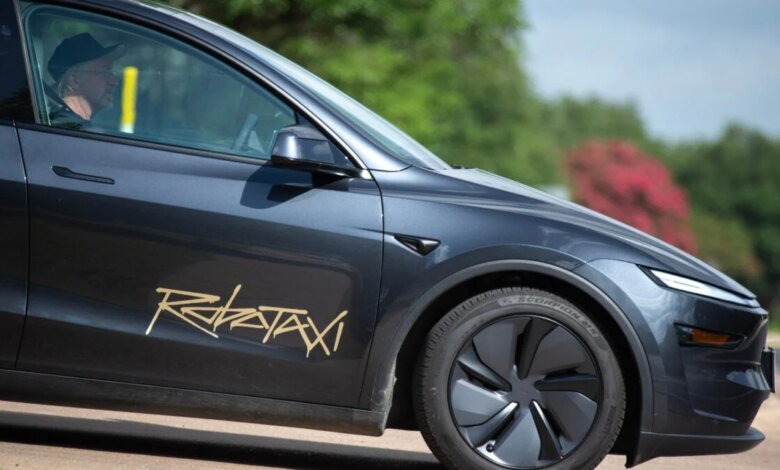
Tesla’s Robotaxis self-driving car in Austin, Texas, operates with a safety monitor in the passenger seat and a trained person who can intervene if anything goes wrong with the self-driving car. On Thursday, CEO Elon Musk announced that the display would no longer be located in the car, which was seen as a major step forward in the company’s capabilities to operate autonomously without human intervention.
Turns out it’s not that simple. Based on videos on social media, it appears Tesla did not actually get rid of the safety monitoring device, Electrek reported. Instead, the company appears to simply transfer the person to a vehicle that follows the Robotaxi for the duration of its journey. Several videos show Tesla cars following Robotaxis, suggesting that Tesla’s self-driving may not be as advanced as the company would like it to appear. It’s worth noting that Tesla has not confirmed whether or not it operates trail cars. The company did not respond to a request for comment at the time of publication, but it also has not had a functioning public relations department in many years.
My first without supervision @robotaxi Ride here in Austin! Come with me on this first experience driving around Austin with just me in the car and in the back seat!
Congratulations to @Tesla_AI a team! 🤠👍 pic.twitter.com/YVJ19zp2qZ
– Joe Tegtmeyer 🚀 🤠🛸😎 (@JoeTegtmeyer) January 22, 2026
In a video uploaded by Tesla fan Joe Tegtmeyer, he can be heard identifying a “pursuit car” following his ride in what he described as his “first ride in an unsupervised robotaxi.” Tegtmeyer suggests that the car is there to “check,” which sounds like a nice way of saying “being at the scene in case anything goes horribly wrong.”
In a vacuum, there’s nothing necessarily wrong with the idea of a trail car for safety purposes – although it seems like a very inefficient way to operate when you’re trying to offer trips on a large scale. But it’s the evasive way Musk presented this change that gives it a bad taste. Musk said robotaxis operate “without safety oversight in the vehicle.” This is technically true. But knowing that the safety monitor is still involved and in a position to potentially intervene on each individual ride undermines the idea that Tesla has achieved a new, meaningful level of autonomy.
The fact that safety monitors are still involved at such a granular level suggests that Tesla is still light years behind Waymo, which currently operates a fleet of about 2,500 cars without a human to physically intervene (although it still has remote operators who can take over the task at any time). Meanwhile, Tesla is reportedly operating about 80 robo-taxis in total, and usually only a few at a time.
Despite this, Musk took to the stage in Davos, Switzerland, at the World Economic Forum and claimed that Tesla had solved the autonomy problem. “I think self-driving cars are basically a solved problem at this point,” he said, before claiming that the Tesla Robotaxis would be “widespread by the end of this year within the US.” If that’s true, get ready for some major traffic jams considering that each Tesla Robotaxi trip actually puts two cars on the road: the one that gets you to your destination and the one that ensures it doesn’t catch fire.
Don’t miss more hot News like this! Click here to discover the latest in Technology news!
2026-01-23 22:00:00