The Surprising History of Tomatoes in Egypt

When I first moved to Cairo, I found tomatoes everywhere – in street foods, cookbooks, family recipes, and local markets. In later years, when I returned to research (and in) Egyptian cuisines, I watched home cooks use them in garnishes and fillings, in salads, for braising meats and vegetables, and even as a spice – grated into a dish for a bright, acidic flavour.
Although tomatoes are ubiquitous today, their popularity in Egypt is considered a recent phenomenon. Native to the Americas, it was widely cultivated in the Nile Valley by the 19th century and became available year-round to Egyptian consumers in the 20th century. Today, Egypt consistently ranks among the world’s largest producers of tomatoes, almost all of which are consumed domestically.
When I first moved to Cairo, I found tomatoes everywhere – in street foods, cookbooks, family recipes, and local markets. In later years, when I returned to research (and in) Egyptian cuisines, I watched home cooks use them in garnishes and fillings, in salads, for braising meats and vegetables, and even as a spice – grated into a dish for a bright, acidic flavour.
Although tomatoes are ubiquitous today, their popularity in Egypt is considered a recent phenomenon. Native to the Americas, it was widely cultivated in the Nile Valley by the 19th century and became available year-round to Egyptian consumers in the 20th century. Today, Egypt consistently ranks among the world’s largest producers of tomatoes, almost all of which are consumed domestically.
The importance of tomatoes to Egyptian society extends beyond the world of cuisine. It has long served as a low-tech economic indicator of instability: a key element that often strains the budgets of ordinary households. Since at least the 1950s, Egyptian vendors have advertised tomatoes using the street cry “Great, Ota(“Crazy tomatoes”) in reference to the notorious fluctuations in their prices. Unsurprisingly, in post-revolution Egypt in the 2000s, tomatoes frequently permeated political and economic discourse. A wave of memes and cartoons decried their high prices, and in 2016, popular Egyptian singer Saad El-Saghir released a song whose opening verse highlights tomatoes’ tendency to fluctuate wildly in price: “Sometimes it’s a penny, sometimes it’s a hundred.”
Whenever I return to Egypt, I find that the cost of tomatoes remains a common complaint. But I argue that the “crazy tomatoes” trend is not just an offhand complaint; Rather, it reflects a popular critique of state power.
This article is adapted from Nightshade of the Nile: An Egyptian Culinary History of the Tomato By Annie Juhl (University of California Press, 304 pages, $27.95, October 2025).
A fundamental feature of Egypt’s modern food system is the expectation that the state will ensure that its citizens have access to certain foods – most notably subsidized wheat bread, which has been the focus of the state’s food policy since the 1940s. In 1977, thousands of Egyptians took to the streets to protest cuts in support in an uprising popularly known as the “Bread Intifada.” Although bread subsidies were affected by the editorial reforms that began in the 1980s, it can be said that the food item remained the most protected from them. Geographer Jessica Barnes writes: “Cheap wheat bread has become an expected part of the state’s social contract with its people.”
After a group of Egyptian army officers overthrew the ruling British-backed monarchy in 1952, the Egyptian state expanded existing controls on wheat production to include other major field crops such as wheat, rice, and sugar. But unlike these staple crops, which were regulated through production quotas, subsidies, and rationing systems, tomatoes and other fruits and vegetables were excluded from such direct forms of state regulation and intervention, and were also subject to less intensive pricing and distribution mechanisms than subsidized foods.
There are many other factors that have historically contributed to tomato price volatility. The first is the exceptionally high rate of spoilage, caused by the fragility of the fruit, exacerbated by Egypt’s hot summers and lack of transportation and storage infrastructure. Some estimates indicate that up to 50 percent of Egypt’s tomato crop is lost between the farm and the consumer. Seasonal fluctuations in production and pests, such as yellow leaf curl virus, also contributed to price volatility.
However, the most famous problem facing tomato producers and consumers in the twentieth century was the concentration of vegetable trade in the wholesale markets of Cairo and Alexandria.
Cairo’s Rawd al-Farag market has been known for its profitable wholesalers since the 1920s. In his 1991 study of Egyptian agriculture, Yehia Sadosky, a senior fellow at the Brookings Institution at the time, noted that although hundreds of wholesalers operated in the market, “all but 10 percent of them originally came from the same three villages in Sohag” in Upper Egypt.
Egyptian officials knew that a small group of merchant families controlled the wholesale vegetable trade and benefited from their role as middlemen, passing on costs to consumers and producers alike. However, state interventions on vegetable supplies have never come close to complicating the systems put in place to ensure public access to staple foods such as bread, sugar or vegetable oil. The appointment of market inspectors and the investment of state resources to support farmers starting in the 1950s had limited effects on tomato prices, which continued to fluctuate “more than any other vegetable,” Egyptian horticulturist Said Hamdy wrote in 1958.
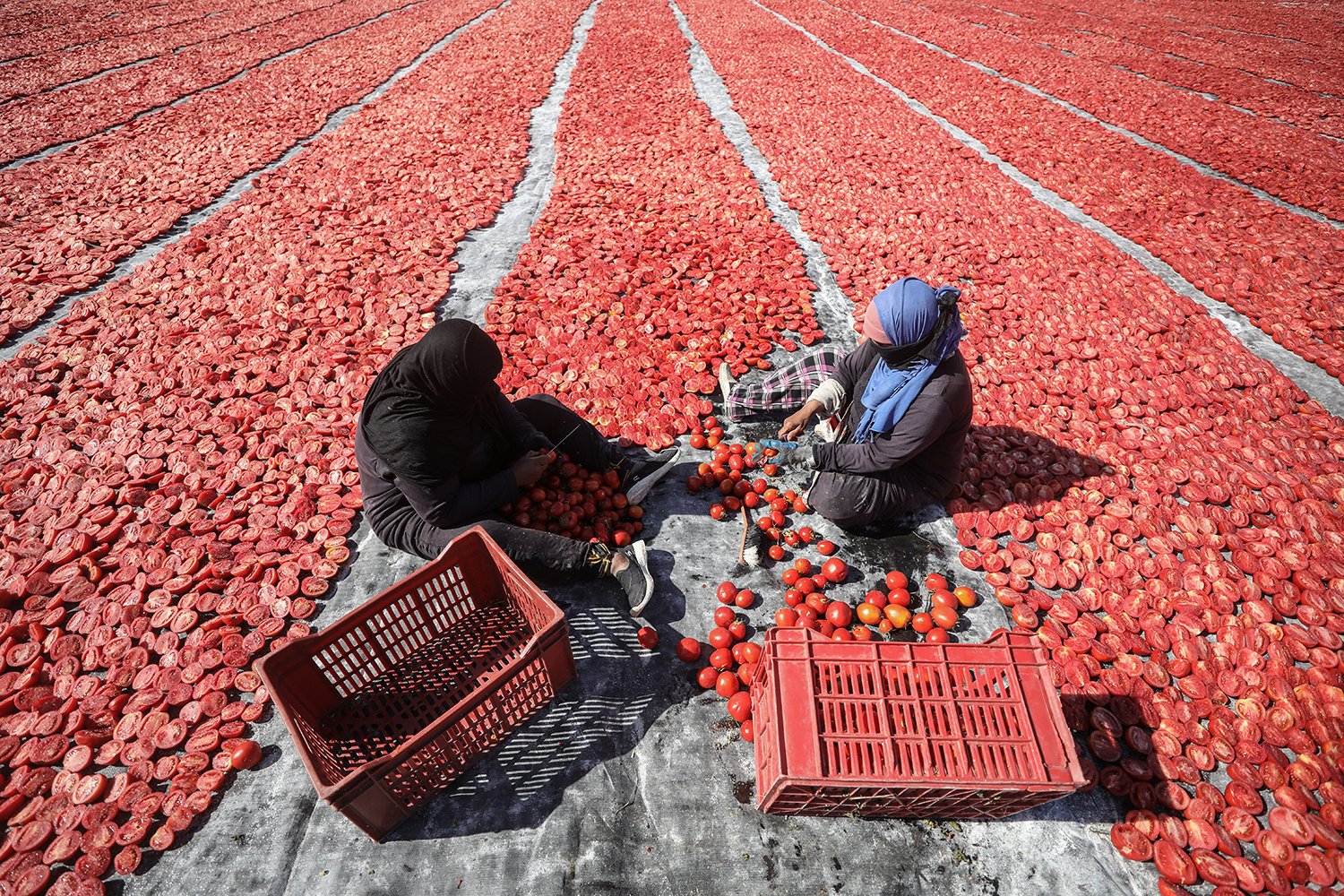
People work in a field drying tomatoes in Luxor, Egypt, on January 11, 2024. Muhammad Al-Shahed/Anadolu via Getty Images
In the 1960s, when the state turned to more concerted planning mechanisms, it consolidated additional controls, including imposing a price ceiling on fruits and vegetables. Although these measures helped curb price fluctuations to some extent, the Ministry of Supply “was never able to completely suppress the black market trade in agricultural commodities,” Sadoski wrote. For decades, traders worked secretly, making deals that drove down official prices.
Policy documents and officials’ statements reveal that the state was fully aware of the inner workings of Rod al-Farag’s extortionist vegetable traders, and sometimes even coordinated with families in their efforts to control prices. But the state’s efforts to impose a price ceiling failed. With tomatoes becoming a common staple in Egyptian home kitchens, their “crazy” prices have become an integral part of Egyptian life.
Although Egyptians have never taken to the streets to protest tomatoes as they did over bread, they have also not been silent about it. Cultural references to tomato prices were part of a broader political trend in twentieth-century Egypt that saw citizens across the ideological spectrum look to the state to address societal problems.
The tomato crisis in Rawd al-Farag was made famous, for example, in the 1957 film Salah Abu Seif. The serial killer (Fatwa). It is now considered an Egyptian classic. The serial killer It highlights the way tomatoes united farmers and workers, both Cairene and southern, in a common set of demands on the state.
One early scene depicts Abu Zaid, a prominent wholesale vegetable trader, ordering one of his followers to restrict tomato supplies to raise prices – and sending a message to other traders to do the same. When the film’s hero, Haridi, first arrives in Cairo from the countryside, he is shocked by the price of tomatoes in the city. (“This is crazy!” he shouts, referring to a street cry that moviegoers would have recognized.) After finding work in the market, Hriddy soon learns the inner workings of the vegetable trade, including the traders’ alliances with powerful government officials who provide cover for their collusion. Shocked and angry, Hriday devises a plan to pool resources and source tomatoes directly from the countryside and sell them at reasonable prices. But he is thwarted by Abu Zaid’s thugs who sabotage the trucks carrying tomatoes. Eventually, Haridy’s elaborate tricks to outmaneuver the oligopoly corrupted him, and he became the kind of predatory merchant against whom the neighborhood had once rallied.
At first glance, the film’s main focus appears to be the corruption of merchants, but a closer reading suggests that it is actually criticizing the political structures that keep the corrupt merchant system in place. The film’s opening credits include the caption: “The events of this film take place at a time when the livelihoods and sustenance of the many were controlled by the few.” In the closing scene, a policeman declares that the market’s problems are not caused by this or that individual; It is systemic and inevitable. He repeats, saying: “Abu Zaid and Al-Haridi may go, but a thousand like them will come.”
In 1957, The serial killer He was visionary in his assessment of the problem of tomato pricing, which persisted even as prevailing regimes and ideologies changed over the course of the twentieth century. Cairo’s wholesale vegetable trade was redistributed in the 1990s, but persistent complaints about tomato prices remained part of Egyptian life. They have the same phrase they did decades ago: We’re crazy, Ota, Crazy tomatoes.
According to food historian Jayeta Sharma, “food cries” like these can help us understand the role that both food and its vendors have played in shaping the social fabric of modern cities.
I understand that the phrase “Crazy Ota” is, at its core, a complaint and disavowal of an unjust system. Through it, the seller announces that he is selling tomatoes while emphasizing that he cannot make any promises about their price. As a cry in the street, it also confirms that seller and customer participate in the tomato market anyway—largely because they have little choice.
In the second half of the twentieth century, Egyptians could rely on the government to ensure the delivery of bread supplies, but the state’s failure to control tomato prices was an open secret. Tomatoes were not considered important enough to merit the kind of government interventions reserved for bread. However, as a common staple of everyday cooking, it was important enough that the most common public reference to it was to refrain from collective, if resigned, complaint.

Egyptians buy products from a market in Old Cairo on May 12, 2014. Khaled Desouky/AFP via Getty Images
Political scientist José Ciro Martinez describes a similar phenomenon in Jordan. He notes that outright resistance or rejection of a welfare program that provides state-subsidized bread is generally impossible because of people’s dependence on it for their basic livelihood and survival. He points out that when rejection and resistance are not possible, people interact with the system in other ways, such as filing complaints with state-appointed inspectors, to hold the state accountable for the expectations of its citizens.
Complaining about crazy tomatoes in Egypt goes a little differently; The state’s role in shaping tomato supplies is much less clear than its role in ensuring the supply of cheap bread. But as a refrain, it mentions the failures and limitations of the state while implicitly emphasizing the moral economy of well-being that the state is committed to upholding. As it spreads throughout Egyptian society, it constitutes a sense of shared experience across social classes, livelihoods, and geographic regions.
As a garnish for street foods, a base for stews and sauces, and as a seasoning in favorite home-cooked dishes, tomatoes have cemented their place in the modern Egyptian diet. It reminds us that flavor and culinary heritage are just as important as calories and other livelihoods in creating a just diet.
Don’t miss more hot News like this! Click here to discover the latest in Politics news!
2025-11-07 19:45:00