Three Lessons China Learned from the United States
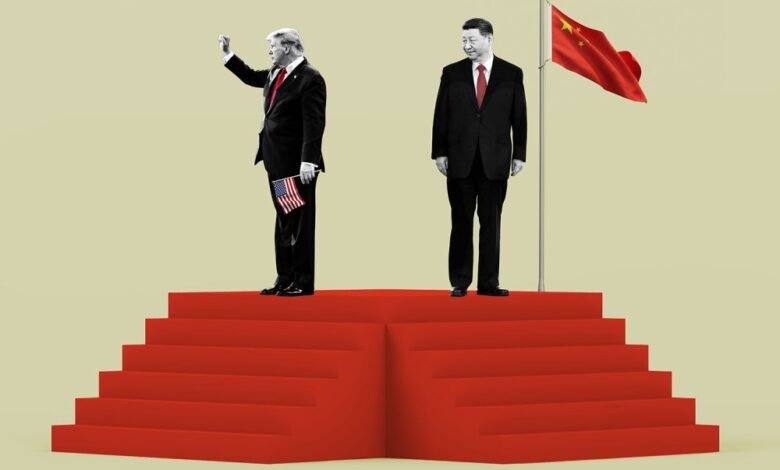
When historians look back at the early twenty-first century, they might conclude that the United States taught China more by example than by lectures on trade practices or political systems.
In October, the Chinese leadership issued its recommendations for the country’s 15th Five-Year Plan, which will cover the period from 2026 to 2030. The document not only specified where the leadership intends to direct the world’s second-largest economy, but also how it wants to project China’s power globally. Without explicitly mentioning the United States, Beijing’s policy outline reveals the leadership’s intense focus on addressing technological choke points and its concerns about the extent of the country’s dependence on external suppliers of cutting-edge technologies.
When historians look back at the early twenty-first century, they might conclude that the United States taught China more by example than by lectures on trade practices or political systems.
In October, the Chinese leadership issued its recommendations for the country’s 15th Five-Year Plan, which will cover the period from 2026 to 2030. The document not only specified where the leadership intends to direct the world’s second-largest economy, but also how it wants to project China’s power globally. Without explicitly mentioning the United States, Beijing’s policy outline reveals the leadership’s intense focus on addressing technological choke points and its concerns about the extent of the country’s dependence on external suppliers of cutting-edge technologies.
Despite Washington’s insistence that Beijing is an adversary, China’s approach to global power increasingly reflects three lessons it has learned from the United States: build economic resilience, weaponize supply chains, and avoid the quagmires of an exhausted superpower. The student may not share the teacher’s values, but China has certainly mastered the curriculum and adapted it to its own purposes.
China has taken The same lesson to heart, albeit through the lens of its institutional memory. Its desire to control its technological future long predates its current technological competition with the United States. The shock of the Sino-Soviet split of the 1960s – when Soviet leader Nikita Khrushchev suddenly cut off China’s access to critical civilian and military technologies – remains alive among generations of senior Chinese Communist Party leaders. More than any contemporary conflict with Washington, that episode reinforced the belief that dependency is a weakness.
In the mid-2000s, when Beijing’s relations with Washington were already tense, Chinese leaders feared that the country’s heavy reliance on a high-tech supply chain from a small number of advanced economies might become one of its most acute vulnerabilities.
As a result, the “Made in China 2025” initiative is among many critical steps taken by the Chinese government in recent years to enhance the country’s capacity for domestic scientific innovation. The aim of introducing the “dual circulation” strategy in May 2020 was to strengthen local supply chains while maintaining selective engagement with global markets. This is essentially a version of US industrial policy, which stems from the realization that a supply chain with too many foreign links is weak.
But what sets China and the United States apart in this current technological competition is Beijing’s determination to mobilize funding, manpower, and administrative capacity from the center by pooling all available national resources together to support domestic technological breakthroughs.
Going further, Beijing’s overarching goal is to make China a global champion in innovation. The vision is of a nation that not only produces technology, but sets its own global boundaries and standards in areas such as artificial intelligence and quantum computing.
The perpetual challenge facing China is to find the balance between prioritizing technological self-reliance while ensuring job creation and income growth for its younger generation. The focus on technological self-reliance implies a shift towards fewer and more specialized jobs, in contrast to the mass employment provided by the real estate sector and fintech conglomerates as was the case in the past. Such a shift would exacerbate the high youth unemployment rate, which reached 17.3% throughout 2025.
For decades, Washington Export controls were used as a strategic weapon. From the Coordinating Committee for Multilateral Export Controls during the Cold War to recent restrictions on advanced semiconductors, the United States has long believed that control of critical technologies is essential to maintaining military and economic superiority.
China has carefully studied these rules of the game and used its influence as the world’s largest trading nation and its dominance of industrial supply chains to project its power in international affairs.
In the past decade, China has issued its own export control laws and lists of “unreliable entities.” Restrictions on exports of gallium, germanium, and graphite – all essential components of global semiconductor and battery supply chains – show that China is now willing to exercise its own version of American-style technological statecraft. When Washington uses interdependence as a weapon, Beijing responds with imitation, not fury.
In this sense, Beijing has used control over important minerals to gain leverage during tariff negotiations with Washington. Its export control regime is less an act of defiance than an acknowledgment of how great powers operate. The United States has taught China that exercising control over your opponent’s weaknesses is leverage, and leverage is leverage. Beijing’s policies are not so much anti-American as they are based on the same logic of strategic advantage through control.
The intended recipient is not just the United States. It is intended to serve as a signal to other countries about how equally disruptive China can be. This convinces other countries to think twice before allying too closely with Washington.
China’s leaders realize that global power does not depend on openness alone, but rather on the ability to close doors when necessary. By building resilience in key sectors — energy, food, pharmaceuticals, semiconductors and shipping — Beijing is learning the same lesson that Washington perfected during the 20th century: a great power cannot be at the mercy of another nation’s supply chain.
Maybe the most The profound lesson China has learned from the United States is not what the latter did, but what it did poorly. From Vietnam to Iraq to Afghanistan, the United States has repeatedly been drawn into regional conflicts that it only partially understands, with often messy consequences. Beijing has long been a strong advocate of non-interference in foreign affairs and a frequent user of diplomatic non-alignment, with the notable exceptions of Russia, North Korea, and Pakistan.
China’s current foreign policy still shows somewhat conservatism. Despite fiery rhetoric and military exercises around the Taiwan Strait, or the South China Sea, Beijing has been keen to avoid getting involved in wars it cannot control. For example, in the Middle East, it maintains relations with both Iran and Saudi Arabia; She diligently avoided getting involved in major crises outside her immediate surroundings.
China’s restraint is not purely moral or peaceful, but rather practical. I have studied previous US military interventions and concluded that a superpower’s influence often erodes when it becomes trapped in local conflicts. The United States has taught China that arbitrating conflicts at a distance is better than fighting them up close.
However, China has limits as a security actor. Its activities in the Taiwan Strait and the South China Sea are fueling significant mistrust and anxiety among regional neighbours, undermining Beijing’s ambitions to be seen as a stabilizing force. It aspires to gain greater regional importance to advance its diplomatic goals—such as global development, security, and governance initiatives—as the United States becomes less predictable and its influence declines. But China also realizes that adopting the role of global security manager would expose it to the same pitfalls that have weakened the power of the United States.
Irony The rivalry between the United States and China today is such that much of what Washington finds threatening about Beijing’s behavior reflects its past choices. The United States has built its power on industrial policy, technological control, global infrastructure investment, and thoughtful engagement abroad. Now China is following a similar path – through its “Made in China 2025” initiative, its proliferating global initiatives, and its diplomatic posture that mixes high-octane rhetoric with targeted economic coercion.
More than a decade ago, the United States wanted China to be a “responsible stakeholder.” But what it got instead was a mirror – a force that absorbed American strategic logic, stripped it of its political façade, and applied it to its own rise.
If the United States wants to understand China’s path, it must first acknowledge its own reflection on Beijing’s actions. China is neither an aberration nor an adversary of the order that the United States built, but rather a consequence of it. The management habits of great powers are contagious.
For China, the United States’ greatest exports have never been democracy or consumer culture; It was a model of global power itself. China has studied this more well than any other country – even as it is now beginning to write a version of the playbook that is uniquely its own.
Don’t miss more hot News like this! Click here to discover the latest in Politics news!
2025-12-11 05:01:00