Trump says cost of living is too high when he says so but ‘affordability is a lie when used by the Dems’
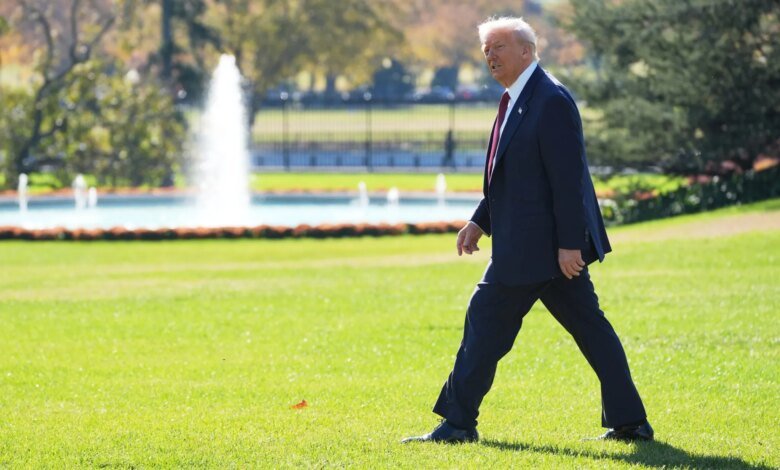
Nearly two weeks after Republicans lost massive elections in Georgia, New Jersey, Pennsylvania and Virginia, many GOP leaders insist there is nothing wrong with the party’s policies, message or President Donald Trump’s leadership.
Trump says Democrats and the media are misleading voters who are concerned about rising costs and the economy. Republican officials, aiming to avoid another defeat in next fall’s midterm elections, are encouraging candidates to fully embrace the president and talk more about his accomplishments.
These are the key takeaways from a series of private conversations, briefings and official talking points involving top Republican decision-makers across Washington, including inside the White House, following their party’s losses on November 4. Their assessment highlights how tied the fate of the Republican Party is to Trump, a term-limited president who insists that the economy under his watch has never been stronger.
This is despite the fact that a growing number of voters speak of a different reality in their lives.
But with few exceptions, the Trump aides who lead the Republican Party’s political strategy have no desire to challenge his wishes or beliefs.
“Republicans enter next year more united behind President Trump than ever before,” Republican National Committee spokesperson Kirsten Bales said. “The party is fully aligned with its ‘America First’ agenda and the results it delivers for the American people. President Trump’s policies are popular, he drives voter turnout, and standing with him is the strongest path to victory.”
However, Trump’s approval resembles that of former Presidents Barack Obama, a Democrat, and George W. Bush, a Republican, on the same point in their terms. Their parties suffered heavy losses in the midterm elections.
Trump insists there is no affordability problem
Since the election, the White House has quietly decided to shift its message to focus more on affordability.
Much of the first year of Trump’s second term was dominated by his trade wars, his campaign against illegal immigration, his decision to send National Guard troops into American cities, and the longest government shutdown in US history.
Trump talked more about affordability in the days after Election Day. On Friday, he reduced tariffs on beef and other goods that consumers say are too expensive. But Trump’s main message is that the economy is better and consumer prices are lower than the media reported. It’s the same message that Democratic President Joe Biden and his allies have spent years promoting, with little success.
In a social media post on Friday, Trump said costs were “going down.”
“Affordability is a lie when Democrats use it. It’s a complete CON JOB,” Trump wrote. “Thanksgiving costs 25% less this year than last, in the era of Crooked Joe! We are the party of affordability!”
A few days ago, he asserted on Fox News: “We have the greatest economy in history.”
Trump’s numbers on the cost of Thanksgiving dinner are wrong. Grocery prices are 2.7% higher than they were in 2024.
Economic concerns were voters’ top concern in this month’s election, according to an AP Voter poll.
Republican strategist Doug Hee said Trump’s approach is not necessarily helpful for the GOP or its candidates, who already face a difficult political environment in 2026 when voters will decide the balance of power in congress. Historically, the party that occupies the White House suffers significant losses in non-presidential elections.
“Republicans need to convey to voters that they understand what they’re going through and that they’re trying to fix it,” she said. “This may be difficult to do when the president is taking a non-metaphorical wrecking ball into parts of the White House, distracting much of Washington and the media.”
“Candidates cannot afford to be distracted,” she added. “As we saw in the last election, especially in Virginia, if you don’t talk about what voters are talking about, they will ignore you.”
A view from the main governor’s race
The reality outside Washington suggests that not every Republican candidate shares Trump’s view.
New York Rep. Elise Stefanik, the Republican leader in the House who began a campaign for governor last week, said there is no doubt about the issue most important to her constituents: affordability. She also reduced her party’s focus on conservative cultural priorities, including transgender athletes, which was a GOP focus in the recent race for Virginia governor.
“I certainly support and protect women’s and girls’ sports, but as you can see in all of our messaging, we focus on the most important issues, with every conversation with voters about high taxes, spending and unaffordability,” Stefanik told The Associated Press.
She offered a nuanced perspective of Trump’s leadership, unwilling to criticize any of his major policies or governing decisions, but also unwilling to say her party is completely united behind him.
“My feeling is that our party is completely united behind firing Kathy Hochul,” Stefanik said of the Democratic New York governor when asked about her party’s support for Trump. “I am very focused on delivering for New Yorkers and putting New Yorkers first.”
While Stefanik said it was important for the governor to have an “effective working relationship” with Trump, she declined to say whether she would support Trump’s hypothetical move to send the National Guard to New York City, as he threatened. “That wouldn’t have to happen if there was a Republican governor,” she said.
Stefanik’s comments reflect the challenge that awaits Republican candidates running in a tough political district.
Challenging talking points
The Republican National Committee, which serves as the political arm of the Trump White House, has issued a series of talking points that dismiss recent election losses as a byproduct of Democratic voters’ advantage in states with top races.
The talking points, obtained by The Associated Press, ignore Republican losses in Georgia and Pennsylvania. They also overestimate Trump’s political power, claiming that he is more popular than Obama and Bush were at the same time during their terms.
This claim has been echoed across conservative media in recent days.
An AP poll analysis concludes that Trump’s approval is no higher than that of Obama or Bush at a similar point in their second term.
Trump’s approval, at 36% in a November poll by The Associated Press-NORC Center for Public Affairs Research, is slightly higher than it was at this point in his first term. But both Obama and Bush’s approval ratings were in the low 40s at this point in their second terms, according to Gallup polls, which is similar to where Trump stood in the last Gallup approval poll in October.
As for Obama and Bush, their parties suffered heavy losses in the midterm elections that followed.
However, the Republican messaging crafted by the Trump team amplifies support for the president and his policies.
The Republican National Committee’s talking points point out that the last election “was not a referendum on President Trump, Republicans in Congress, or the MAGA agenda.” To win in 2026, “Make America Great Again” voters will need to show up at the polls; “President Trump and Republicans will work to make that happen.”
___
Associated Press writers Will Weissert and Amelia Thompson Defoe in Washington contributed to this report.
Don’t miss more hot News like this! Click here to discover the latest in Business news!
2025-11-16 18:29:00