This Engine Sucks Energy From Deep Space Without Leaving the Ground
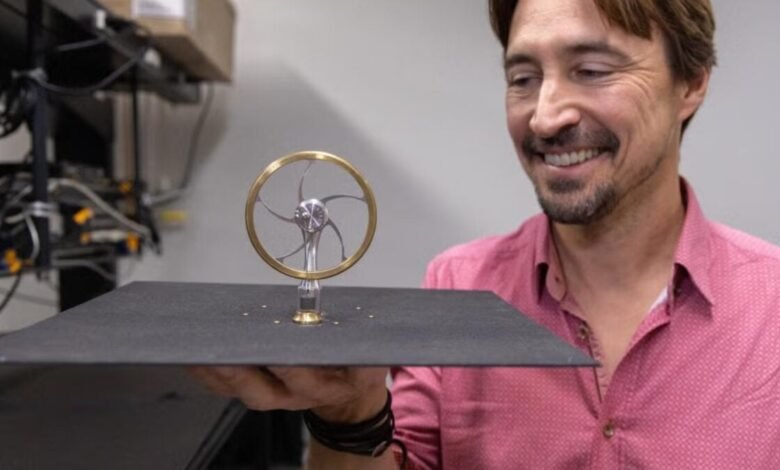
Deep space may provide hidden sources of energy, such as dark matter, to fuel future spacecraft. However, before we get there, a new experimental engine suggests that it is indeed possible to harness deep space as a potential energy source, albeit on a smaller scale that would likely not support interstellar travel.
In fact, the purpose of the new engine, described in a paper published in the journal Science Advances on November 12, is much less ambitious, but still represents an important step forward. Until now, its primary purpose is to ventilate greenhouses and other buildings. This simple device, known as a Stirling engine, converts differences in heat into mechanical energy.
But what distinguishes this particular engine is that it uses the depths of space to provide the required cooling. The “warm” part is Earth’s natural warmth, while the “cold” part is something “very, very cold but also very far away: deep space,” the team of engineers at UC Davis explained in a statement.
“It doesn’t actually have to physically touch space, it can only radiatively interact with space,” lead study author Jeremy Munday added in the statement.
But how does that even work?
First, consider how Stirling engines work. Unlike many other engines, Stirling engines are surprisingly efficient when “there are only small differences in temperature… like that between a hot cup of coffee and its surroundings,” Munday explained. The key, he added, is to make sure the warm and cold parts of the engine are clearly separated.
Creating the new engine requires only one minor modification. Munday and his co-author and graduate student Tristan Dibb fabricated a simple plate to act as an antenna that radiates heat. They then mounted a commercially available Stirling motor onto the square antenna, which ended up being slightly larger than a laptop.
Simply put, the side facing the ground was attached to the soil with an aluminum bracket to ensure it absorbed heat from the ground’s surface, according to the paper. On the other hand, the side facing the night sky was covered with a special type of coating that enabled it to capture infrared rays from deep space and from the Sun.
“The reason this technology is different from any other technology is that a lot of engines operate at different temperatures, but usually operate on close objects,” Munday explained in a video introducing the engine. “For us, we have the warm Earth nearby, but the cold of space very, very far away. The leap we’ve made is that, even though these things are far apart, we can connect them radiatively.”
Small engine, cosmic power
Over the course of a year, Munday and Debbie set aside a plot of land to test their device outside the laboratory. They found that after sunset, their setup created a temperature difference of about 18 degrees Fahrenheit (10 degrees Celsius) on either side of the square antenna.
This temperature gradient was enough to generate at least 400 milliwatts of mechanical energy per square metre, enough energy to directly drive a fan and a small electric motor, according to the paper.
However, for the researchers, the most promising experiment was the one they conducted inside a small greenhouse. In this test, they replaced the engine’s flywheel with a custom fan blade and watched if the setup could help ventilate the greenhouse at night.
To their surprise, they found that the fan provided sufficient airflow to regulate the temperature of the greenhouse. Since this is just a prototype, continued improvements and scaling up of the technology “could provide a completely passive way to ensure healthy breathable air in public spaces and promote plant growth by regulating humidity and carbon dioxide levels in greenhouses and grow houses,” the paper noted.
UC Davis has filed a provisional patent for the design, according to the statement.
Don’t miss more hot News like this! Click here to discover the latest in Technology news!
2025-11-13 16:55:00