What Can Be Done to Halt Iran’s Massacres?
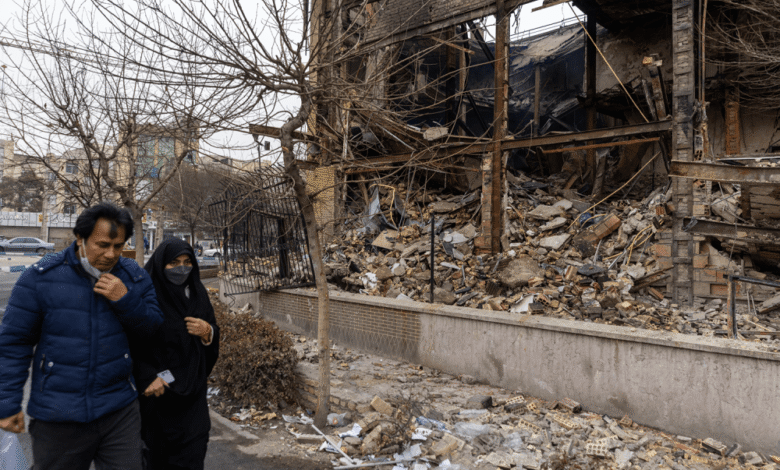
Last week, the Islamic Republic committed the largest massacre in Iran’s modern history. In response to massive popular protests against its rule, the regime killed thousands of unarmed demonstrators. The death toll is still unclear, but reasonable estimates indicate that it ranges between 12,000 and 20,000 dead. Many other people were also caught in the crossfire.
Some analysts and commentators claim that the recent series of events is the end of the Islamic Republic. But while the regime has been greatly weakened by dissent, war, and sanctions, it has nevertheless proven resilient and ruthless. The Iranian opposition is divided, and foreign intervention is not a magic solution.
However, the regime could still be overthrown if cracks within the ruling elite widen significantly and if security forces begin to defect in large numbers. The United States can also play an important role in disrupting the regime’s ability to shut down the Internet and commit crimes against humanity under the cover of darkness.
The current uprising against the regime began with protests in a Tehran market, sparked by a major currency crisis. Students, workers, and many Iranians tired of the grinding misery of daily life soon joined the bazaar strikes. The protests spread to smaller towns in the west and southwest, which, like the capital, were hard hit by the regime’s mismanagement of water. These cities included Lordjan, Malikshahi, and Abdenan, where the majority of the town’s residents reportedly turned out in protest.
The regime allowed the protests to continue for a few days before responding forcefully, initially using regular security forces, mostly police. But by January 3, the regime’s rhetoric and stance on force had become tougher: Supreme Leader Ayatollah Ali Khamenei said troublemakers should be “put in their places,” while messages linked to the Islamic Revolutionary Guard Corps, the regime’s brutal paramilitary force, declared that “tolerance” was over and the state “will not submit to the enemy” — a clear inflection point in the crackdown. On January 8, Iranian authorities imposed an almost complete internet and communications blackout, and killings escalated under the cover of a power outage.
The Iranian Revolutionary Guard opened fire on thousands of unarmed protesters, not only in major cities like Tehran, Isfahan, and Mashhad, but in countless small towns and villages across the country. There were even reports of the regime using Russian-made heavy machine guns against peaceful demonstrators. Witnesses described the level of violence as shocking, with parts of the country resembling war zones. One witness said that there was a stark difference in the suppression of the protests in 2009, when most security forces used batons, and even armed units used their weapons carefully. They said that this time, riot control units linked to the Iranian Revolutionary Guard fired continuous bursts of fire at full capacity, including the use of machine guns.
The regime has framed the uprising as a Mossad plot and labeled the protesters “terrorists” — a dangerous escalation that would, in the state’s own logic, expand the justifications for lethal force and severe punishment. On Wednesday, the Iranian Minister of Justice told the media that from January 8 onwards, the protests would be considered an “internal war.” On January 7, Iran’s chief judge said that “there will be no leniency towards those who help the enemy against the Islamic Republic and calm the people.” Public allegations by some Israeli politicians that imply Israeli involvement may exacerbate this risk for thousands who are now under threat of execution by reinforcing the Iranian espionage narrative.
In addition to portraying protesters as “terrorists” under Israel’s control, the regime seeks to instill fear among the population and prevent more people from taking to the streets by using grief as a weapon. Families are not allowed to retrieve the bodies of their loved ones from morgues or hold funerals for them. The message is clear: dissent will not only get you killed, it can deprive you of your family dignity, your closure, and even your right to mourn.
In this climate, fear not only deters protest; It isolates people from each other and makes sharing seem like a trap with consequences beyond the individual. When the state can punish the living through the dead, many will think twice – not because they accept the system but because the cost has become unbearably personal.
The opposition may hope that the end of the regime is in sight, but there are several reasons why it will be able to survive this phase of popular revolutions. The Islamic Republic appears cohesive and united under Khamenei’s leadership, although there are rumors of dissent and resentment against the supreme leader within the regime’s ranks – especially as he stands in the way of nuclear concessions that could mitigate the regime’s existential crisis.
While the majority of Iranians despise the regime, it still has a large support base among the population and can command hundreds of thousands of armed supporters. Many sectors of Iranian society, concerned about instability and chaos, such as the oligarchs and senior bazaaris, have decided not to stand against the regime. Although battered, it is possible that the regime will remain in a weakened state, and the uprising could turn into an armed civil war, especially in light of the number of Iranians slaughtered by the IRGC.
The division of the Iranian opposition also greatly helped the regime. Former Crown Prince Reza Pahlavi may have emerged as an opposition leader on social media, but the reality on the ground is different. Iran is a diverse country with a population of 92 million, and while Pahlavi has a notable support base in Iran, he is by no means supported by the majority of Iranians inside or outside Iran. Pahlavi also proved to be an unaccountable and divisive leader by dividing the opposition rather than uniting it.
His credibility gap has widened due to his failure to fulfill his promises. Last year, he claimed that he had achieved the defection of 50,000 members of the regime through a television broadcast using QR Code technology. However, there appears to be no evidence of major defections within the ranks of regime forces, at least not on the scale that Pahlavi promised. Instead, the protesters were left exposed to the regime’s killing machine, which reinforced suspicions that the Pahlavi defection campaign was merely a publicity stunt.
During the crucial first days of the unrest, Pahlavi’s role was mostly performance: pronouncements, appearances, and encouragement to the masses. He has never held public office nor built a credible organization on the ground capable of leading protesters. Instead, Pahlavi tends to ride the waves of uprisings, receiving media attention as a self-proclaimed leader of demonstrations and strikes that began days before his participation.
On Monday, CBS News anchor Norah O’Donnell asked Pahlavi a question that most Iranians inside the country cannot safely ask, and most Iranians in the diaspora will not ask out loud: “As you urge people to protest and take to the streets, the death toll is rising in Iran. And this violent crackdown continues, just as it has in previous attempted revolutions. I mean, is it responsible for sending citizens in Iran to their deaths? Do you bear some responsibility?”
Pahlavi’s response was condescending and isolated, especially since he called on Iranians to take to the streets without any planning, organization or support.
He said: “This is war, and war has victims.”
A fair and simple question: What happened to the fifty thousand defectors from the regime that he promised them? If it existed, why did it not prevent the massacre, disrupt it, or at least reduce its size?
A harsh response to this question will undoubtedly displease many Iranians. But Pahlavi may have a bigger problem: He has already made enemies among many members of the opposition when he declared himself the leader of the revolution. The constant threats and harassment by his advisors against other opposition leaders have also damaged chances for unity.
Iran’s ethnic minorities also largely distrust Pahlavi and his ultra-nationalist advisors. It is worth noting that Iran’s large Kurdish population (estimated at about 10%) is particularly opposed to Pahlavi. Iranian Kurdish political parties are the best armed and perhaps the most organized of the opposition groups, thanks to their connections with the broader Kurdish movement.
Promising protesters to help without delivering while countless people are slaughtered is likely to create long-term distrust, whether Pahlavi or US president Donald Trump does so.
One protester who fled Iran this week told us that many people flocked to the streets after Trump’s first statements supporting the uprising and warning the regime of the consequences. After the massacre, that initial surge turned into disappointment and anger, he said.
However, the Trump administration can play a critical role in helping Iran’s freedom struggle by hindering the regime’s ability to shut down the Internet. This could be done through cyber operations, although analysts have indicated in both public comments and private statements to us that kinetic strikes against regime targets are necessary to fully disable the regime’s capability.
Trump should be careful not to favor one opposition leader or group over another. Pahlavi may enjoy some degree of support among Iranians, but he does not represent the majority of the population and has no capacity to lead a revolution.
What is lacking in Iran is not courage. What we lack is a revolutionary machine led by competent leaders.
In 1979, Ayatollah Ruhollah Khomeini built a revolutionary machine and united with several non-Islamic groups to overthrow the Shah, groups he eventually betrayed and, in many cases, executed. No one has this ability in Iran today.
Even if the Islamic Republic were indeed collapsing, it would continue to fight to the death. The Iranian people need more than just TV speeches and mass campaigns on social media. They need material support, real leadership, and a shared vision for the future that can save their country from destruction.
Don’t miss more hot News like this! Click here to discover the latest in Politics news!
2026-01-16 17:50:00