What would EU’s €93bn retaliatory tariffs against US cover?
Open Editor’s Digest for free
Rula Khalaf, editor of the Financial Times, picks her favorite stories in this weekly newsletter.
The European Union is preparing to impose 93 billion euros in retaliatory tariffs against the United States if President Donald Trump goes ahead with his threat to impose tariffs on six member states plus the United Kingdom and Norway on February 1 as part of his efforts to seize Greenland.
The list was prepared last year but was suspended until February 7 after the two sides signed a truce in their trade war. The tariffs will apply automatically from that date unless a majority of member states vote to postpone them again.
Here’s a guide to what’s included.
What is covered?
Under the agreement signed between Trump and European Commission President Ursula von der Leyen in Scotland last year, the European Union agreed to 15 percent tariffs on most of its exports to the United States and halted the implementation of its retaliatory tariffs worth 93 billion euros.
EU steel and aluminum exporters are still paying 50 percent tariffs, and the EU has agreed to drop duties on industrial goods and some agricultural products.
But pending tariffs are back on the table after the president threatened to impose punitive tariffs on the United Kingdom, France, Germany and other countries that sent troops as part of a planned military exercise in Greenland, a Danish territory. The European parliament said it would not agree to extend the suspension of customs duties until the matter is settled.
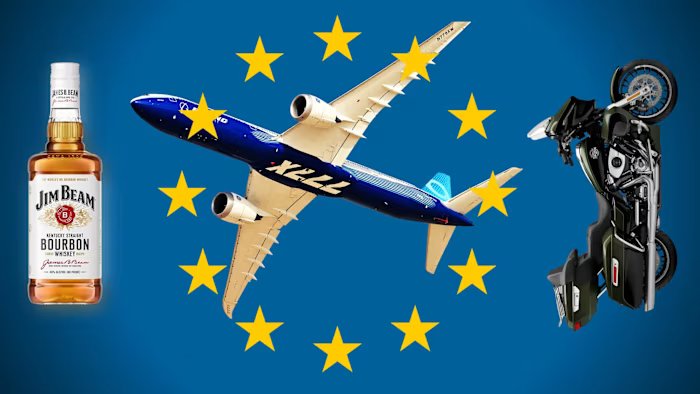
Aircraft manufacturer Boeing will be the biggest victim of the new trade war. The EU package includes 25 percent tariffs on US aircraft, and the American company accounts for the bulk of US aircraft imports of €11 billion in 2024.
Cars, bourbon and soybeans are other big-ticket items on the list of retaliation measures, which has not been published but has been seen by the Financial Times.
The list also includes popular American products such as Harley Davidson motorcycles, Levi’s jeans, and Lucky Strike cigarettes.
Machinery, medical devices, chemicals, plastics and electrical equipment will also be hit.
Why these products?
EU trade officials say the targets are carefully chosen. They must be products that can be easily replaced from elsewhere to avoid consumer ire.
Whiskey drinkers could switch to Scottish or Irish brands, for example.
It also targets specific American politicians and voters. House Speaker Mike Johnson and Majority Leader Steve Scalise represent Louisiana, a soybean-producing state.
“The basic criteria for drawing up a retaliatory list is to choose products in which the EU is not dependent on the United States, so as to minimize economic damage to the EU,” said Ignacio Garcia Persero, a former senior EU trade official.
“The secondary criterion is to choose products that can have an immediate political impact on the United States. Since the €93 billion list is very broad, I think the main criteria would have been to minimize negative impacts on the EU.”
The European Commission must muster support from member states to adopt tariffs, with some capitals insisting on dropping some products for fear of retaliation for their exports, such as spirits and wine. Products worth more than 20 billion euros have already been removed from the initial retaliation list.
Brussels also agreed to export controls on aluminum scrap, which the United States imports for smelting as a basis for fresh metal.
What about a “commercial bazooka”?
Adopted in 2023 but never used, the anti-coercion instrument (ACI) could restrict access to the internal market for major US tech companies and other companies and has been called the bloc’s “trade bazooka”, seen as the most powerful tool in the EU’s arsenal.
It could revoke intellectual property rights, impose tariffs on Netflix or Hollywood movies, prevent American companies from winning government procurement contracts, and even close financial markets to American banks.
France is pushing to activate the AI initiative, but other governments are concerned that such measures could harm the EU economy and its consumers, and there are few alternatives to American venture capital funds or cloud computing companies, for example.
It is also slow – the Commission must investigate alleged cases of coercion, negotiate with the United States, and then obtain the approval of a likely majority of member states to approve measures, a process that takes at least several weeks.
2026-01-19 11:35:00