Why is India’s car market still on fire?
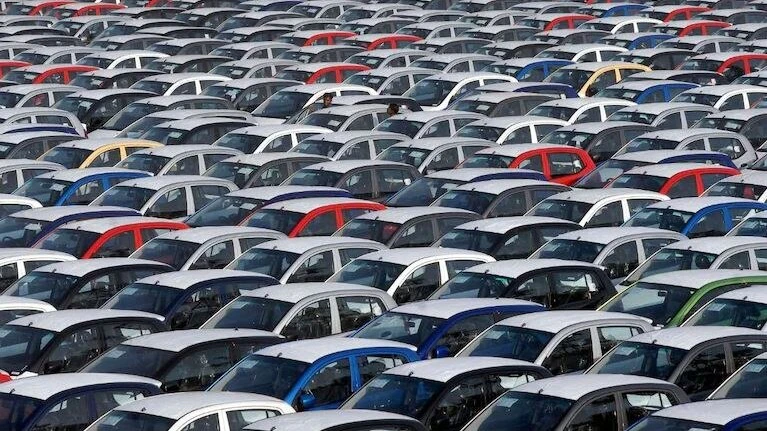
Automakers in India are witnessing brisk sales. After a record-breaking October, sales once again reached new highs in November.
Maruti Suzuki India Limited, India’s largest carmaker, recorded a 21% year-on-year growth in wholesale passenger vehicle sales – despatches from the factory workshop to dealerships – in November.
Tata Motors and Mahindra & Mahindra, the second-largest and third-largest car manufacturers by volume, respectively, saw 22% year-on-year growth in domestic passenger vehicle sales last month. Hyundai Motor India Ltd (HMIL) achieved monthly domestic sales of 50,340 units in November 2025, registering a growth of 4.3% year-on-year.
South Korean luxury car maker Kia achieved its best ever sales for the month of November since its entry into the Indian market. The company’s wholesale sales grew 24% year-on-year in November 2024. Japanese automaker Toyota Kirloskar Motor’s sales jumped 28% year-on-year to 33,752 units.
The recovery in passenger vehicle sales comes after the industry’s growth declined by 1.4% year-on-year in the first half of the current financial year, according to the Society of Indian Automobile Manufacturers (SIAM).
Rahul Bharti, chief corporate officer at Maruti Suzuki, says the recovery in sales is because the small car segment is rebounding in full force after many years, thanks to the historic GST reform.
Sales of the Alto and S-Presso, Maruti Suzuki’s subcompact cars in the mini segment, which SIAM classifies as entry-level hatchbacks up to 3.6 meters long and with a one-litre engine displacement, rose 26.6% year-on-year to 12,347 units for November.
“We are seeing very good traction. The market is very bullish. We have pending bookings for nearly 1.5 lakh units. Our retail sales have grown by around 31% in November,” says Partho Banerjee, chief marketing and sales executive, Maruti Suzuki.
“Currently, we have sold out of 8 models in our factory. All the vehicles have been sent to our dealers. This is the market demand,” says Banerjee. “The car market is very bullish, and our network inventory is up to 19 days. There are approximately 80,000 vehicles in our network inventory, and about 40,000 vehicles are in transit, so we have approximately 1.2 thousand vehicles in the network as of December 1.”
In terms of retail sales, the small car segment, which attracts 18% GST, registered a whopping 39% growth, more than double the 17% growth witnessed by cars falling in the 40% GST slab, says Banerjee.
Car penetration rate in India is less than 33 cars per 1,000 people. “Today, only 3% of India’s population owns a car… We have to enable people from the 97% club to experience the joy of mobility and join the car ownership club,” says Maruti Suzuki’s Bharti.
Bharti has also done away with the narrative of Indian buyers preferring SUVs. “A lot of people were spreading a false narrative before the GST reform that small cars were not being bought because entry-level customers were directly buying expensive SUVs and therefore did not need any support. If that were true and if large cars and SUVs were growing anyway and entry-level customers were also buying expensive cars, then the pre-GST industry should have been growing at over 20%, but it was stagnating at almost zero. Clearly something was not consistent. This narrative has now been proven to be completely incorrect, thanks GST reforms “Our efforts are aimed at revamping the small auto sector,” he says. We will do everything we can.”
Tarun Garg, permanent director and chief operating officer at HMIL, credits GST 2.0 reforms for the sales momentum. The recent relaxation of GST, supportive policy environment and rapid progress in mobility infrastructure continue to expand purchasing confidence across segments, says Atul Sood, Senior Vice president, Sales and Marketing, Kia India.
Don’t miss more hot News like this! Click here to discover the latest in Business news!
2025-12-01 13:47:00