Wild Video Captures the Violent Trigger Behind Solar Flares
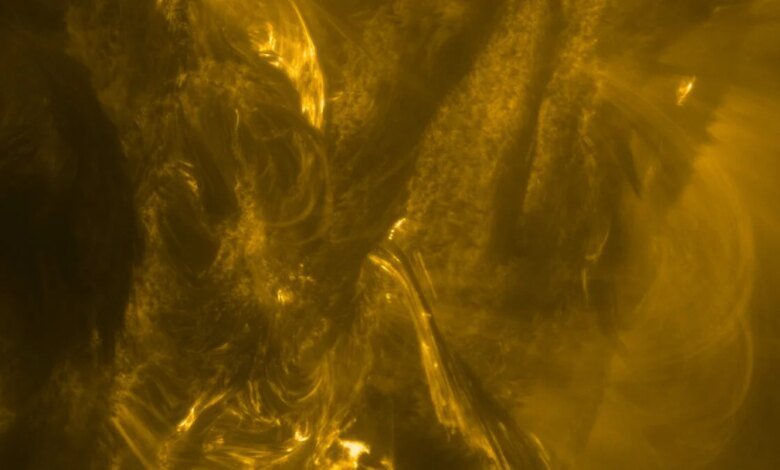
On September 30, 2024, the Sun unleashed a powerful explosion, causing magnetic field lines to break and reconnect in a criss-cross pattern. A sun-observing probe was there to watch it unfold, collecting unprecedented data that would help scientists better understand the mechanism behind solar flares.
Using the European Space Agency’s Solar Orbiter spacecraft, a team of scientists has discovered that solar flares are caused by initially weak disturbances that become more violent, similar to avalanches on snowy mountains. This process creates a sky of raining plasma droplets that continue to fall even after the solar flare has subsided, according to a new study published in the journal Astronomy & Astrophysics.
Magnetic collapse
Solar flares are giant explosions that occur in the Sun, spewing energy, light and particles into space. It occurs when energy stored in twisted magnetic field lines is suddenly released. The most powerful solar flares can disrupt technologies on Earth, creating geomagnetic storms capable of causing power outages.
Scientists have observed solar flares for years, but they still lack a detailed understanding of how such a massive amount of energy is released so quickly from the Sun. Using high-resolution data from Solar Orbiter, scientists now have a better picture of the process that leads to the violent explosion.
Solar Orbiter zoomed in on a region of the Sun with dark, arc-like “strands” of twisted magnetic fields and plasma, linked by a cross-shaped structure of bright magnetic field lines. Scientists pointed the spacecraft’s Extreme Ultraviolet Imager (EUI) at the area approximately 40 minutes before the peak of the flare activity.
By zooming in, the observations revealed that new magnetic field filaments appear in every image frame, equivalent to every two seconds or less. Each thread was magnetically contained and twisted like a rope. The area became gradually less stable, just as the avalanche had.
The twisted magnetic field strands began to separate and reconnect, quickly triggering a cascade of instabilities in the region. When the filaments broke, they triggered progressively stronger reconnection events and bursts of energy, which appeared as increased brightness in the images.
Then, the sudden brightness was followed by the dark thread detaching on one side, shooting out into space while violently unfurling at high speed. Scientists first recorded the uncoiling process at a speed of 155 miles per second (250 kilometers per second), rising to 248 miles per second (400 kilometers per second) at the site of separation. Bright sparks of reconnection appeared along the filament in stunning high resolution as the glow erupted.
“We were very lucky indeed to witness the preceding events of this large flare in such beautiful detail,” Pradeep Cheeta, a researcher at the Max Planck Institute for Solar System Research in Göttingen, Germany, and lead author of the paper, said in a statement. “Such detailed, high-frequency observations of the flare are not possible all the time because of limited observation windows and because such data take up a large amount of memory on the spacecraft’s on-board computer. We were truly in the right place at the right time to capture the finer details of this flare.”
The scientists behind this study were surprised to learn that the big flare is driven by a series of smaller reconnection events that spread rapidly in space and time, creating a cascade of increasingly violent events.
Plasma rain
Even before the flare erupted, the Solar Orbiter revealed that emissions from the Sun were slowly rising when the spacecraft first began observing the region. During the flare itself, the particles are accelerated to speeds between 40 and 50 percent of the speed of light.
Detailed observations also revealed that energy transferred from the magnetic field to the surrounding plasma during these reconnection events. “We saw ribbon-like features moving very quickly through the sun’s atmosphere, even before the main flare episode,” Cheta said. “These streams of ‘plasma rain blobs’ are signatures of energy deposition, which become stronger and stronger as the flare progresses.”
Cheetah added that even after the flame subsided, plasma droplets continued to fall for some time.
“Solar Orbiter observations reveal the central driver of the flare and underscore the crucial role of the avalanche-like magnetic energy release mechanism at work,” Miho Janvier, ESA’s Solar Orbiter project scientist, said in a statement. “An interesting possibility is whether this mechanism occurs in all flares, and in other burning stars.”
Don’t miss more hot News like this! Click here to discover the latest in Technology news!
2026-01-22 18:05:00